When you leave Vantelin Dome Nagoya, the station you pick decides whether you make the last Nozomi to Tokyo at 22:12. The nearest station, Nagoya Dome-mae Yada (ナゴヤドーム前矢田), is a 5-min walk under cover the whole way. For the first 30 to 45 minutes after the show, though, the line backs up outside the ticket gates. There have been reports of waiting more than 30 minutes just to board. The obvious move, “the closest station must be fastest,” backfires here. JR Ozone (大曽根) is the fastest route: a 15-min walk, then 13 minutes and ¥210 to Nagoya Station. But the Yada-minami Deck on the way has open-air stretches, and on a day of heavy rain you cannot get through without an umbrella. Get one decision wrong and you end up standing at a ticket gate in a residential neighborhood, still holding a Shinkansen express ticket you can no longer use.
Vantelin Dome Nagoya opened in March 1997 and holds up to 49,185 people for concerts. The area around it, however, is mostly residential with no entertainment district, and many shops close from 21:30. That is a structural weakness. Killing time in a cafe while the crowd thins is not a realistic option, so from the moment you leave your seat you are already deciding how to reach Nagoya Station. On top of that, if an 18:30 show ends at 21:00, the staged exit does not reach the rear arena seats (the back rows of the floor area) until 30 to 40 minutes later. On paper, that makes you miss the 22:12 Nozomi to Tokyo. At this venue, the combination of end time and seat location decides whether you can make it back to where you are staying that night.
This GuideBridge decision guide works backward from the journey out of Vantelin Dome Nagoya: one continuous route to the last Nozomi to Tokyo at 22:12. No hype and no guesswork: it lays out only the decision points that keep you from getting stuck on the way out, based on official information and several on-site records. One note before you start: if you are visiting Japan, wherever this guide says Tokyo, Kansai or Kyushu, read it as the city where you are sleeping tonight. If you are flying in through Chubu Centrair, Narita or Kansai International Airport, your starting point and your next-morning plan (often a flight home) will differ, so check that flight time before you pick a plan from the summary at the end.
- A timeline worked backward from the last Nozomi to Tokyo at 22:12 (through the gates at 21:50, on the train at Ozone at 21:35, out of the dome at 21:00)
- A rain-and-station flowchart that sorts three stations and a taxi by whether the route is covered
- When to use Dome-mae Yada, Ozone or Sunadabashi (accepting the crowd, going for speed, or getting a seat)
- How an 18:00 start and an 18:30 start change whether you can take the Shinkansen back toward Tokyo
- Four hotels around Nagoya Station (for women traveling alone, chosen for Shinkansen access and security features)
The subway, JR and bus journey times and fares, the taxi fares and the parking arrangements in this guide are as of May 2026, when this guide was first published in Japanese (the walking times and the parking details are the figures given in the venue’s official access guide). For the latest, check the access page on the official Vantelin Dome Nagoya website and the official timetables for the JR Chuo Line, the Meijo Line and the Meitetsu Seto Line.
Vantelin Dome Nagoya by the numbers: room for 49,185, and no shops to wait in
Before getting into the decisions, here are the venue basics and its structural weakness: there are few places to kill time after the show. Vantelin Dome Nagoya is a multipurpose dome that opened on March 12, 1997, with a roof 183.6 m in diameter, a ceiling height of 64.3 m and 6 stories above ground. The address is 1-1-1 Daiko-minami, Higashi-ku, Nagoya. Naming rights passed to Kowa (the maker of the Vantelin brand) in January 2021, and an extension of the contract was announced in December 2025.
Capacity and seating breakdown
The official figures list 36,778 seats (for professional baseball in 2026) and a maximum capacity of 49,185 people when the arena floor is used (as of 2026). By tier, there are about 26,000 lower-tier seats, about 1,900 middle-tier seats and about 8,500 upper-tier seats (as of 2024, baseball layout). As a concert venue it is far larger than KSPO Dome in Seoul, and it ranks among Japan’s biggest, alongside Tokyo Dome and Kyocera Dome.
Parking runs differently on event days, so plan on public transit
According to the official access page, the parking lot is normally open 8:00–17:00 (last entry 16:00) and costs ¥1,000 for a standard car. On concert days it runs under separate rules, so the safe plan is to drop the car from the equation and build your trip on public transit. Bicycle parking is free in three places: North 1, North 2 and South.
A residential neighborhood: the venue’s built-in weakness is that you cannot linger
AEON Mall Nagoya Dome-mae stands on the north side of the venue, so you can find food, cafes and restrooms there. Beyond that, the area is mostly residential, the station neighborhoods have little nightlife, and in practice many shops close between the end of the show and 21:30. With no realistic way to kill time in a cafe while the crowd thins, you need to decide the moment you leave how you are getting to Nagoya Station, your hotel or the Shinkansen. This is the difficulty that sets Vantelin Dome apart from K-Arena Yokohama or Saitama Super Arena. If rain or the staged exit forces you to wait, AEON Mall Nagoya Dome-mae is the last place to fall back on for food and restrooms. Its restaurant floor and AEON Style are open until 22:00, the food court until 21:00 and the ground-floor food market until 23:00 (as of October 2026, per the mall’s official website).
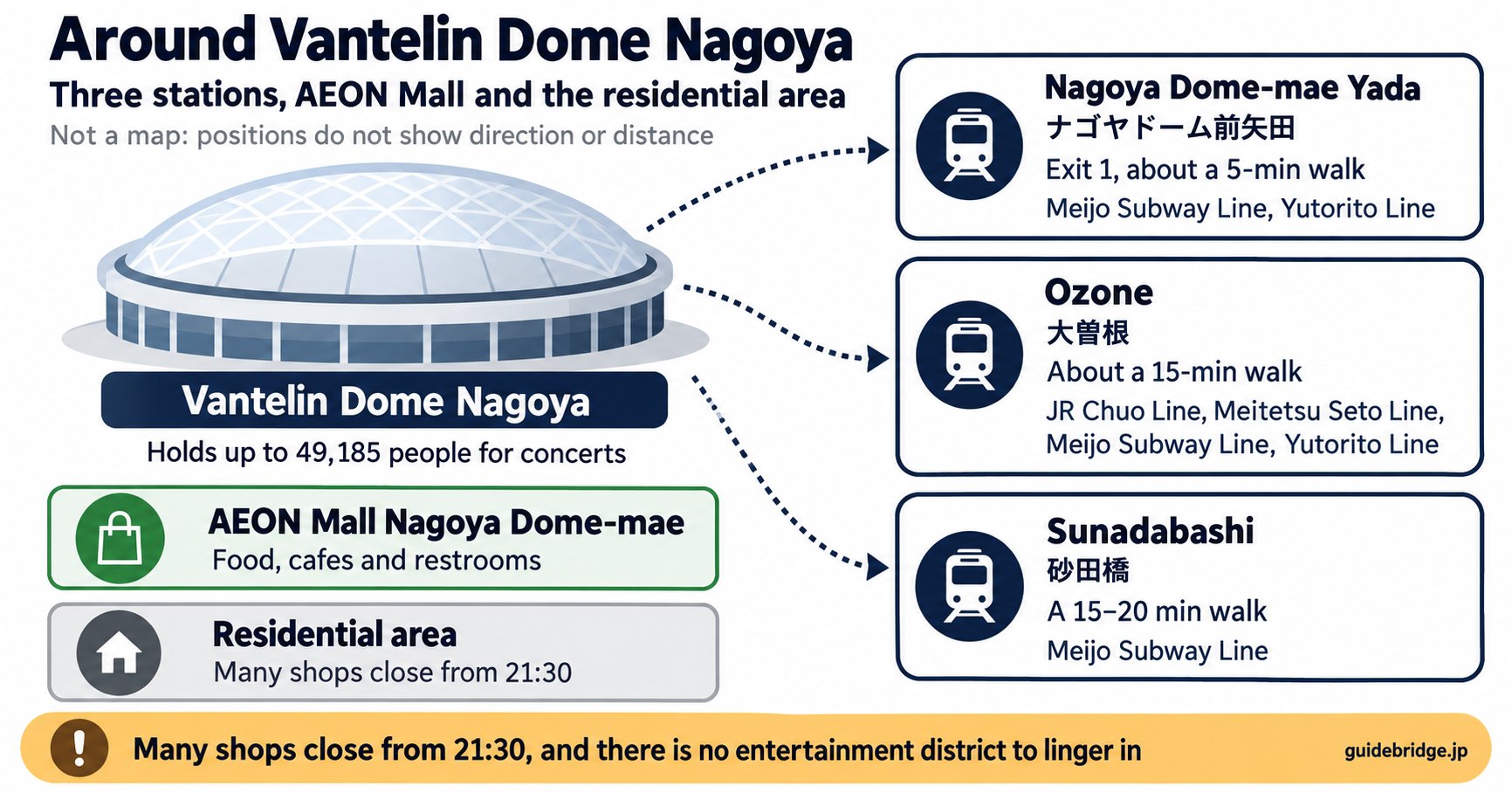
Vantelin Dome holds 49,185 people, but the area around it is mostly residential and there is nowhere to pass the time after the show. Plan to move straight from exit to station to Nagoya Station to the Shinkansen, starting the moment you leave.
Getting there: five routes and when to use each (the nearest is Nagoya Dome-mae Yada, a 5-min walk)
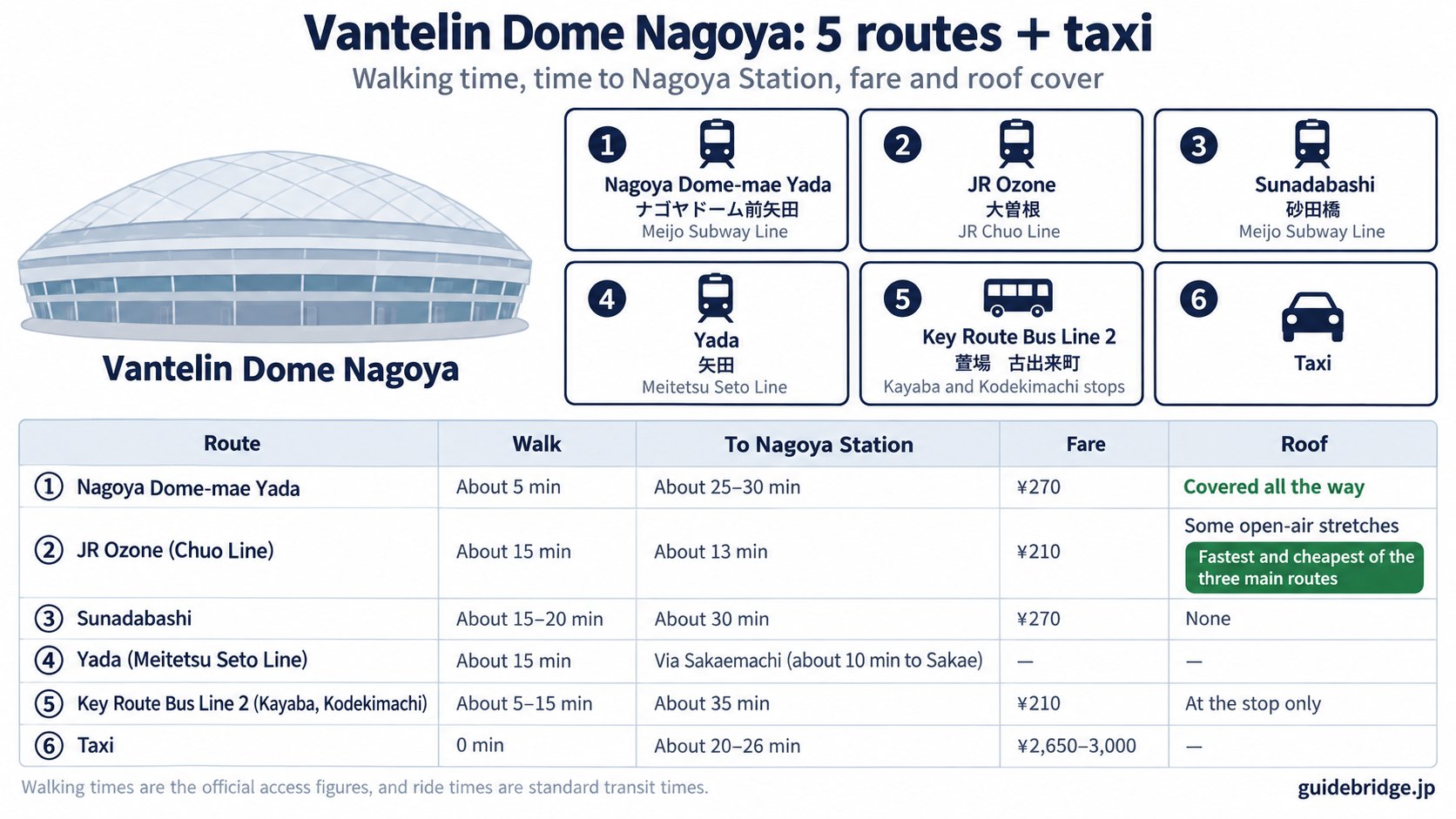
To lock in your route on the day, here are the five access routes side by side, with travel time and whether the walk is covered. Walking times are the official access figures, and ride times are standard transit times.
Nagoya Dome-mae Yada: a 5-min walk, covered all the way
Nagoya Dome-mae Yada (ナゴヤドーム前矢田) station, on the Meijo Subway Line and the Yutorito Line, is about a 5-min walk from Exit 1. The walkway to the venue is covered the whole way, so you can arrive without an umbrella even in the rain. It is the most convenient station, and also the most crowded one right after the show. Do not confuse it with Yada (矢田) station on the Meitetsu Seto Line, which is a different station.
JR Ozone: a 15-min walk, then 13 minutes and ¥210 to Nagoya Station
Ozone (大曽根) station, where the JR Chuo Line, the Meitetsu Seto Line, the Meijo Subway Line and the Yutorito Line meet, is about a 15-min walk from the dome. Each operator has its own ticket gates and fares here. The JR Chuo Line gets you to Nagoya Station in about 13 minutes with no transfer, for ¥210, the fastest and cheapest of the three stations near the dome (Dome-mae Yada, Ozone and Sunadabashi). The route runs from the South Exit across the Yada-minami Deck, and part of the deck has no roof, so you need an umbrella in the rain.
Sunadabashi: a 15–20 min walk, with a good chance of a seat on the way back
Sunadabashi (砂田橋) station on the Meijo Line is one stop before Nagoya Dome-mae Yada. The walk takes 15 to 20 minutes, but while you walk from the dome the crowd at Dome-mae Yada clears, and you have a good chance of a seat even on the counterclockwise train (via Sakae). The Meijo Line is a loop, so its two directions are called counterclockwise (via Sakae) and clockwise (via Motoyama). The walk goes through a residential area with no roof, so treat this as a fair-weather route for avoiding the crowd.
Yada on the Meitetsu Seto Line, and the Key Route Bus: routes four and five
Route four is Yada (矢田) station on the Meitetsu Seto Line, about a 15-min walk away. From there you head toward Nagoya via Sakaemachi (about 10 minutes to Sakae). Route five is the city’s Key Route Bus Line 2, from the Kayaba (萱場) or Kodekimachi (古出来町) stop, a 5–15 min walk away. Official service data shows 25 buses an hour between 17:00 and 18:00 on weekdays (every 2–5 minutes). On these Nagoya city buses, you board through the rear door and get off through the front door.
| Route | Walk | To Nagoya Station | Fare | Roof | Crowding |
|---|---|---|---|---|---|
| Nagoya Dome-mae Yada (counterclockwise) | About 5 min | About 25–30 min | ¥270 | Covered all the way | Very high |
| Nagoya Dome-mae Yada (clockwise, via Motoyama) | About 5 min | About 30 min | ¥270 | Covered all the way | Medium |
| JR Ozone (Chuo Line) | About 15 min | About 13 min | ¥210 | Some open-air stretches | Low |
| Sunadabashi (via Motoyama) | About 15–20 min | About 30 min | ¥270 | None | Low to medium |
| Key Route Bus (Kayaba, Kodekimachi) | About 5–15 min | About 35 min | ¥210 | At the stop only | Medium |
| Taxi | 0 min | About 20–26 min | ¥2,650–3,000 | ― | ― |
On the way in, aim to head for the dome about 2 hours before the show starts, which gives you a buffer against the crowds. Exit 1 at Nagoya Dome-mae Yada also gets packed on the way in, so if you are coming by Shinkansen from Tokyo or Kansai, the easy plan is to stay the night before and take the subway from Nagoya Station.
You do not need a room in Nagoya if your show starts at 17:00 and tonight’s bed is in Tokyo or elsewhere in that direction, or if it is in Osaka or Kyoto and you have time to spare. The same goes if you live in the Nagoya area. The room matters when the timeline below does not work for you.
The last Nozomi to Tokyo leaves at 22:12: a timeline worked backward so you make it
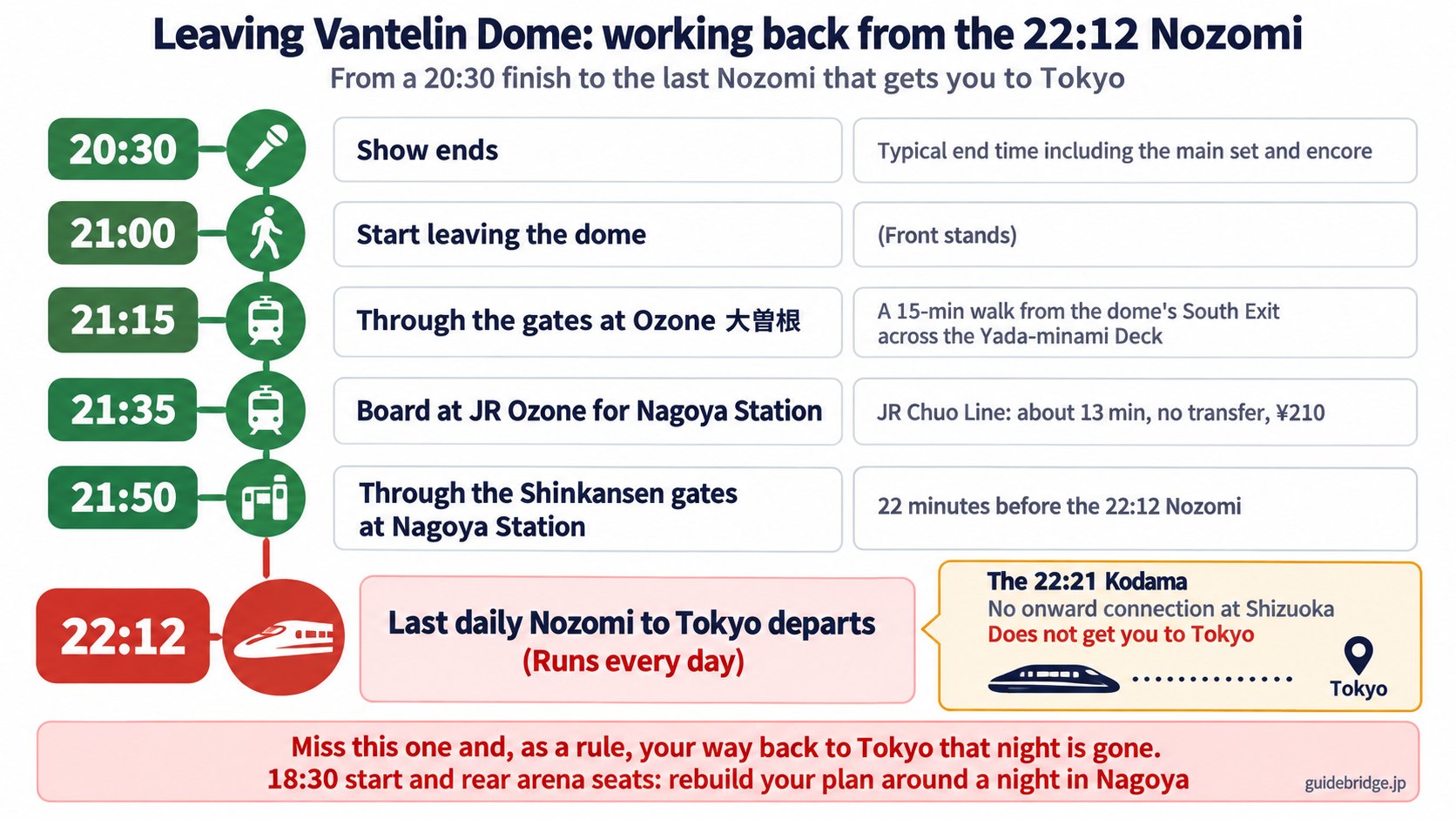
This is the core of the guide. The main reason people get stuck after Vantelin Dome is that the last Shinkansen toward Tokyo leaves earlier than they expect. The last Shinkansen trains of the night leave in the 22:00 hour, and none run again until morning. The last Nozomi that runs every day from Nagoya Station toward Tokyo departs at 22:12 (Nozomi No. 64). The 22:21 Kodama, the slower all-stops service, has no onward connection at Shizuoka (静岡) and does not get you to Tokyo, so in practice the last train that gets you back to Tokyo is the single Nozomi at 22:12 (checked against the timetable as of October 2026; for the latest, check the JR Central timetable for the date of your show).
Six checkpoints worked backward from the 22:12 departure
JR Ozone (大曽根) to Nagoya (名古屋) takes about 13 minutes on the Chuo Line, you pass the Shinkansen gates 22 minutes before departure, and the walk from the moment your block is released to the gates at Ozone takes 15 to 20 minutes. Add those up and, for a show that ends at 20:30, you get these checkpoints.
A typical end time including the main set and the encore. Exits are staged: staff announce which seating area may leave, block by block, so you cannot simply walk out when the show ends. Your turn comes 10 to 15 minutes later in the front stands, 20 to 30 minutes later in the rear stands, and 30 to 40 minutes later in the rear arena.
If you can get moving at this point, you are still on schedule for the 22:12 Nozomi toward Tokyo. If you are in the rear arena and can see a 30 to 40 minute wait coming, decide early to switch your Shinkansen to the next morning.
A 15-min walk from the dome’s South Exit across the Yada-minami Deck. The mixed crowd from the arena and the stands splits up here, and walking on the right side of the deck makes it easier to keep moving.
About 13 minutes on the JR Chuo Line, no transfer, ¥210. Service is not stepped up right after shows, so if you miss one train the next can be 10 minutes later.
22 minutes before the 22:12 Nozomi. Having your basic fare ticket and express ticket on your phone saves fumbling at the gates. In Japan these are two separate tickets, and a reserved-seat express ticket is for a specific train. The shortest way to the Shinkansen platforms is up from the central concourse.
Miss this one and, as a rule, your way back to Tokyo that night is gone. The 22:21 Kodama has no onward connection at Shizuoka, so it is no use for reaching Tokyo.
An 18:00 start works if the show ends at 20:30; with an 18:30 start, plan on a night in Nagoya
The industry rule of thumb is 3 hours 30 min to 4 hours from the start of the show to reaching the station. Add the ride from Ozone to Nagoya and the walk to the Shinkansen gates, and your start time and seat give you this picture.
| Start | Expected end | At Nagoya Station | 22:12 Nozomi |
|---|---|---|---|
| 17:00 | 19:30–20:00 | 20:30–21:15 | Plenty of time |
| 18:00 | 20:30–21:00 | 21:30–22:15 | Stand seats make it if the show ends at 20:30 / with a 21:00 end, plan on a night in Nagoya |
| 18:30 | 21:00–21:30 | 22:00–22:45 | Assume you will miss it and stay in Nagoya |
If the show starts at 18:30, you are in the rear arena and you are heading toward Tokyo, letting go of the same-night Shinkansen and switching to a night in Nagoya ends up lowering both your total cost and your stress. The last Nozomi toward Shin-Osaka (新大阪) and Kyoto (京都) leaves around 22:40–22:55, later than the one toward Tokyo, so the decision works differently for people heading to Kansai.
Apart from an extra Nozomi that runs on some Sundays, public holidays and similar days (as of October 2026 it leaves Nagoya at 22:18; check whether it runs on the date of your show), the last Nozomi that runs every day is the single 22:12 departure. Do not count on the extra train: work backward from the 22:12. Only at shows where the schedule “20:30 end, 21:00 exit, 21:35 board at Ozone, 21:50 through the gates” is achievable can you get back to Tokyo the same night. With an 18:30 start and rear arena seats, do not count on getting back the same night; rebuild your plan around a night in Nagoya.
Rain and station choice: a flowchart that sorts three stations and a taxi by whether the walk is roofed
Once you factor in whether the route is covered, the right station is no longer just “the nearest one.” Your station depends on which case you are in: it is raining and you can live with the crowd, it is dry and speed comes first, or you want a seat.
Rain, and you accept the crowd: Nagoya Dome-mae Yada
On a day of heavy rain, Nagoya Dome-mae Yada (ナゴヤドーム前矢田), covered all the way from the dome to the station, is your first choice. You get there in a 5-min walk, but for 30 to 45 minutes after the show the line reaches outside the ticket gates. There are cases of waiting more than 30 minutes to board, so if your Shinkansen time is tight, consider JR Ozone below instead. One way to beat the crowd: the clockwise train (via Motoyama) is emptier than the counterclockwise one (via Sakae), and the trip takes about the same, roughly 30 minutes.
Fair weather, speed first: JR Ozone
If it is dry, JR Ozone (大曽根), a 15-min walk and then 13 minutes and ¥210 on the JR Chuo Line, is the fastest and cheapest route. Add up the times in the table and, on paper, the gap with Dome-mae Yada is only a few minutes. Where Ozone wins is that it lets you skip the line right after the show. It is also the least crowded of the three main routes. Even in the rain, it stays the first choice for anyone willing to handle the open-air part of the deck with an umbrella.
You want a seat on the way back: Sunadabashi
Sunadabashi (砂田橋) station on the Meijo Line is one stop before Nagoya Dome-mae Yada. The crowd at Dome-mae Yada clears while you walk, so you have a good chance of sitting down even on the counterclockwise train (via Sakae). The walk goes through a residential area with no roof. It suits fair-weather days and people who decide, “rather than stand 30 minutes at Dome-mae Yada, I’ll walk 15–20 minutes and sit.”
Rain, speed first: book a taxi in advance
For anyone facing heavy rain with a Shinkansen departure closing in, the last resort is a taxi: ¥2,650–3,000 and about 20–26 minutes to Nagoya Station. Taxis are hard to catch right after the show, so booking one in advance through a ride-hailing app such as DiDi, Uber or GO lets you get in right after you exit. Spending more than ¥2,500 per person hurts, but it costs less than throwing away your Shinkansen express ticket.
Crowding differs by gate: avoid Gates 1 and 2
How the crowd spreads across the gates on the way out also varies. Gates 1 and 2 get especially crowded, while Gates 4 and 7 move relatively smoothly. Even at shows that assign a gate by seating block, staff may let you take a detour. If an announcement directs the crowd toward Gates 1 and 2, keep the option of turning toward Gates 4 and 7 and rejoining the flow there.
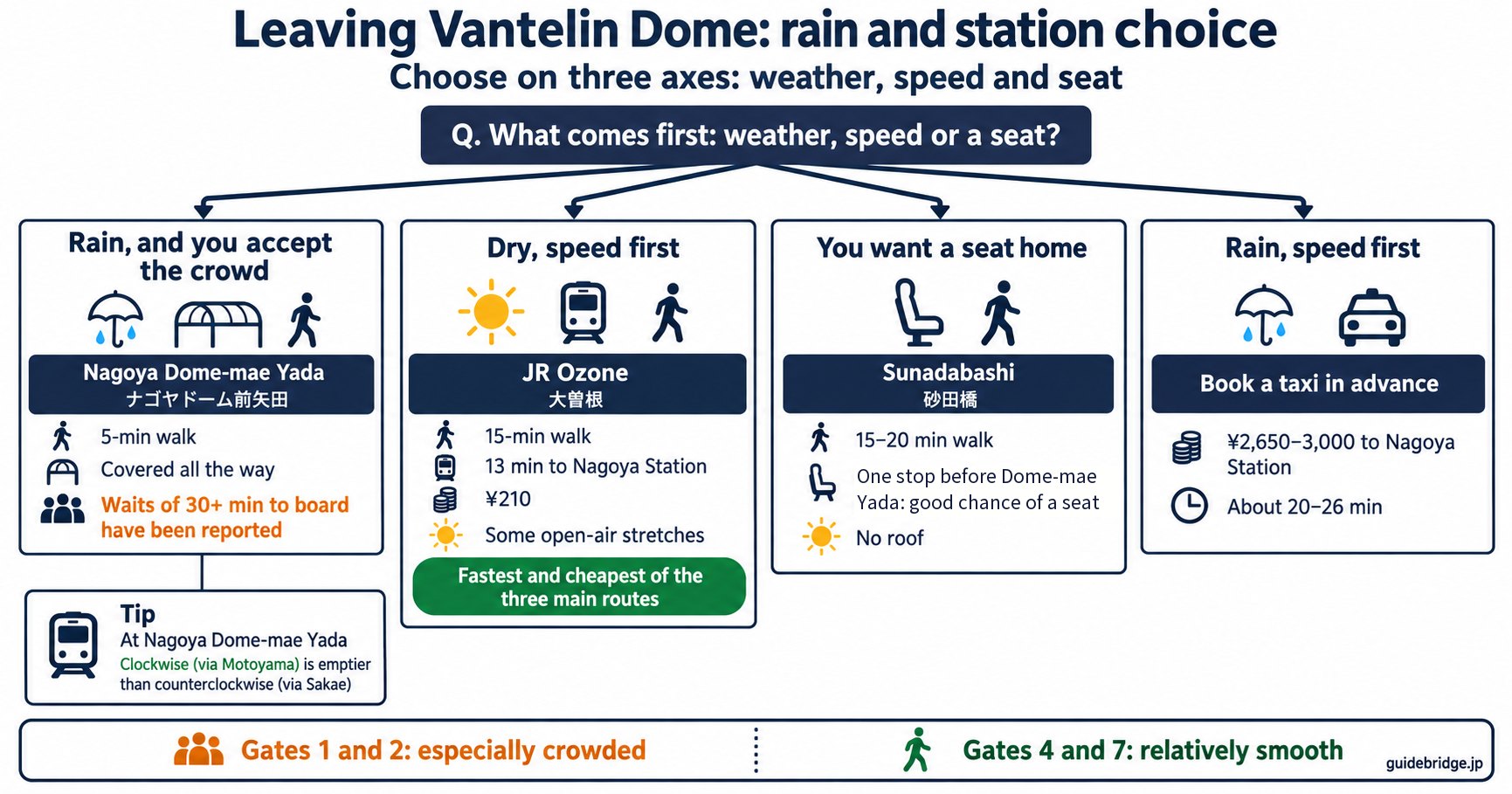
Choose your station not by distance but on three axes: weather, speed and seat. Dome-mae Yada in the rain, Ozone when it is dry and speed comes first, Sunadabashi if you want to sit, and a booked taxi if your Shinkansen is close. Have these four branches in your head before your exit is called.
Four hotels around Nagoya Station, for women traveling alone who want easy Shinkansen access
If your show starts at 18:30, if it is raining, or if you are coming in from Kyushu or Kansai, a night in Nagoya is close to a given. The question is where. The area around Vantelin Dome is residential with few shops, so the standard approach is to stay connected to or walking distance from Nagoya Station rather than near the dome, and step straight onto the next morning’s Shinkansen. Below are four hotels chosen with a woman traveling alone in mind, down to their security features.
Nagoya Marriott Associa Hotel: the upper floors of JR Central Towers
A high-end hotel on the upper floors of JR Central Towers. It sits directly above Nagoya Station, with elevator access straight from the Shinkansen gates. Its biggest value is the location: even if you check in after the show, you can reach the next morning’s Shinkansen without stepping outside. Rates are on the high side, but the time saved is worth it if you are heading to Tokyo or Osaka early the next morning, or have no sightseeing planned for the day after.
Via Inn Nagoya Shinkansenguchi: a 5-min walk from the Taiko-dori Exit, with solid security
A business hotel (a compact, no-frills city hotel type common in Japan) in the JR West group. It is a 5-min walk from the Shinkansen side of the station, the Taiko-dori Exit (the west side), and it has several features that suit women traveling alone. The elevators run on key cards so non-guests cannot ride them, the front desk is staffed 24 hours, and the entrance is locked late at night, as its official information states. Rates are in the business-hotel range, a good balance of value and security.
Meitetsu Inn Nagoya Ekishinkansenguchi: a 4-min walk from the Taiko-dori Exit
A no-frills hotel a 4-min walk from the Taiko-dori Exit. It looks right out on the Shinkansen side of the station, which makes the walk to your morning train one of the shortest around. It handles late arrivals easily and suits anyone expecting to check in after the show, during the 22:00 hour.
DEL style Nagoya Nayabashi: a women-only floor
A hotel in the Nayabashi area. It has a women-only floor with the shared bath on that same floor, which covers the security needs of a woman traveling alone. It is about a 15-min walk from JR Nagoya Station (per the booking site’s property information), so it suits people with time to spare before the next morning’s Shinkansen. Its rates are also lower than the Marriott’s.
Safety around the west (Taiko-dori) side of Nagoya Station: use the Shinkansen side late at night
The west side of Nagoya Station (the Taiko-dori Exit) once had a mixed reputation for safety, but redevelopment has improved it. Even so, when walking to your hotel late at night, you will feel safer on the sidewalks of the Shinkansen side than on the Sakura-dori Exit side (the east side), where the nightlife is. Via Inn and Meitetsu Inn are both on the Shinkansen side, which makes them a good fit for late returns.
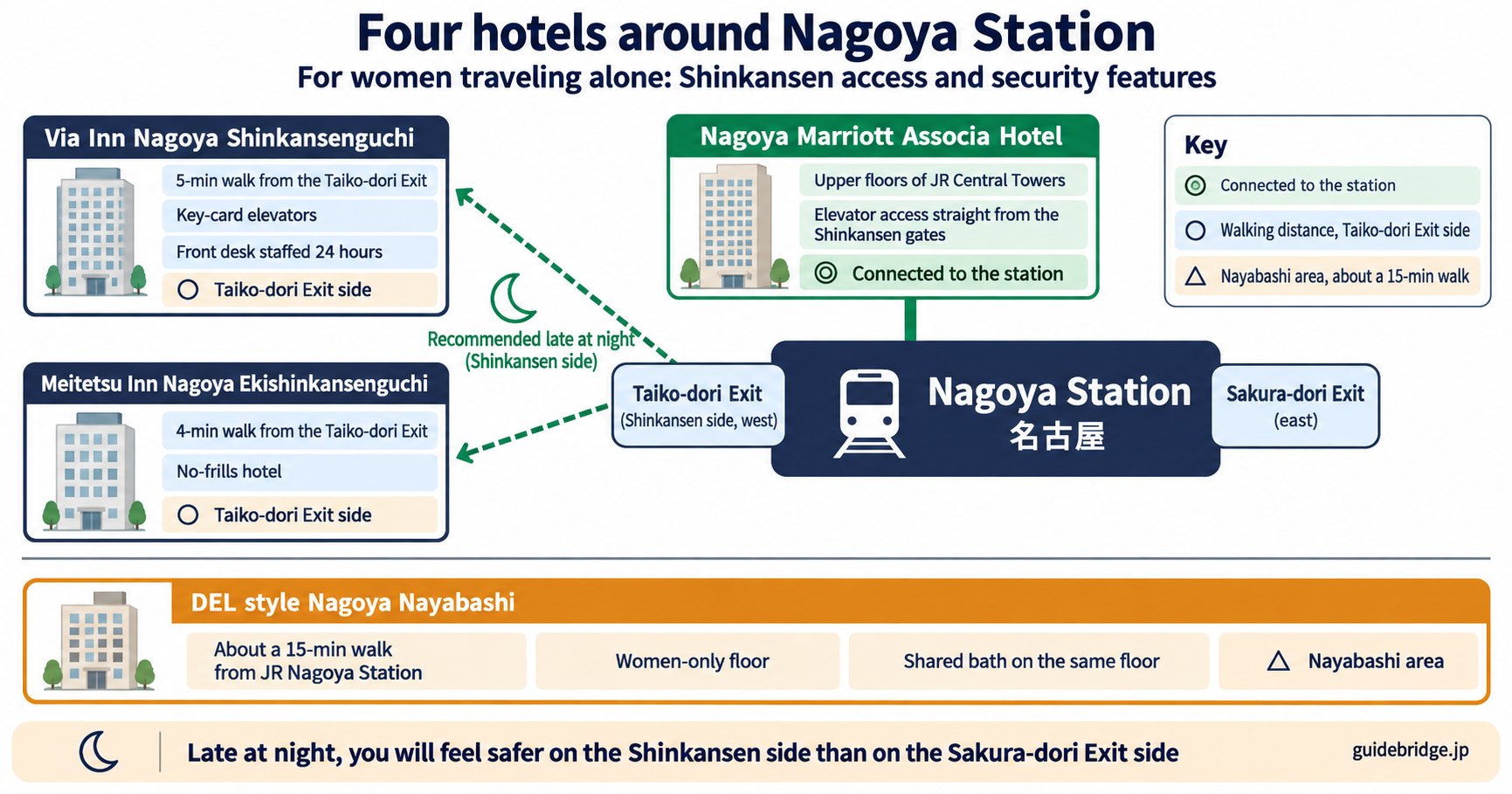
The last Nozomi toward Tokyo comes down to the single 22:12 departure, and once a staged exit makes you miss it, one missed connection leads to the next. Book a hotel connected to Nagoya Station or within walking distance of the Shinkansen side early, and once you reach Nagoya Station you are no more than a 5-min walk from your room, ready for a replacement train the next morning. If you live in the Nagoya area, or tonight’s bed is toward Tokyo and your show ends early enough for the timeline above to work, you do not need the room. If you are coming from Kyushu or elsewhere in western Japan, you cannot get back the same day, so plan on staying in Nagoya.
Summary: the plan by where you are coming from (getting there, getting back, and where to stay)
Here is everything above condensed into a recommended plan by departure area. Each row covers Shinkansen, subway and hotel together, so pick the row closest to your situation and use it as your checklist on the day. As noted at the top, read the departure area as the city where you are sleeping tonight, not the airport you flew into.
| Coming from | Getting there | Getting back | Where to stay |
|---|---|---|---|
| Tokyo and the Kanto region | Shinkansen to Nagoya, then JR to Ozone | Last Nozomi at 22:12 | Stay in Nagoya if your exit comes after 21:00 |
| Nagoya and the Tokai region | Subway to Nagoya Dome-mae Yada | Nagoya Dome-mae Yada or JR Ozone | Same-day return is fine |
| Osaka and the Kansai region | Shinkansen to Nagoya, then JR to Ozone | Last Nozomi around 22:40–22:55 | Day trip possible if you have time to spare |
| Kyushu and western Japan | Shinkansen to Nagoya, then JR to Ozone | Not possible the same day | Plan on a hotel around Nagoya Station |
| Rainy days | ― | Nagoya Dome-mae Yada or a taxi | Plan around Nagoya Station |
With an 18:30 start, rear arena seats and a trip back toward Tokyo, planning to return the same night carries a high risk of missing the last Nozomi. Planning from the start to arrive the night before, or to stay in Nagoya, gives you more room to move. The safe approach is to check the end time and your seat location as soon as you have the ticket, and book the Shinkansen and hotel together.
- The last Nozomi toward Tokyo on the regular timetable is 22:12 (on some Sundays, public holidays and similar days an extra train leaves at 22:18; check whether it runs on your date). Work backward: through the gates at 21:50, on the train at Ozone at 21:35, out of the dome at 21:00
- Rain and you accept the crowd: Dome-mae Yada. Dry and speed first: Ozone. Want a seat: Sunadabashi. Shinkansen closing in: book a car through a ride-hailing app
- 18:30 start, rear arena and heading toward Tokyo: rebuild the plan around a night in Nagoya
- The standard choice is a hotel connected to Nagoya Station or within walking distance of the Shinkansen side, not near the dome
For another dome where the gate number decides the floor you enter on, see the Tokyo Dome guide.
If you live in Nagoya or the Tokai region, or tonight’s bed is toward Tokyo and, given your start time and seat, you will be out of the dome by 21:00, or it is in Osaka or Kyoto and you have time to spare, you do not need a room near the station.
Related guides
This page was produced from the Japanese original with AI assistance. Every number, station name and time was machine-checked against the Japanese source and its official references. If something is wrong, tell us here -> /en/contact/.