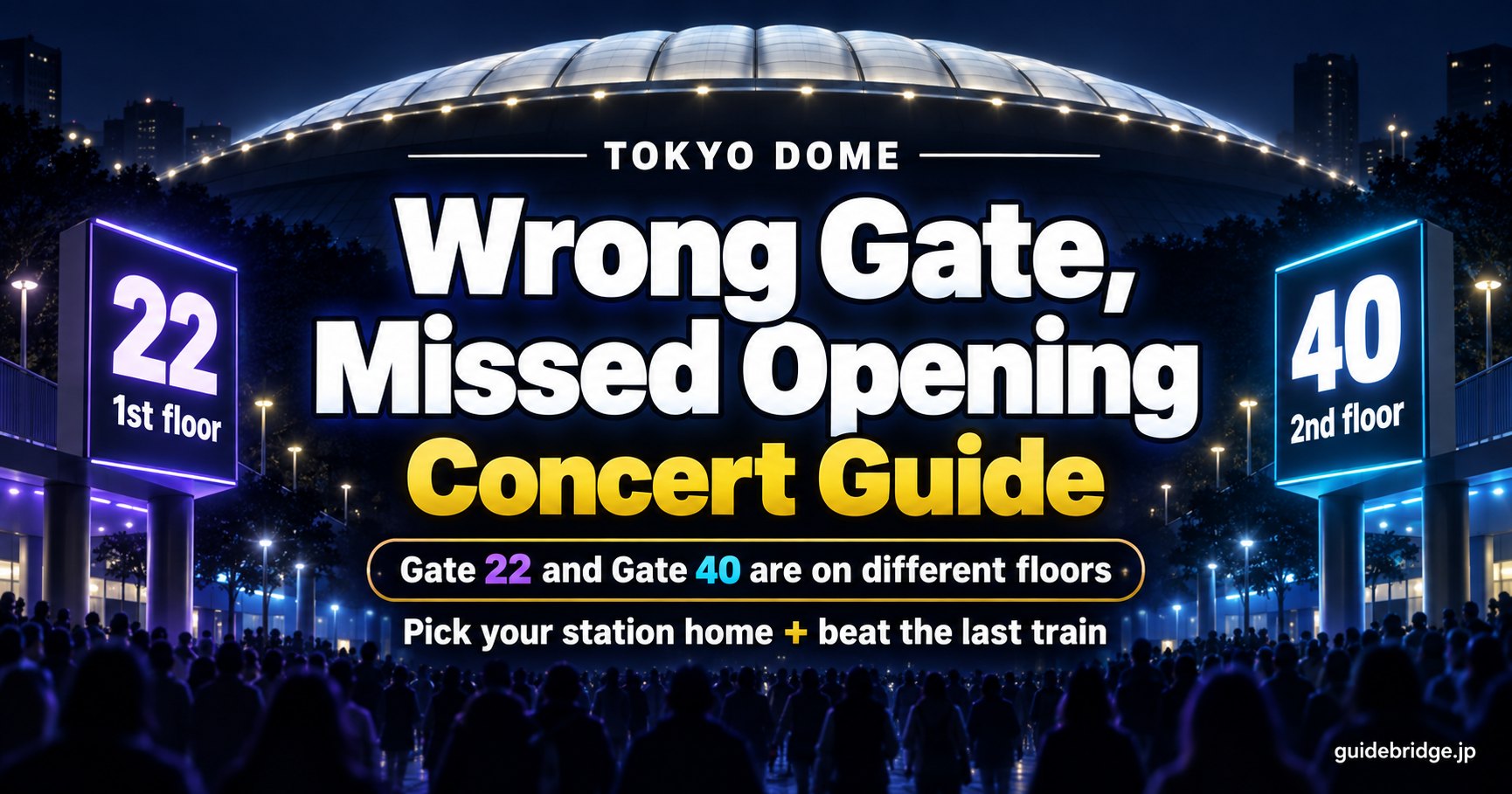
You reach Tokyo Dome with your ticket in hand, and then you stop in front of the signage. Your seat says Gate 22. The sign above you says Gate 40. The two numbers sit on the same outer ring of the same building, but one leads to the 1st-floor stand and the other to the 2nd-floor roof seats. If you do not know that the tens digit of the gate number tells you your tier, you take the wrong entrance, walk round the outside to the right gate, climb back up by stairs and escalator, and look at the clock to find you have less than 10 minutes left. A trip built around a single night — a night bus or a Shinkansen ride for one show — can end with the first songs reaching you from the wrong side of a wall.
A second trap waits after the encore: entry control at JR Suidobashi, stair congestion at Korakuen, and the hunt for an open toilet once the last train has gone. One decision made the night before — which gate, which station — sets the tone for the whole trip. This is the GuideBridge decision guide to Tokyo Dome, running from the gate you walk through to the bed you sleep in.
- The rule that the tens digit of your gate number is your seat tier, and why Gate 22 and Gate 40 are the classic mix-up
- A quick-reference table that tells you your tier the moment the ticket arrives
- How to use Suidobashi, Korakuen, Kasuga and Iidabashi as four separate exits so the stations do not jam
- Leaving 30 min before the end versus staying 60 min after it, and how to decide which
- Where to sleep if the last train goes without you: the Suidobashi and Korakuen area, or Shinagawa
- A coin locker plan, and what to do when a tour refuses large bags at the door
- How this guide sits alongside the other venue guides in the series
Structurally, this is a dome venue. The seating stacks high, the upper tiers sit a long way from the stage, staged exits are standard, and the nearest stations take the whole crowd in one wave. Reading the trip home from the venue type, before you read anything about the show itself, is the method behind every venue guide here. One note before we start: the Japanese original is written for readers who are already inside Japan and come into Tokyo by Shinkansen, night bus or local train. If you are flying in, add your transfer from Narita or Haneda on top of every time below, and read “an early start tomorrow” as your flight home.
The gate layout, last-train times, and locker prices and opening hours in this guide are as of April 2026, when the Japanese original was first published. For the latest last trains, check the official JR East, Tokyo Metro and Toei Subway timetables; for gates and lockers, check the official Tokyo Dome City website.
What goes wrong at Tokyo Dome, and who it happens to
Tokyo Dome holds roughly 55,000 people in concert configuration, which makes it one of the largest indoor venues in Japan. The building is as good as its reputation. The ways fans come unstuck at a K-POP dome show here, though, collapse into three: the wrong gate on the way in, the station crush on the way out, and the missed last train with no room booked. This section puts all three on the table at once. The sections after it take them apart one at a time.
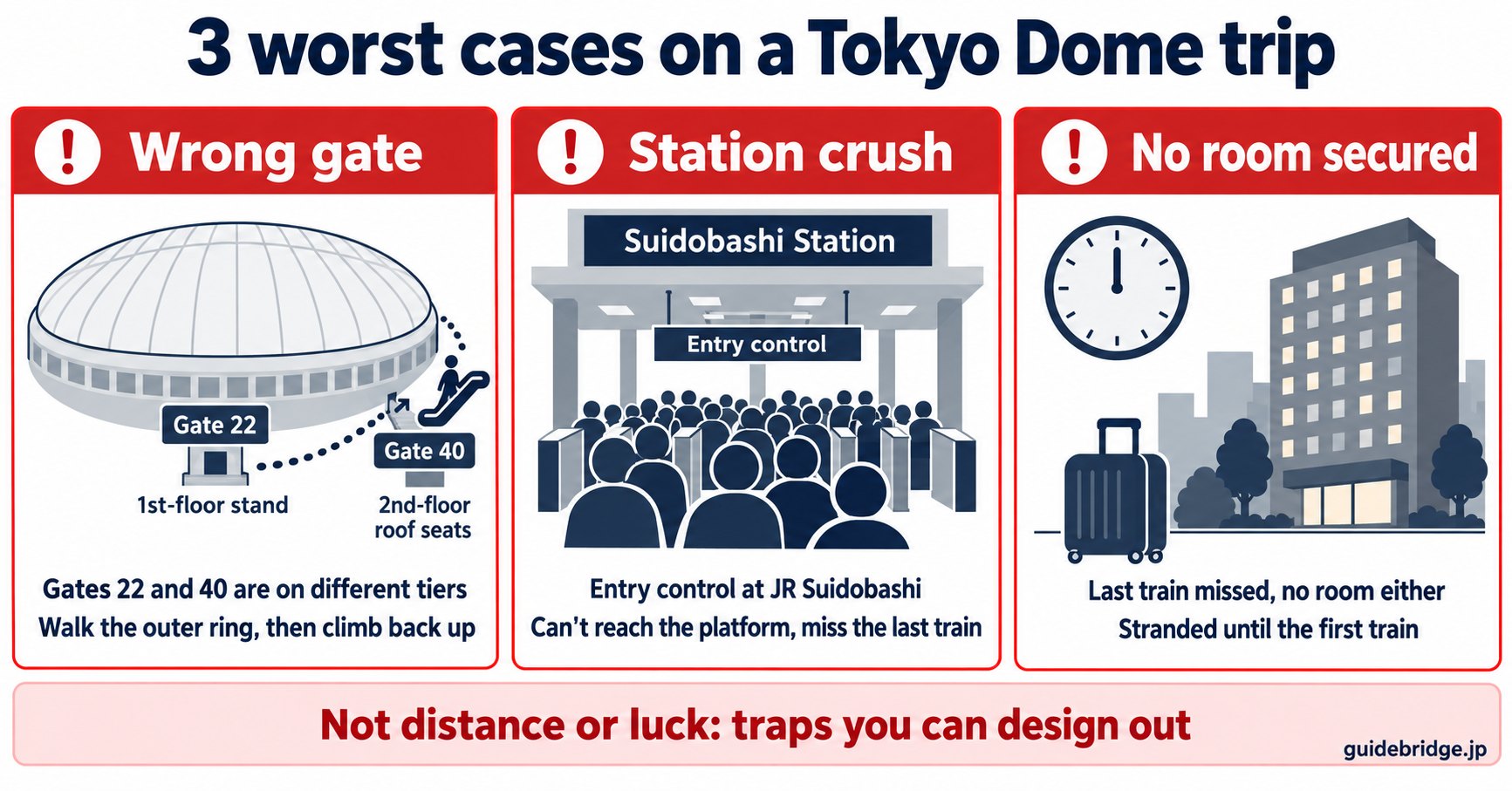
You confuse Gate 22 with Gate 40, walk round the ring and climb back up
Tokyo Dome numbers its gates so that the tens digit gives the seat tier. The 20s are the 1st-floor stand, the 30s are the balcony, and the 40s are the 2nd-floor roof seats. That means Gate 22 and Gate 40 can have adjacent-looking numbers on the same outer ring and still be, in walking terms, two different venues. One lap of the perimeter is roughly 10–12 min. Standing in front of Gate 22, behind home plate, and then moving to Gate 40, on the 1st-base side, means walking the ring towards the 1st-base side and riding an escalator to the upper level, and the loss runs past 10 min without much trouble.
Which gate serves which block of seats is set by the promoter and the artist, show by show. With digital ticketing it is not unusual for the gate number to stay hidden until the day itself. Fans have reported queuing at a gate in the 20s holding a Gate 40 ticket and being turned back. This catches people who reach the venue assuming a gate is a gate, and it catches holders of same-day gate assignments hardest of all. The fix is cheap: open the ticket screen the night before, read the tens digit, and settle your tier. If you are in the 40s, decide now that you are using the 2nd-floor escalator rather than a gate in the 20s, and put yourself at the gate 60 min before the start.
Entry control at Suidobashi keeps you off the platform until the last train has gone
Shows at Tokyo Dome finish in a narrow window, around 21:00–21:30, so the audience arrives at JR Suidobashi (水道橋) and Tokyo Metro Korakuen (後楽園) in a single wave. At JR Suidobashi, staff routinely hold passengers outside the ticket gates, in blocks of 10–30 min, before letting them down to the platform. The “5 min walk” on the official access page is an accurate figure for the way in. On the way out, the walk is not the part that costs you time; the queue at the gate is.
Japanese arenas release the audience block by block, by seating area, over the PA — you do not simply stand up and leave when you want to. Because that release works outwards from the arena floor, holders of Gates 40 and 41, in the roof seats, are called last. Join a held station late in the order and the line you needed to protect — through the ticket gate 30 min before your own last train — is already broken. The countermeasure is to spread the crowd across stations instead of following it: settle on Toei Mita Line Suidobashi, Toei Oedo Line Kasuga (春日), JR Iidabashi (飯田橋) or JR Ochanomizu (御茶ノ水) before the show, based on where you are sleeping.
You miss the last train, have no room booked, and wait standing up for the first one
The station crush does its real damage later, as a missed train. Japanese rail shuts down for the night: once the last service has gone there is no metro until the first train around dawn, and a taxi across the city is priced accordingly. The chain is short — you are released late, you join the hold at Suidobashi, you miss your train, your hotel check-in deadline passes — and it only takes one of them to go wrong to leave you waiting for the first train. Day-trippers get caught, so do people whose hotel has a check-in cut-off, and so does anyone with a Shinkansen or a flight in the morning. The strongest countermeasure runs from the moment your ticket is confirmed: hold a room as insurance, with a 24-hour front desk, either inside the walking radius (Suidobashi, Korakuen) or in an area that suits the morning (Shinagawa, Shinjuku).
The three failures stack: the gate number misread before you go in, the station hold that costs you the last train, and the missed train with nowhere booked. None of them is about distance or luck — each is avoidable by design. The next section starts where the fix starts, with the shape of the building.
How Tokyo Dome is built, and why the gate number is the floor
Avoiding the wrong gate starts with holding one picture of the building in your head. Tokyo Dome opened in 1988 as the first air-supported dome in Japan, and in concert configuration it takes around 55,000 people. This section breaks the tiers and the gate numbers down far enough that you can read your floor off the ticket at a glance.
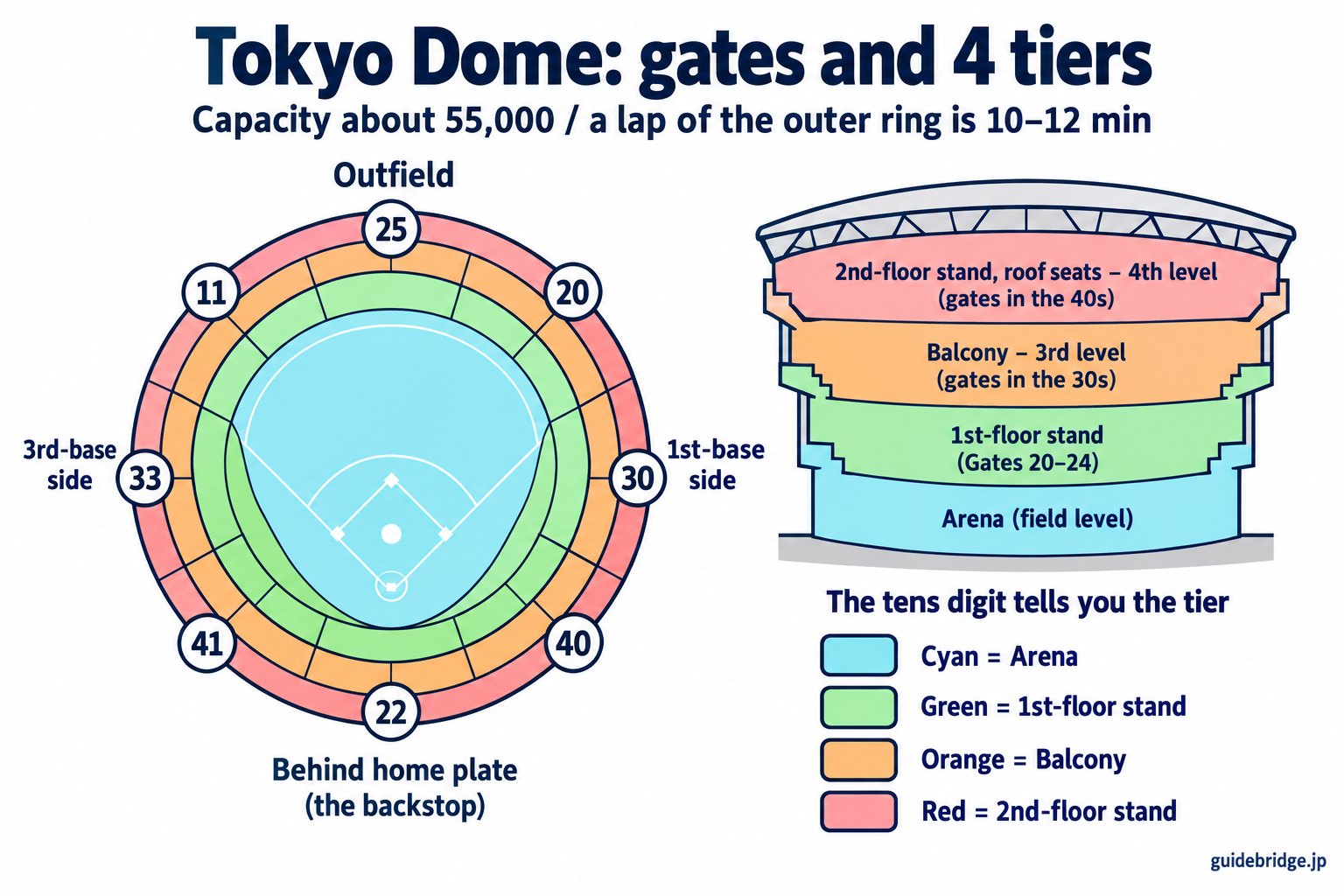
Roughly 55,000 seats across 4 tiers
- Arena, the field itself: the lowest level, sunk 5.5 m below ground. Closest to the stage, and the experience swings hugely with where the catwalk and the centre stage are placed.
- 1st-floor stand, from the infield round to the outfield: the stepped bowl. You enter through the gates in the 20s.
- Balcony: the middle deck wedged between the 1st and 2nd floors. Further from the stage, but raked enough to give you the whole floor at once.
- 2nd-floor stand, known to fans as the roof seats: the top level. The stage reads as a dot from here, and whether you brought binoculars decides what kind of evening you have.
The building is close to circular, and a lap of the outer ring takes about 10–12 min on foot. A circular layout across 4 tiers, together with the gate numbering, is what makes it so easy to get lost.
The tens digit is the tier: 11, the 20s, the 30s, the 40s
Tokyo Dome’s gate numbers are built so that the tens digit gives the floor. On Tokyo Dome’s official all-facility guide map, Gates 11 and 25 sit on the 1F concourse (outfield side), Gates 20–24 on 2F, Gates 30, 31 and 33 on 3F, and the 40s on 4F; the 20s are the entrances to the 1st-floor stand, the 30s to the balcony, and the 40s to the 2nd-floor roof seats. One digit on your ticket decides which stream of people you belong in.
Without that rule, Gate 22 for the 1st-floor stand and Gate 40 in the roof seats look like the same kind of thing, and the entrance mix-up follows. With it, the moment you open the ticket on the day, the tier is known and the route into the building picks itself.
A perimeter lap is 10–12 min, so wrong floor plus wrong side is the worst loss
The expensive combination is wrong floor together with wrong side. Take Gate 20, on the 1st-base side of the 1st-floor stand, and a seat behind Gate 41, in the roof seats on the 3rd-base side. You walk the outer ring from the 1st-base side, round behind home plate, to the 3rd-base side, and then ride the 2nd-floor escalator back up. That is 10–15 min from the moment you arrive, and more with luggage or a crowd. Walk this route having arrived 5 min before the start and you do not make it in.
Gate operations change per show, and digital tickets sometimes confirm on the day
The second thing worth holding on to is that gate operations vary between shows. In the same building, an international tour and a domestic tour can use different gate-to-block assignments and different door times. With a digital ticket, some shows do not confirm your gate number until the day. So keep the advance work to settling the tier from the tens digit, and take the final confirmation on the day from the ticket screen and the announcements at the venue. That two-stage approach survives contact with reality; memorising a gate number weeks out does not.
Tokyo Dome is a circular venue with 4 tiers, and the tens digit of the gate number is the tier. 11 is the arena, the 20s are the 1st floor, the 30s are the balcony, the 40s are the roof seats. Learning that one line takes the odds of an entrance mix-up down sharply. The next section turns the rule into the actual numbers printed on tickets.
The core of this guide: reading your seat tier straight off the gate number
This is the part of the guide worth saving. The table below turns the gate number printed on a Tokyo Dome ticket into the tier and the side of the building you belong to. Open your ticket the night before you travel, match it against this, and the route into the venue is settled nine times out of ten.
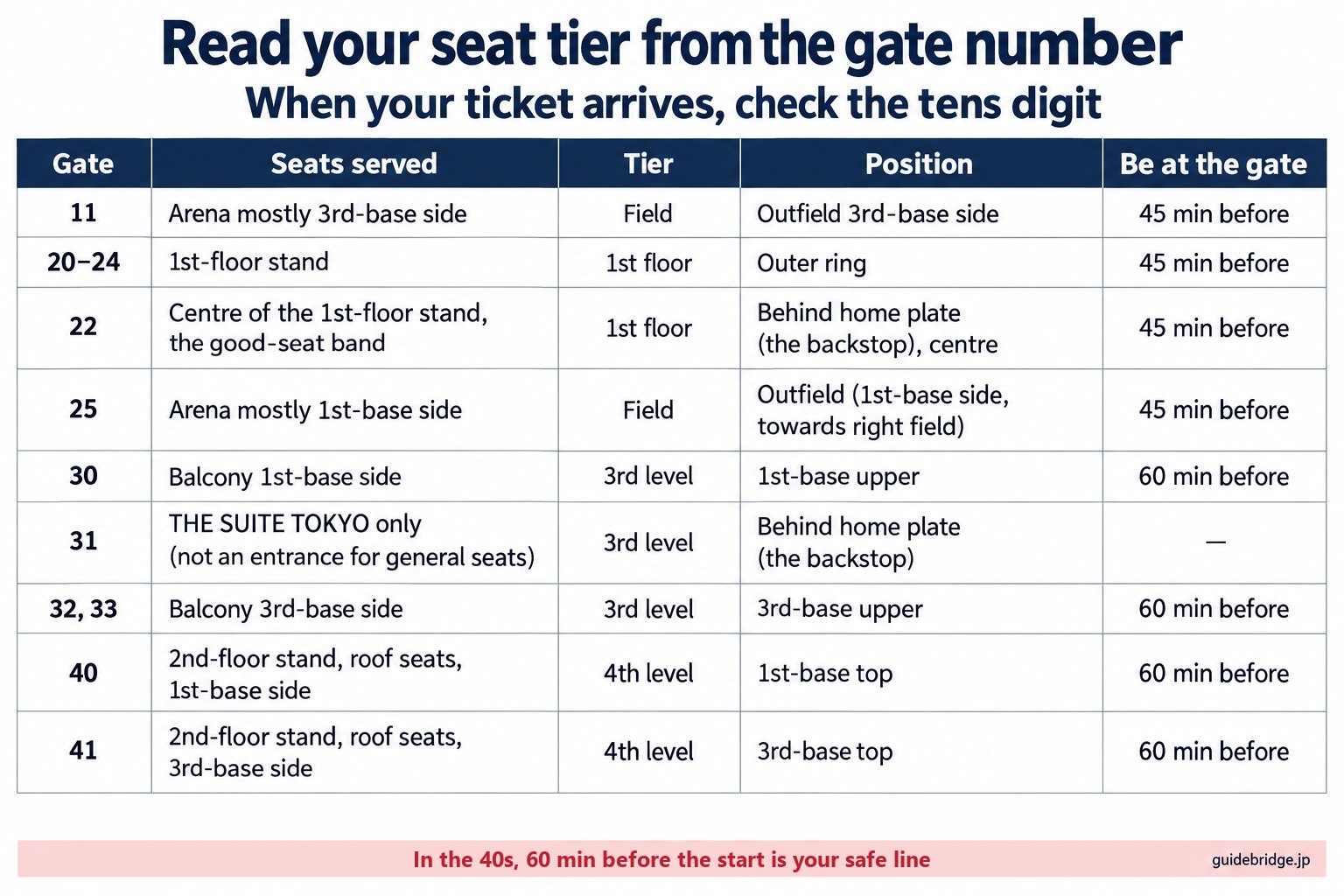
| Gate | Seats served | Tier | Position | Be at the gate |
|---|---|---|---|---|
| 11 | Arena, mostly 3rd-base side | Field | Outfield, 3rd-base side | 45 min before |
| 20–24 | 1st-floor stand | 1st floor | Outer ring | 45 min before |
| 22 | Centre of the 1st-floor stand, the good-seat band | 1st floor | Behind home plate (the backstop), centre | 45 min before |
| 25 | Arena, mostly 1st-base side | Field | Outfield (1st-base side, towards right field) | 45 min before |
| 30 | Balcony, 1st-base side | 3rd level | 1st-base upper | 60 min before |
| 31 | THE SUITE TOKYO only (not an entrance for general seats) | 3rd level | Behind home plate (the backstop) | — |
| 32, 33 | Balcony, 3rd-base side | 3rd level | 3rd-base upper | 60 min before |
| 40 | 2nd-floor stand, roof seats, 1st-base side | 4th level | 1st-base top | 60 min before |
| 41 | 2nd-floor stand, roof seats, 3rd-base side | 4th level | 3rd-base top | 60 min before |
Gate 11 and Gate 25: the two short routes onto the arena floor
Gate 11 sits near the 3rd-base side of the arena and Gate 25 near the 1st-base side. Both take you down to the field, 5.5 m below ground, by the shortest available path, which makes them the efficient doors for anyone holding an arena ticket. The catch is that bag-check queues stretch out as door time approaches, so an arena ticket is not a reason to relax about timing. If your ticket reads 11 or 25, make “standing at that gate 45 min before the start” the rule you work to.
The 20s (20–24): the main 1st-floor stand, with Gate 22 on the good seats
The 20s are the entrance gates for the 1st-floor stand. It is a stepped bowl with a comfortable balance of distance and height, and at K-POP shows it takes the largest share of the allocation. Gate 22 in particular covers the centre of that bowl, the band where the better seats concentrate, and arena-adjacent and premium blocks are mixed in around it. See a 22 on your ticket and head for Gate 22, behind home plate, without second-guessing it.
The 30s (30, 31, 32, 33): the balcony, effectively a third level
The 30s serve the balcony, the middle deck between the 1st-floor and 2nd-floor stands, which sits at what counts as the 3rd level. Gate 30 serves the 1st-base side and 32 and 33 the 3rd-base side, so whether your number is 30 or 32–33 decides which way you walk (Gate 31 is the dedicated entrance for THE SUITE TOKYO, on the 3rd level behind the backstop). The balcony’s awkward position — further out than the 1st floor, closer in than the 2nd — makes its wayfinding signs easy to miss, and it produces more lost fans than its size suggests. Be at the gate 60 min before the start.
The 40s (40, 41): the roof seats, where the escalator is the only way up
The 40s are the 2nd-floor roof seats. This is the top level, far enough back that the stage reads as a dot and faces are unreadable without binoculars. The route in is the 2nd-floor escalator, not the gates in the 20s (the 1st-floor stand). Queue at a gate in the 20s holding a Gate 40 ticket and staff will redirect you to the upper level. Close to the start time, that redirect alone is enough to leave you outside when the lights go down. Gates 40 and 41 also face opposite sides of the building, 1st-base and 3rd-base, so treat 60 min before the start as your arrival target.
Three steps before you arrive: check the ticket, read the tier, walk to the right side
Digital or paper, write the gate number down. Some shows only release gates on the day, and in that case set an alarm instead of guessing.
11 is the arena, the 20s are the 1st floor, the 30s are the balcony, the 40s are the roof seats. Settle your tier before you reach the building.
For the 1st-floor stand, use a gate in the 20s. The 40s go via the 2nd-floor escalator. If you have to cross to the far side of the ring, budget 10 min or more.
The tens digit on your ticket is the tier. The 20s mean the 1st-floor stand, the 30s mean the balcony, the 40s mean the 2nd-floor escalator. Confirm that the night before and almost nothing is left to get lost over on the day. The next section is about the other half of the evening: getting home.
Four stations compared: Suidobashi, Korakuen, Kasuga and Iidabashi
The single strongest piece of leverage on the way home from Tokyo Dome is the decision not to use JR Suidobashi. Official access lists four stations — JR Suidobashi, Toei Mita Line Suidobashi, Tokyo Metro Korakuen and Toei Oedo Line Kasuga — but in practice the judgement is made across six, with JR Iidabashi and JR Ochanomizu added. The four-station comparison worked out for K-Arena Yokohama is the same method, redrawn here for where Tokyo Dome actually sits.
One piece of background the Japanese original does not stop to explain: JR, Tokyo Metro and Toei Subway are three separate operators. “Suidobashi” is two different stations — a JR one and a Toei Mita Line one — with separate ticket gates and separate fares. Korakuen (Tokyo Metro) and Kasuga (Toei) are connected underground but keep different names. Changing between operators means paying a second fare, which is why the choice of station is about your destination, not only about walking distance.
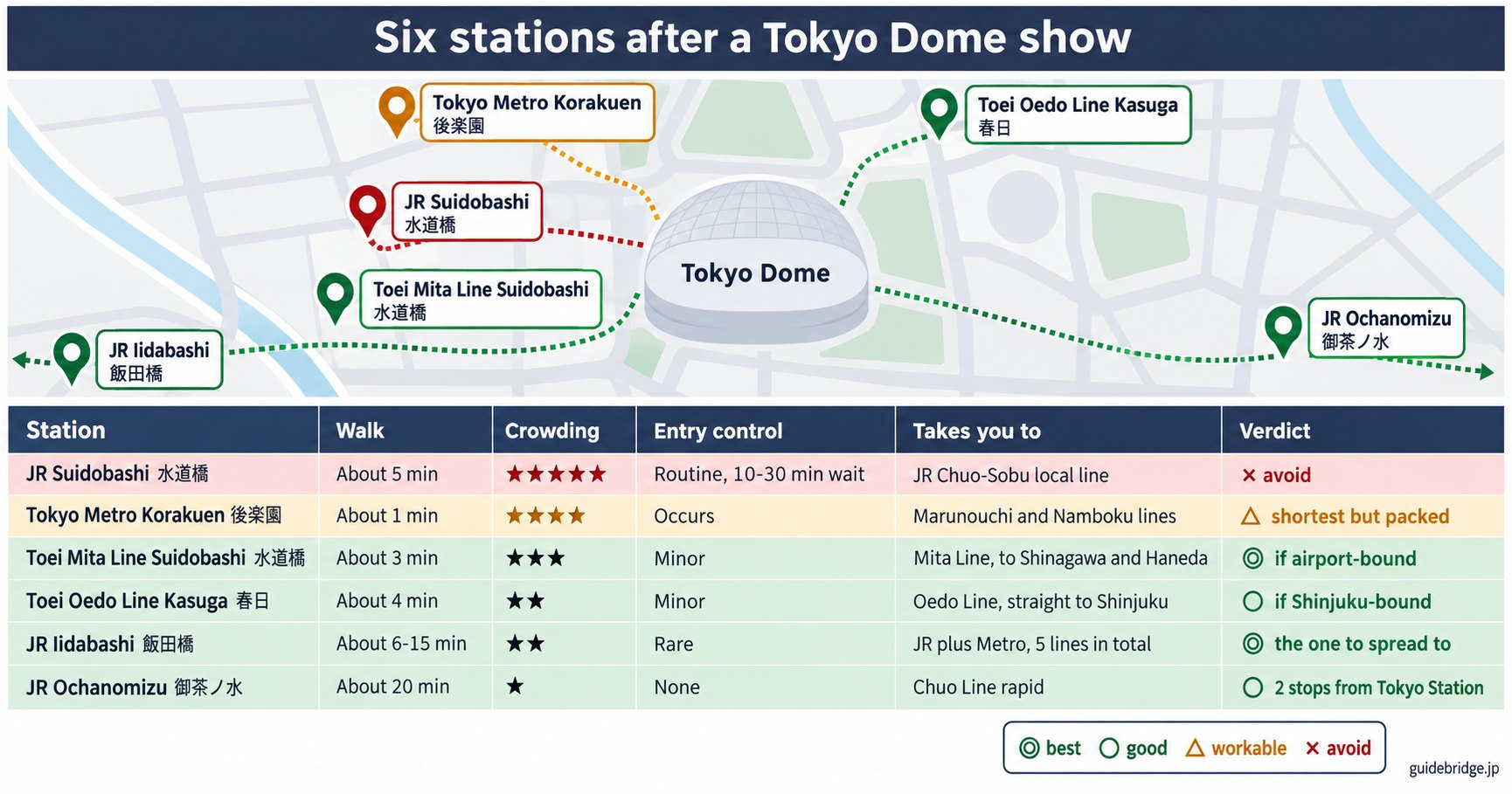
Two conventions in the table below are standard in Japanese guides and worth a line of explanation. Crowding runs from ★ (calm) to ★★★★★ (heaviest). The verdict column runs ◎ best, ○ good, △ workable, × avoid. The walking times are the official figures published by the venue and the railways, measured on the way in — they are not what the same walk costs inside a post-show crowd.
| Station | Walk | Crowding | Entry control | Takes you to | Verdict |
|---|---|---|---|---|---|
| JR Suidobashi (水道橋) | About 5 min | ★★★★★ | Routine, 10–30 min wait | JR Chuo-Sobu local line | × avoid |
| Tokyo Metro Korakuen (後楽園) | About 1 min | ★★★★ | Occurs | Marunouchi and Namboku lines | △ shortest but packed |
| Toei Mita Line Suidobashi (水道橋) | About 3 min | ★★★ | Minor | Mita Line, connecting to Shinagawa and Haneda | ◎ if you are airport-bound |
| Toei Oedo Line Kasuga (春日) | About 4 min | ★★ | Minor | Oedo Line, straight to Shinjuku | ○ if you are Shinjuku-bound |
| JR Iidabashi (飯田橋) | About 6–15 min | ★★ | Rare | JR plus Metro, 5 lines in total | ◎ the one to spread to |
| JR Ochanomizu (御茶ノ水) | About 20 min | ★ | None | Chuo Line rapid | ○ 2 stops from Tokyo Station |
JR Suidobashi: 5 min away, worst crowding, entry control as standard
JR Suidobashi is the nearest station at a 5 min walk, and after a show that is precisely the problem. The bulk of the JR crowd heading for Shinjuku, Akihabara or Chiba flows into it at the same moment, and entry control severe enough to keep you off the platform is the normal state of affairs, with waits of 10–30 min building up in front of the gates. Picking it because the official access page calls it the shortest is a decision to walk into the middle of the crush.
- Walking back to a hotel that is itself within walking distance of JR Suidobashi
- Left with no physical alternative, because your line is the Chuo-Sobu local or a through service onto it
Tokyo Metro Korakuen: 1 min and the shortest walk, but the lines fill too
Tokyo Metro Korakuen is 1 min from the dome via Exit 2, the shortest walk of the six. The Marunouchi Line runs to Tokyo Station and Ikebukuro, the Namboku Line to Tameike-sanno and Meguro, and if one of those matches your direction this is a strong choice. The trouble is that its reputation as the shortest is widely known, so immediately after the show the stairs and the gate hall bottleneck. Entry control of the JR Suidobashi kind is less likely, but plan for ★★★★ pressure all the same.
- Heading back towards Tokyo Station or Ikebukuro on the Marunouchi Line
- Staying somewhere on the Namboku Line, around Yotsuya, Tameike-sanno or Meguro
- Travelling with someone for whom the walking distance is the thing to minimise
Toei Mita Line Suidobashi and Toei Oedo Line Kasuga: the first places to spread to
The Toei Mita Line side of “Suidobashi” is a 3 min walk and drops to ★★★ crowding. Mita Line passengers scatter in a way JR passengers do not, so entry control here stays minor. The line reaches Mita, Hibiya and Otemachi without a change, and anyone heading for Shinagawa or the airport can switch to the Keikyu Line at Mita. Book a hotel inside walking distance of Toei Mita Line Suidobashi and you check in quickly after the show and start the next morning from the same station.
Toei Oedo Line Kasuga is a 4 min walk at ★★ crowding. The Oedo Line runs directly towards Shinjuku, which makes Kasuga the right answer if you are staying around the Shinjuku west exit. Its platforms connect with the Mita Line, so you can also change here for central Tokyo and Shinagawa without going back through the crush.
- Heading out early tomorrow towards Shinagawa or the airport (Toei Mita Line Suidobashi)
- Staying around the Shinjuku west exit (Toei Oedo Line Kasuga)
- Trying to stay clear of the JR side of the staged exit altogether
JR Iidabashi: a 6–15 min walk, quiet, with 5 lines to choose from
JR Iidabashi is 6–15 min away depending on which exit you use, and it is the quiet one: ★★ crowding, entry control rare. On top of the JR Sobu line it carries Tokyo Metro’s Tozai, Yurakucho and Namboku lines and the Toei Oedo Line — 5 lines in total — which gives it a flexibility none of the others match, because you can decide your route after you have started walking. There is almost no cover from the rain on the path northwest along the edge of Koishikawa Korakuen gardens, but the pavements are wide enough that the walk does not feel congested. If you remember one alternative station, make it Iidabashi.
- Undecided about your route, and want to pick from 5 lines once you get there
- Staying along the Tozai or Yurakucho lines
- Travelling alone and untroubled by a longer walk
- More interested in getting a seat on the train than in catching the earliest one
JR Ochanomizu: the 20 min walk that puts you 2 stops from Tokyo Station
JR Ochanomizu is the furthest at a 20 min walk, and the calmest: ★ crowding, no entry control at all. Chuo Line rapid services stop here, which puts Tokyo Station 2 stops away and Shinjuku 3 stops away. For anyone connecting to the Shinkansen at Tokyo, those 20 min on foot buy insurance against the station crush. The walk also works as a delay in its own right — by the time you arrive, the staged exit at Suidobashi and Korakuen has usually finished, and it is not unusual to overtake people who left the venue ahead of you.
The right station by destination: Tokyo, Shinjuku, Shinagawa, Ikebukuro
- Towards Tokyo Station: walk to Ochanomizu and take the Chuo rapid, 2 stops. Or Korakuen and the Marunouchi Line, 3 stops.
- Towards Shinjuku: Kasuga and the Oedo Line, direct to the west exit. Or Ochanomizu and the Chuo rapid, 3 stops.
- Towards Shinagawa or Haneda: Toei Mita Line Suidobashi, changing at Mita onto the Keikyu through service.
- Towards Ikebukuro: Korakuen and the Marunouchi Line, no change.
Deciding where you are going before you decide which station gets you there removes the hesitation entirely. This section opened with “do not use JR Suidobashi” as the first principle; the more accurate operating rule is “of the stations that serve your destination, take the least crowded one”.
JR Suidobashi and Korakuen are the centre of the crush. The first places to spread to are Toei Mita Line Suidobashi, for central Tokyo and Shinagawa, and Iidabashi, with its 5 lines. Ochanomizu is the quiet card: a 20 min walk, then 2 stops to Tokyo Station. Fix the route for your destination in advance and there is nothing to work out in the minutes after the show. The next section is about when to move.
A companion guide applies the same four-station comparison to K-Arena Yokohama. If your schedule includes both venues, reading the two station sections side by side sharpens the judgement in each.
The post-show timeline: leave 30 min early, or stay for an hour?
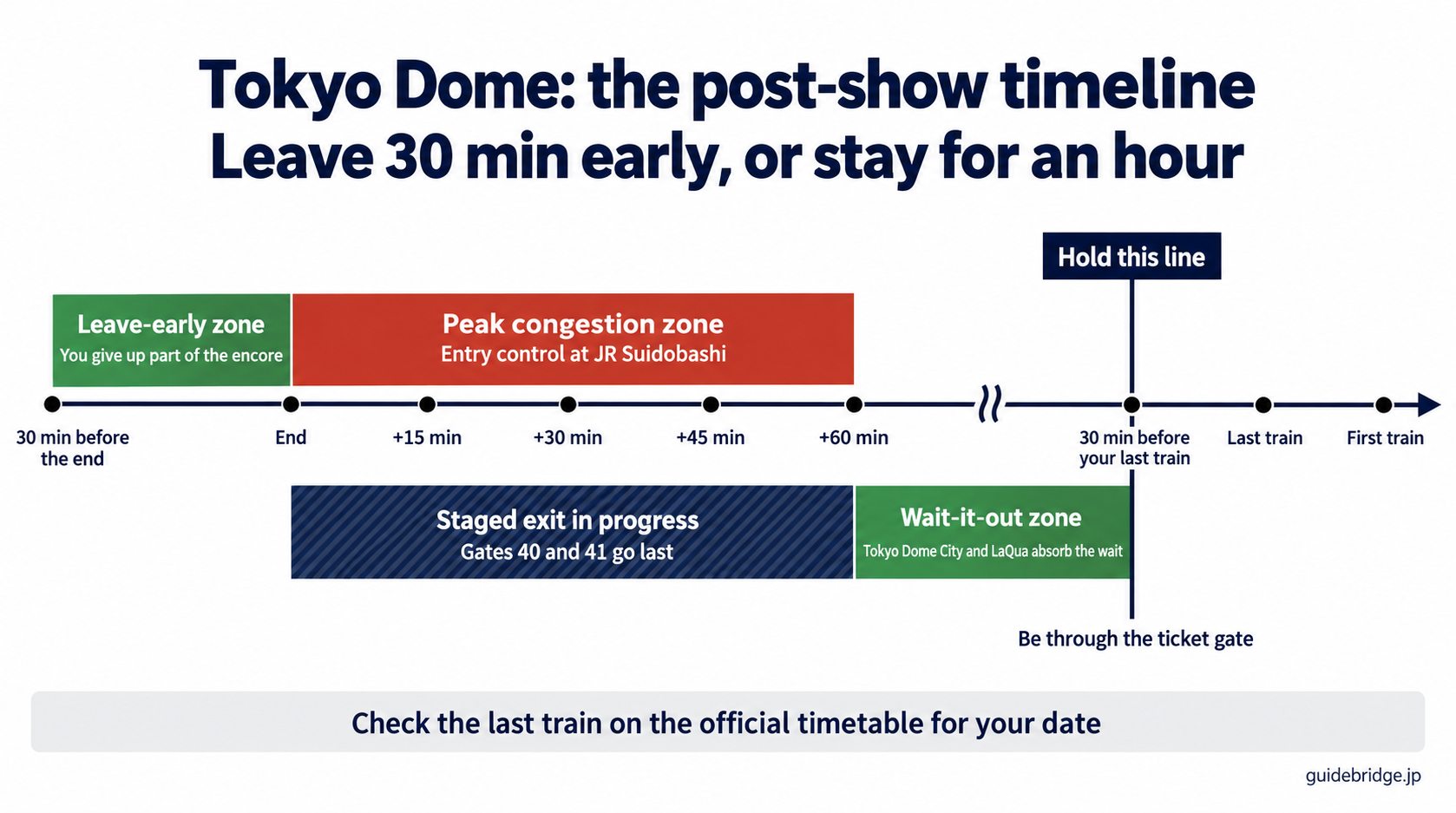
With the station settled, the remaining question is timing. Two strategies survive contact with a Tokyo Dome crowd: leave 30 min before the end, or stay inside for 60 min after it and move once the wave has passed. Walking out with the crowd, in the middle, is the weakest way to do it — the same structure as at K-Arena Yokohama. What Tokyo Dome adds is a staged exit ordered by seating block, and a whole entertainment complex next door in which to spend the wait.
The staged exit runs by seating block, and Gates 40 and 41 go last
Tokyo Dome releases the arena blocks nearest the stage first, then works outwards: 1st-floor stand, balcony, 2nd-floor stand. That means the roof seats behind Gates 40 and 41 are the last block called. The gap between the final song and the last person leaving can reach 30–60 min, and how you spend that enforced wait decides how efficiently the rest of the night goes.
Leaving 30 min early: what the encore is worth
Stand up 30 min before the end and you clear almost the entire staged exit. You are through the JR Suidobashi ticket gates before the hold begins, and whichever station you choose drops a level or two in crowding. The cost is psychological rather than logistical: you give up part of the encore. Rather than deciding that in the moment, decide it mechanically beforehand — if there is an early start tomorrow, a first train or a Shinkansen, you leave; if not, you stay. Settling it in advance removes the hesitation on the night.
Staying 60 min: Tokyo Dome City and LaQua absorb the wait
If you stay, Tokyo Dome has more to offer than most venues. The dome sits inside Tokyo Dome City, a complex that includes the LaQua spa and shopping building, the Meets Port dining area and an amusement park, all immediately next to the venue. That is what makes an hour bearable rather than wasted: merchandise queues, toilets, packing the binoculars away, a last check of tomorrow’s plan, posting about the show. Fill the 60 min with things you actually meant to do. By the end of it the staged exits at Suidobashi and Korakuen have largely cleared, and the same station feels like a different place. For anyone in the roof seats behind Gates 40 and 41, released last in any case, planning for this from the start is simply the rational move.
How to hold the line 30 min before your last train
Final services on JR, Tokyo Metro and Toei Subway need checking against the official timetable for your own date, but on weekends and public holidays they generally fall between 24:00 and 24:30. Whichever line you are using, one rule carries most of the weight: be through the ticket gate at your station 30 min before your own last train. The moment that line looks like it might break, end the wait-it-out plan and switch to a room. Counting backwards is straightforward, because noise rules cap amplified sound at 21:30 and the show itself at 22:00, which is why the end time lands at 21:00–21:30.
If the train has already gone: a room in Suidobashi, or a taxi to Shinagawa
Once the last train has gone there are two reasonable moves. One is checking into a hotel in the Suidobashi or Korakuen area that accepts 24-hour check-in. The other is a late taxi — ranks sit outside Korakuen station, outside Suidobashi station and in front of the hotel on the dome site — across to Shinagawa or Tokyo. With a Shinkansen or a flight in the morning, the taxi costs you sleep but protects the booking you cannot move, and that trade is usually the right way round.
Moving with the crowd, right after the final song, is the weakest option. Early start tomorrow means leave early; no early start means wait it out; and the line 30 min before your last train holds in both cases. Fix those rules beforehand and the decisions on the night make themselves. The next section turns the missed-train case into a concrete plan.
Where to stay, whether you missed the last train or mean to catch it
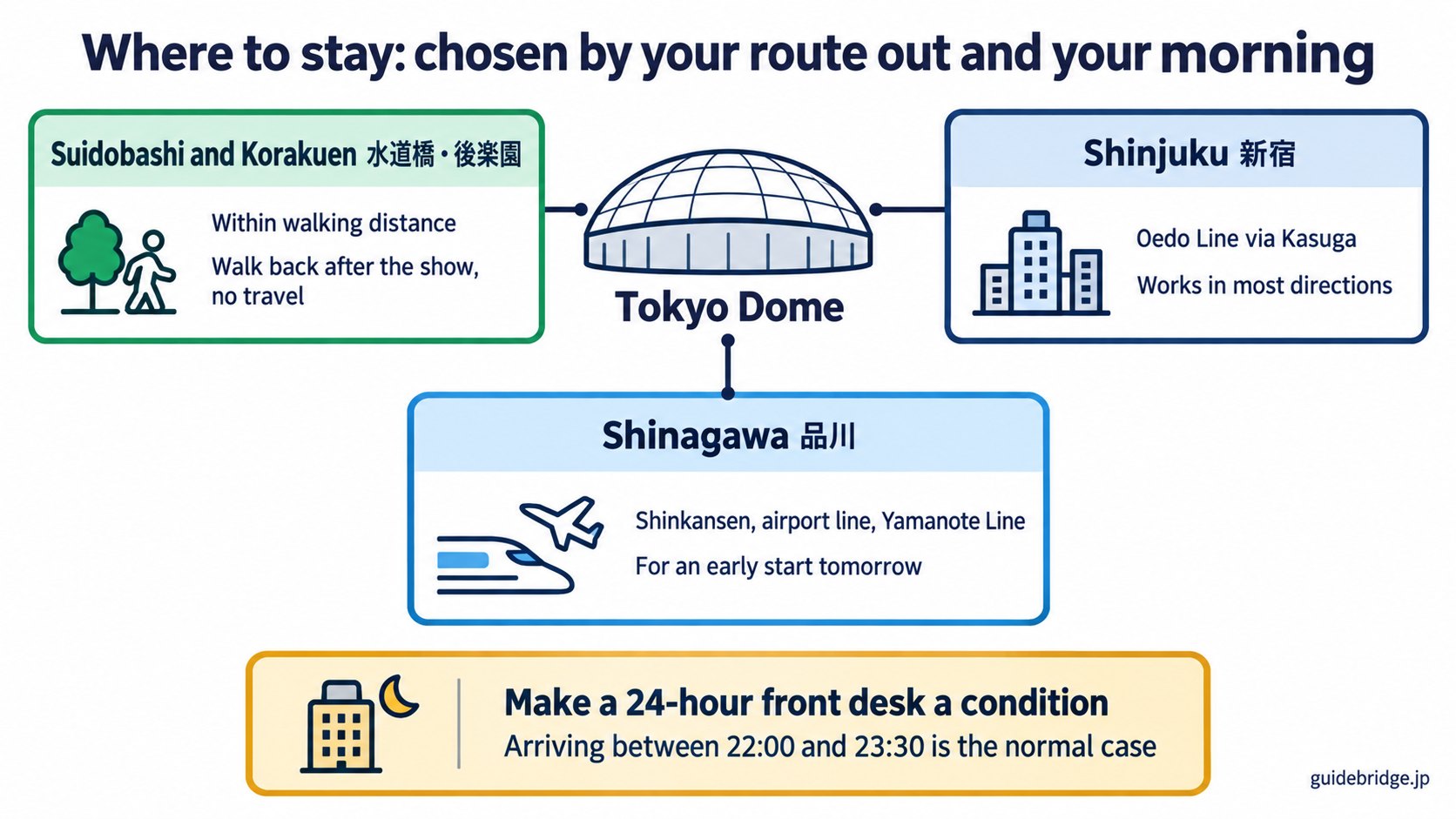
The strongest insurance for a Tokyo Dome trip is holding the option of not going home at all, and holding it from the start. If the last train is tight, or the morning starts early, a room beats a sprint on every axis — sleep, luggage, and the amount of the evening you spend watching a clock. The accommodation decision here is binary: the walking radius around the venue (Suidobashi, Korakuen), or an area that is strong for tomorrow’s travel (Shinagawa, Shinjuku).
Staying in Suidobashi or Korakuen: walking distance, no travel at all
A hotel within walking distance of Suidobashi or Korakuen station means you walk back from the venue and are done. Check in shortly after 22:00, leave your bag, eat inside LaQua — the evening stays simple. The weakness shows the next morning, when travel time to central Tokyo or the airport gets added back, so if you are moving early, work your wake-up and departure times backwards. Hotels on the dome site itself, with no walk at all, are also an option, but on K-POP dates they sell out early and prices climb to the ¥20,000 band, so check live availability and rates with a Trip.com search and lock one in early if the numbers work.
Staying in Shinagawa or Shinjuku: stronger for travel in every direction
Shinagawa is a transport hub where the Shinkansen, the Keikyu airport line and the Yamanote Line meet, which makes it strong for anyone heading home to another region in the morning or flying out. Shinjuku is easy to reach via Kasuga on the Oedo Line and works in most directions after that. The drawback in both cases is around 30–45 min of travel after the show. You are moving late at night, so plan to check in before tiredness lands, and make a 24-hour front desk a condition rather than a preference.
Why 24-hour check-in is the condition that matters
With an end time of 21:00–21:30, adding the staged exit and the journey puts your arrival at the hotel somewhere between 22:00 and 23:30 as a matter of course. Japanese business hotels commonly operate rules that catch exactly this window: arrivals after 22:00 require a phone call ahead, and check-in after 24:00 may not be accepted at all. Making “24-hour front desk” a filter rather than a hope is the insurance. Setting that filter on Trip.com before you compare anything else is also the fastest way to cut the list down.
Suidobashi and Korakuen keep the walking down; Shinagawa and Shinjuku keep the morning easy. Either way, making 24-hour check-in a condition is what stops a late finish from turning into a problem you have to solve at midnight.
You do not need a hotel near the venue if the last train on your route leaves after the staged exit clears and you can be through the ticket gate 30 min ahead of it. If Iidabashi or Ochanomizu connects directly to where you are already staying, going back there is the cheaper and better night, and this section is not for you. The two searches below are for anyone whose train does not work out that way.
Filtered for places you can still check into after the last train, chosen around the walk back from the venue.
If tomorrow starts with a Shinkansen or a flight, the same search sorted towards Shinagawa and Shinjuku is the one to open instead.
What to pack: gear that works inside the dome and on the way home
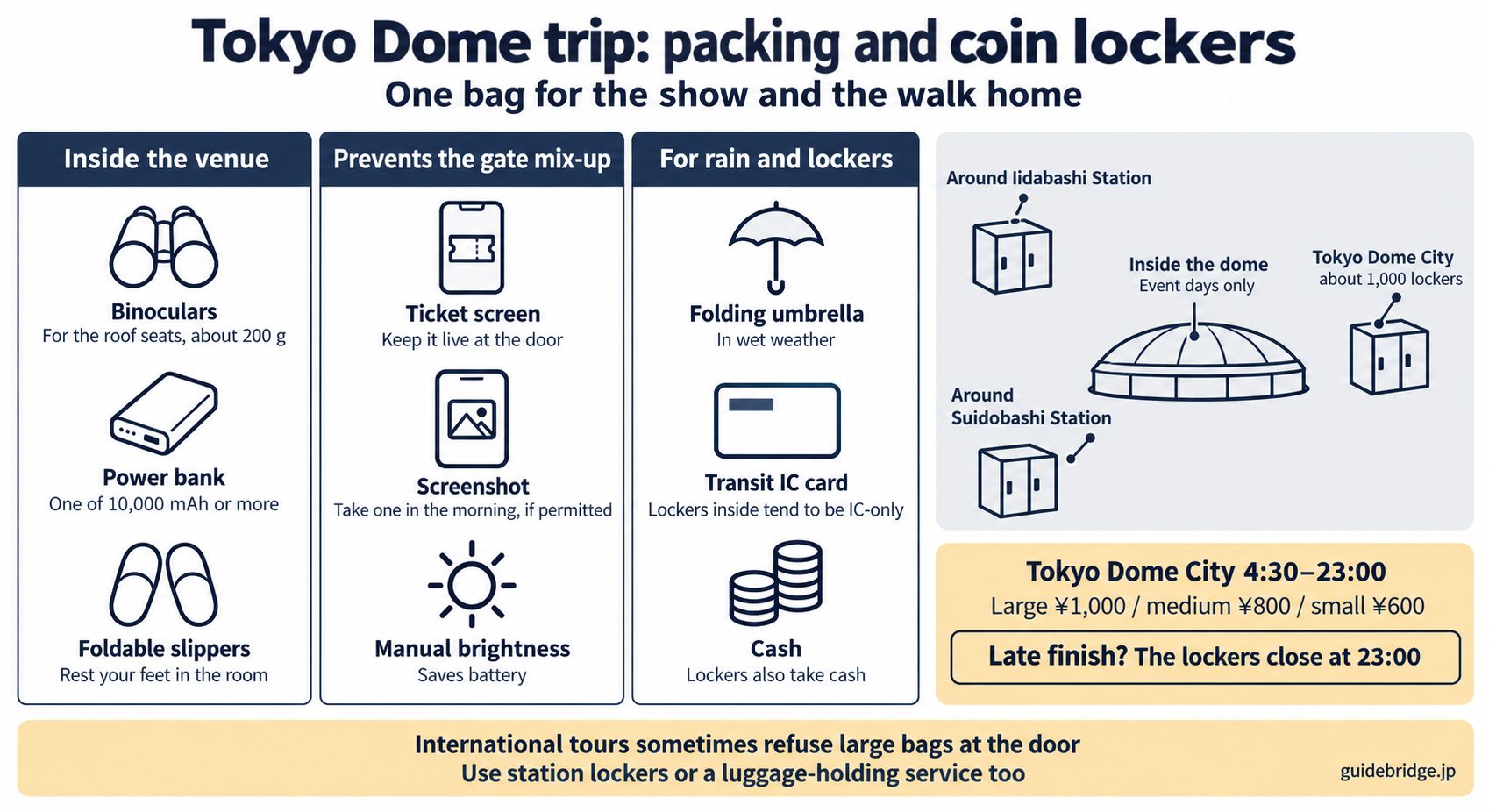
The packing principle is one bag that covers both halves of the night: what helps inside Tokyo Dome, and what helps on the way home. Every item you add makes the crowded walk after the show harder, so the list is short on purpose.
Inside the venue: binoculars, a power bank, foldable slippers
- Binoculars: from the roof seats behind Gates 40 and 41 in particular, the stage reads as a dot. A light stabilised model, around 200 g, changes the quality of the evening rather than just improving the view.
- Power bank: light-stick control, photographs and navigation on the way home all drain the battery, without exception. Carrying one of 10,000 mAh or more removes the worry.
- Foldable slippers: whether you can rest your feet the moment you reach the room decides how much energy tomorrow starts with. A folding umbrella belongs on the list too in wet weather.
Gear that prevents the gate mix-up: the power bank and your ticket screen
At Tokyo Dome shows using digital tickets, you are generally required to keep the ticket live on your phone screen at the door. Screenshots and printed substitutes are not always accepted. If the battery dies while you are standing in the queue outside, you do not get in at all — which is why the power bank belongs in the “you are stuck without it” category rather than the “handy to have” one. Combine it with battery discipline: take a screenshot of the ticket screen in the morning where the venue permits it, and switch screen brightness from automatic to manual so the display stops fighting you.
Toilets, and why you go 30–50 min before the start
Toilets inside Tokyo Dome fill up fast immediately before the start and during any break. Women’s queues of over 30 min are common enough to be the expected case, which puts the start time itself at risk. The countermeasure is a single line: go 30–50 min before the start. If the queues inside are already long, the toilets in LaQua, Meets Port and the other Tokyo Dome City facilities next door spread the load. Going before you enter the venue also gives you more freedom to move once the show has started.
A locker plan: inside the dome, Tokyo Dome City, Suidobashi and Iidabashi, about 1,000 in total
Tokyo Dome City has about 1,000 coin lockers. They come in three sizes — large at 89 × 34 × 67 cm, medium at 57 × 34 × 67 cm and small at 33 × 34 × 67 cm — priced at ¥1,000, ¥800 and ¥600 respectively. Payment is by cash or transit IC card (Suica or PASMO), and the lockers inside the venue tend to be IC-only; if you are visiting from abroad, set up a physical or mobile IC card before you need one. Tokyo Dome City is open 4:30–23:00, and the lockers inside the dome itself operate on event days only.
Depending on the end time, the Tokyo Dome City lockers closing at 23:00 can strand a bag, so for anything large use the lockers around Suidobashi and Iidabashi stations, or a luggage-holding service such as ecbo cloak, where ordinary shops and cafes take your bag by the hour. International tours sometimes run a “no large bags” policy at the door, and there are shows where a full-size suitcase cannot come into the building at all. Build that possibility into the plan rather than discovering it in the queue.

Binoculars, stabilised and lightweight
The one piece of gear that decides what the roof seats behind Gates 40 and 41, or the balcony, are actually like. Models around 200 g are light enough to leave hanging round your neck for the whole show. These are Japanese retailers, so pricing and delivery are domestic.

Power bank, 10,000 mAh with fast charging
Enough capacity to hold a digital ticket live on screen at the door and still navigate home afterwards. Choose fast charging, and a capacity your airline accepts in the cabin.
Pack for the seat and for the walk home at the same time. Binoculars, a power bank and foldable slippers cover both. The failure that ends the evening before it starts is a dead battery with a digital ticket, so a power bank of around 10,000 mAh is the first thing in the bag.
FAQ: the five questions that come up most
The K-Arena Yokohama guide covers the trip home in the same structure. If both venues are on your schedule, comparing the two station sections is where the judgement gets sharper.
Bottom line
What goes wrong at Tokyo Dome is not distance and it is not luck. It comes down to three decisions that can all be settled in advance. Before the doors: read your tier from the tens digit of the gate number, and if you are in the 40s, confirm the 2nd-floor escalator route in advance. Going home: avoid JR Suidobashi and Korakuen, and spread to Toei Mita Line Suidobashi for the Haneda connection or Iidabashi for its 5 lines. Last train and bed: count backwards from the line 30 min before your train, and hold a room with 24-hour check-in as the insurance that stops a missed train from becoming a night on your feet. Fix those three in advance and there is nothing left to work out on the day.
The point is not to lose a ticket you queued for to an entrance mix-up or a blocked station. It is to design the way home and the room the moment the ticket is confirmed. Gate assignments, timetables and venue rules all change from show to show, so confirm the gate on your ticket screen, the last train on the official timetable for your date, and the bag rules on the tour’s own announcement.
Choosing a room around the route out of the venue is what decides how the night is remembered.
Related guides
- Belluna Dome: the trip home, and why this venue is its own problem
- Ariake Arena: getting in, getting out, and where to stay
This page was produced from the Japanese original with AI assistance. Every number, station name and time was machine-checked against the Japanese source and its official references. If something is wrong, tell us here -> /en/contact/.