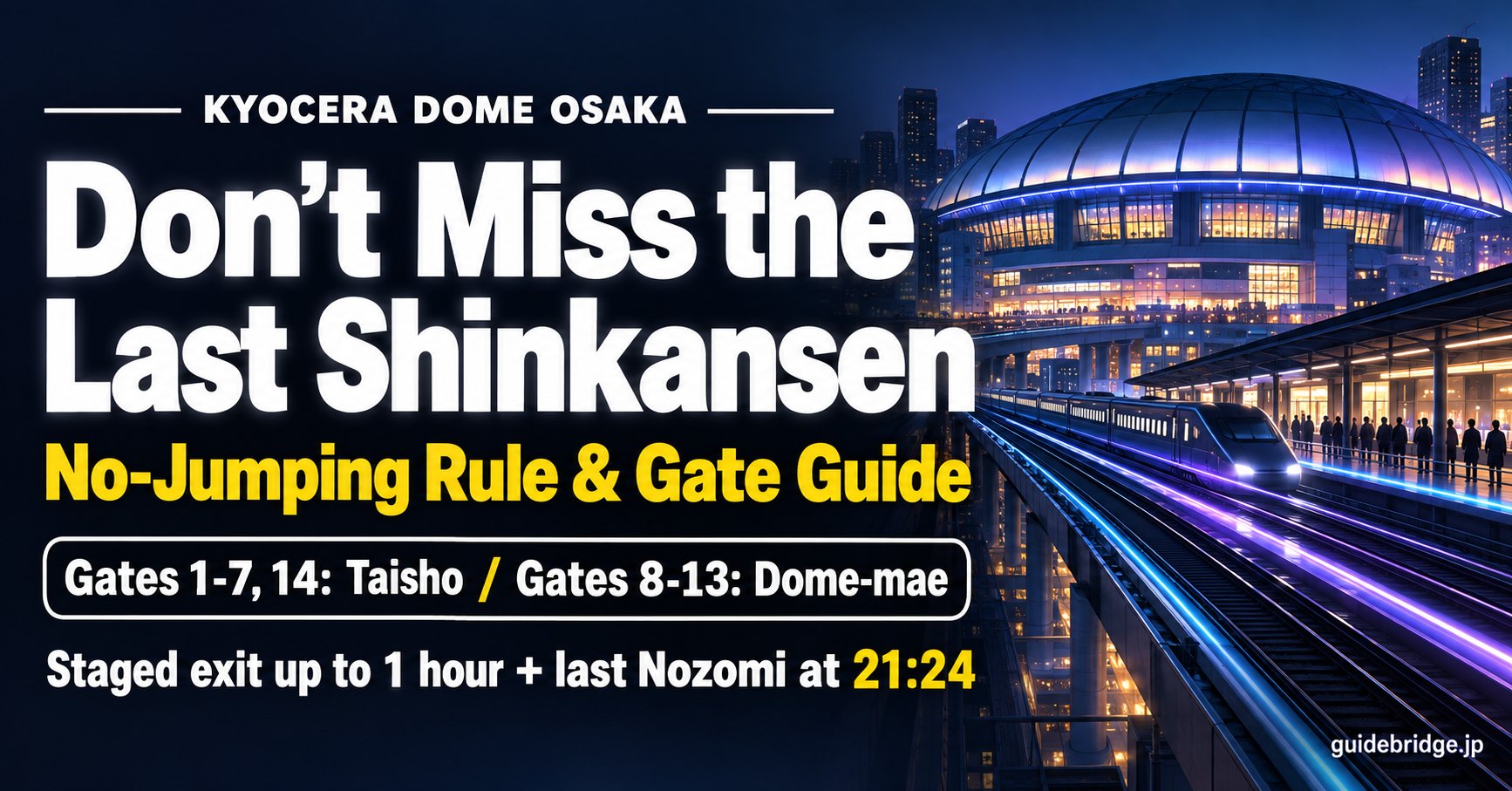
The trip home from Kyocera Dome Osaka has three traps, and if you do not know them in advance, any one of them can leave you stuck. The first is the venue’s no-jumping rule: jump during the show without knowing it, and you will get disapproving looks from the people around you. The second is mixing up your ticket’s gate number and the nearest station (Gates 1–7 and 14 = Taisho; Gates 8–13 = Dome-mae), which can cost you up to 10 min of extra walking. The third is the combination of a staged exit that can take up to 1 hour and station entry control of about 30 min, after which you find the last Shinkansen, Nozomi No. 64 leaving Shin-Osaka at 21:24, already out of reach.
Kyocera Dome Osaka opened in 1997. It is a large dome with 14 gates, 9 floors above ground and two tiers of stands running around both the infield and the outfield. That unusual layout gives first-time visitors from out of town a lot to work out. Take a show ending at 21:00, add a 30 min staged exit and 30 min of station entry control, and the dome-to-Shin-Osaka leg comes to 40–60 min. Unless you leave early, there is a real chance you will not get back to Tokyo the same night.
GuideBridge is a travel media site for K-POP fans traveling to shows in Korea. This guide collects what you need so that a Kyocera Dome trip does not stall. It covers the basis for the venue’s no-jumping rule and how to stay on the right side of it, a table that tells you your nearest station from the gate number on your ticket, a reverse calculation of the last Shinkansen for shows ending at 21:00, 21:15 and 21:30, and the point at which you should give up and book a room. No hype and no guesswork. Only the decision points, based on official information and several on-site accounts.
- Why Kyocera Dome bans jumping (the 1999 GLAY concert, shaking reported at seismic intensity 3, and the official announcements)
- A gate-to-station table (Gates 1–7 and 14 = Taisho; Gates 8–13 = Dome-mae)
- The last Shinkansen, worked back from your end time (21:00, 21:15 or 21:30, crossed with a 30 min or 1 hour staged exit)
- A timeline of the staged exit and station entry control
- When to give up and stay the night, and three nearby hotels that work for a woman traveling alone
Structurally, this is a dome venue. Domes tend to bring staged exits and a crowd that piles into the nearest stations all at once, so the key is to work backward from the last flight or the last Shinkansen. One note before we start: the Japanese original is written for readers who live in Japan, come in from Tokyo, Nagoya or Fukuoka by Shinkansen, and go home the same night. If you are flying in through Kansai or Itami airport, you may not need to reach Tokyo that night at all. The last-train sections below cover the Shinkansen only; this guide does not list the last local trains in Osaka.
The train times and journey time from Taisho Station to Osaka Station in this guide were checked against the JR West timetable (JR Odekake Net) as of October 2026, and the last-Shinkansen time from Shin-Osaka is as of June 2026. The capacity, the number of lockers, the journey time to Shin-Osaka and the taxi fare are as of May 2026, when the Japanese original was first published. For the latest, check the JR Odekake Net timetables and the official Kyocera Dome Osaka website.
Deal with this first: visitors who do not know Kyocera Dome’s no-jumping rule get disapproving looks
Jumping during a show is officially prohibited at Kyocera Dome Osaka. Bring the habits of another dome and jump without thinking, and regulars around you will stare; staff may also step in and warn you. Before we get to the trip home, this section clears away that culture-shock trap.
Why jumping is banned at Kyocera Dome and not elsewhere
Kyocera Dome stands on reclaimed land, and the ground there lets vibration travel into the surrounding area easily. At a 1999 concert by GLAY, a Japanese rock band, about 50,000 people jumping in sync were reported to put an impact load of about 2,750 metric tons on the ground. The neighboring Kubota head office building and nearby apartment buildings reportedly recorded shaking equivalent to seismic intensity 3 on the Japanese scale. That led to the no-jumping rule becoming official around 2003, and more than 100 vibration-damping devices are now installed inside the venue.
The official basis, and an example of advance notice
The “Manners & Rules” page on Kyocera Dome Osaka’s official site states plainly that jumping as a form of cheering is prohibited. “No jumping” signs are posted inside the venue and around it, and the pre-show announcements repeat the message. For the dance event “D.U.N.K.” in October 2023, SOGO OSAKA’s official X account announced in advance that jumping would be prohibited under the event rules. In recent years, organizers giving notice themselves has become standard practice.
What you can do instead, and how it differs from Tokyo Dome
Movements that keep your feet on the ground, such as bending your knees, are said not to fall under the ban. Waving your light stick in big arcs, holding up glow sticks and cheering out loud are all fine. Tokyo Dome, by contrast, places no restriction on jumping as such, even though it is also a dome; Kyocera Dome is the exception. If you arrive with Tokyo habits, or treat it like your favorite group’s show at another dome, you can easily end up on the receiving end of cold looks just after the show starts. The safe move is to decide before you go in what you will and will not do.
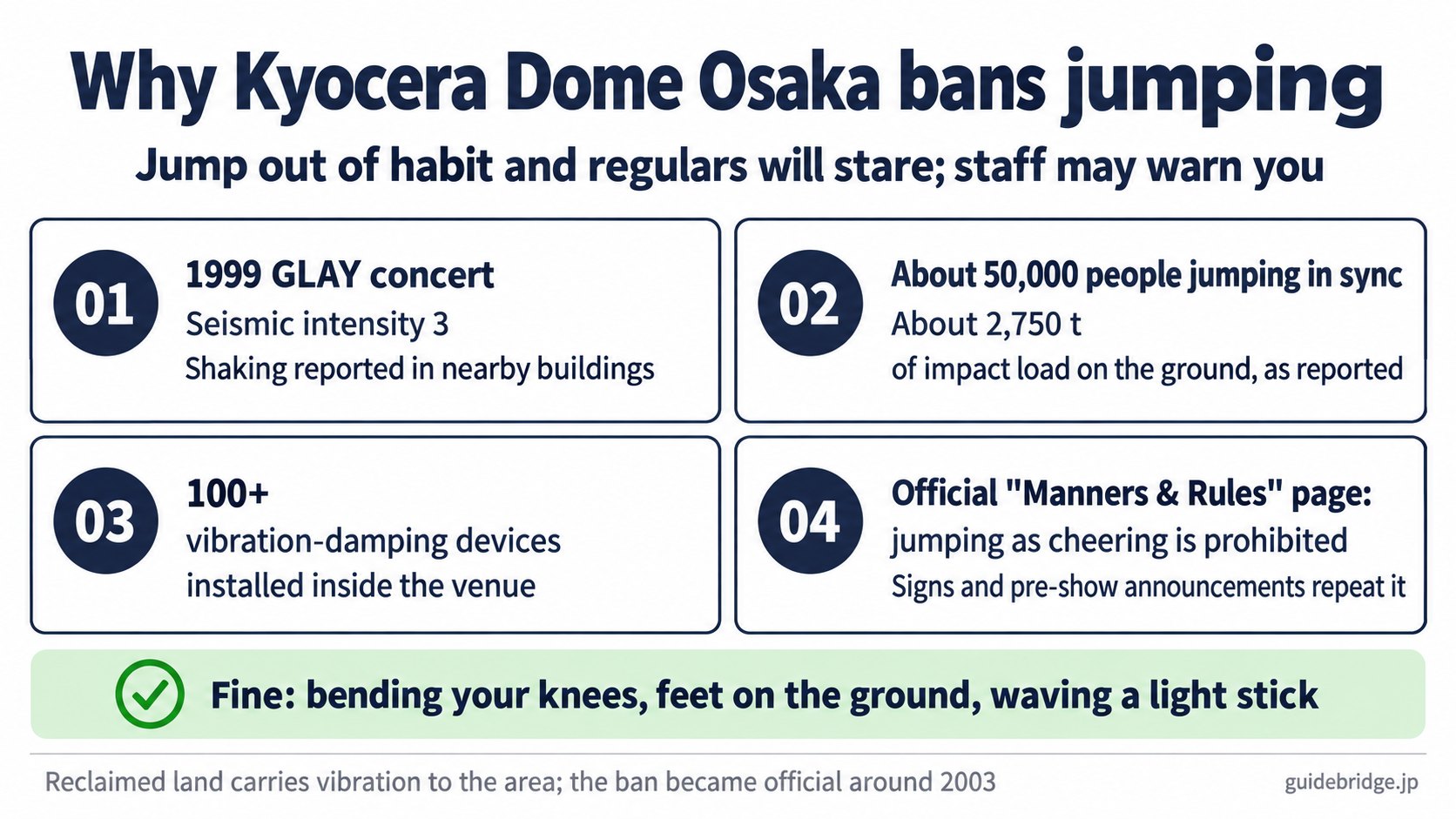
Kyocera Dome’s no-jumping rule rests on the ground conditions of reclaimed land and the 1999 GLAY concert, where shaking equivalent to seismic intensity 3 was reported. It is enforced through the official site, in-venue announcements and more than 100 vibration-damping devices. Bending your knees is fine; any move that lifts your feet off the ground is not. Go in knowing that the rules here are not the same as at Tokyo Dome.
Kyocera Dome Osaka in full: 14 gates and two-tier stands
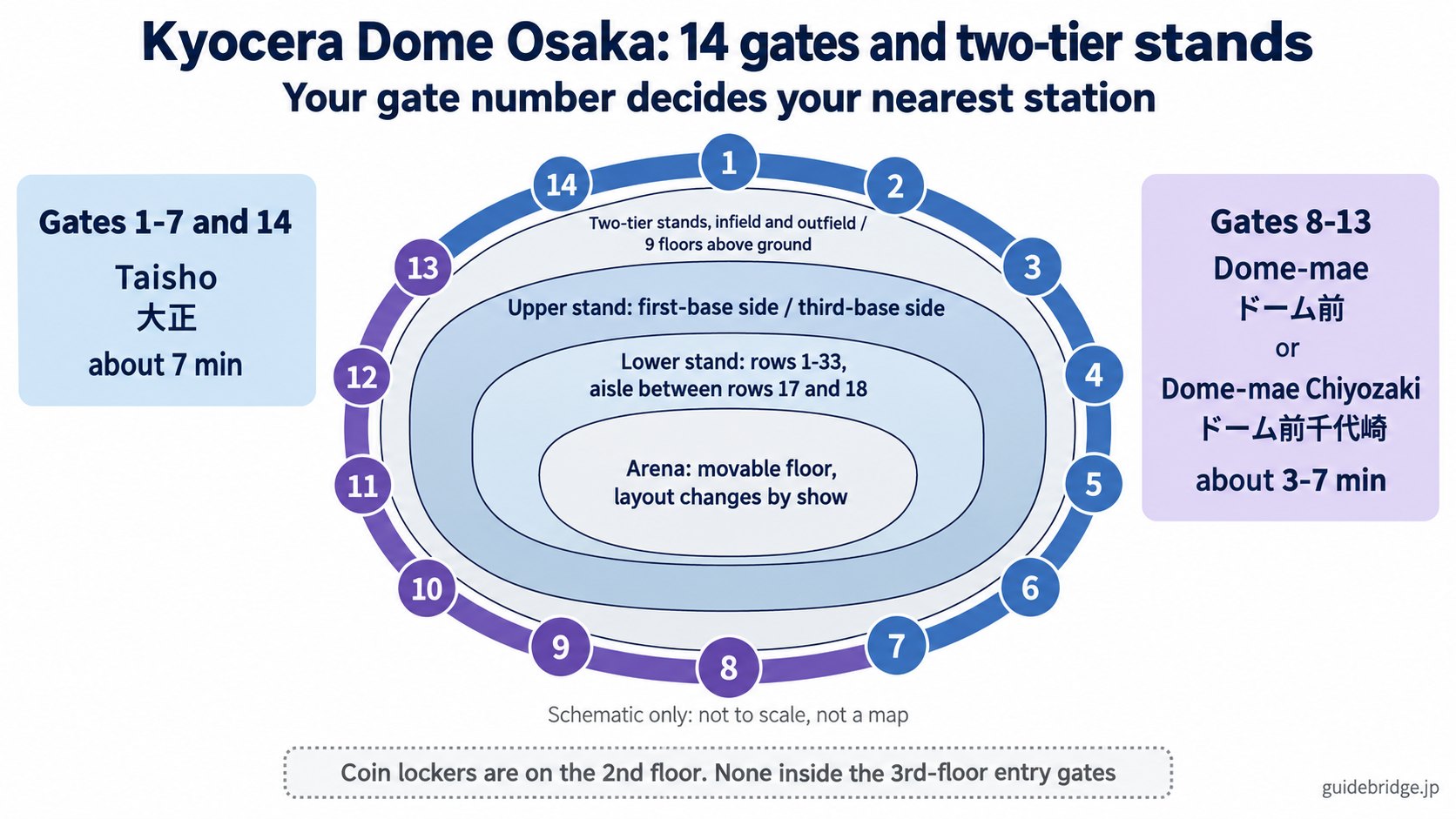
Before planning the trip home, get a clear picture of the venue’s layout. Kyocera Dome Osaka is used for both baseball and concerts, and it has 14 gates spread around the building. That distribution feeds straight into which station you should pick for the trip home.
Opening, operator and capacity: the basic facts
- Opened: March 1, 1997. Address: 3-chome Naka 2-1, Chiyozaki, Nishi-ku, Osaka, Osaka Prefecture
- Operator: Osaka City Dome Co., Ltd. (90% owned by ORIX Real Estate). Architect: Nikken Sekkei
- Capacity: up to 55,000 people, and up to 36,220 seats for professional baseball (both official figures; no official figure is published for concerts)
- Structure: two-tier stands around both infield and outfield, 9 floors above ground, total floor area of 156,409 m², 14 gates
The 14-gate layout and the seating tiers
Gates 1–14 are spread around the outside of Kyocera Dome, and the gate you enter by changes both your nearest station and your seating area. The lower stand runs from row 1 to row 33, with an aisle between rows 17 and 18, and the upper stand is split into a first-base side and a third-base side. Arena seats sit on movable flooring, and their layout changes from show to show. From the top of the stands (about the height of a fifth floor), the stage can feel far away. On the way out, though, you return through the same gate, so as long as you know your gate number, your plan for the trip home holds.
Coin lockers: always use them before you go in
Kyocera Dome’s coin lockers are concentrated on the second floor (floors here are counted with the street level as the first): 189 at the back of the East Entrance, 36 facing the East Entrance, 13 facing the South Entrance and 52 facing the North Entrance. There are no lockers inside the entry gates on the third floor, so once you are in, you cannot go back and check a suitcase. If you arrive with luggage, your route has to take you to the second-floor lockers before entry. If they are full, the realistic option is to use the lockers at AEON MALL Osaka Dome City, Dome-mae Station and Taisho Station as well.
Gate number to nearest station: decide with your ticket in hand
Kyocera Dome has 4 nearby stations, and which one is closest depends on the gate number printed on your ticket. Trust a site that lists a flat “7 min walk” and set off in a direction that does not match your gate, and you can lose up to about 10 min walking. All walking times in this guide are normal-day estimates; after a show, the crowd makes them longer. A table you can read with your ticket in hand turns the decision into one step, on the way in and on the way out.
Gates 1–7 and 14: Taisho Station, about 7 min
Taisho (大正) is an above-ground station served by the JR Osaka Loop Line and the Osaka Metro Nagahori Tsurumi-ryokuchi Line. From Gates 1–7 and Gate 14 it is about 600 m, or about 7 min on foot. If your ticket is for Gates 8–13 and you still choose Taisho, the distance grows to about 750 m, or about 10 min on foot, so a gate and station that do not match leave you noticeably more tired. The Loop Line gets you to Osaka Station (大阪) in 11–12 min (JR West timetable as of October 2026), so this is the default route if you are heading to Shin-Osaka or Tokyo.
Gates 8–13: Dome-mae or Dome-mae Chiyozaki, about 3–7 min
Exit 2 of Dome-mae (ドーム前) on the Hanshin Namba Line connects to the dome by an underground passage, and the nearest entrance, Gate 5, is about 210 m away, 2–3 min on foot. Gate 5, however, is the gate for seats assigned to the Gates 1–7 side, so if your ticket says Gates 8–13, you continue along the underground passage for about 3–7 min to your gate. Exit 1 of Dome-mae Chiyozaki (ドーム前千代崎) on the Osaka Metro Nagahori Tsurumi-ryokuchi Line also connects by underground passage, and it is 3–7 min on foot to the Gates 8–13 side. Despite the similar names, these are two separate stations run by different companies, Hanshin and Osaka Metro, with separate fares. Either way, you stay dry when it rains, and this is also the quicker route if you are heading toward Namba (難波) or Shinsaibashi (心斎橋).
Kujo Station comes back later as the low-crowd option for the trip home
Exit 6 of Kujo (九条), on the Osaka Metro Chuo Line and the Hanshin Namba Line, is a bit farther at about 9–10 min on foot. It is known, though, as a little-used way around the station entry control that starts right after a show. You may not pick it on the way in, but it is worth keeping as an option on the way home if your seat is in an area held back in the staged exit (covered below).
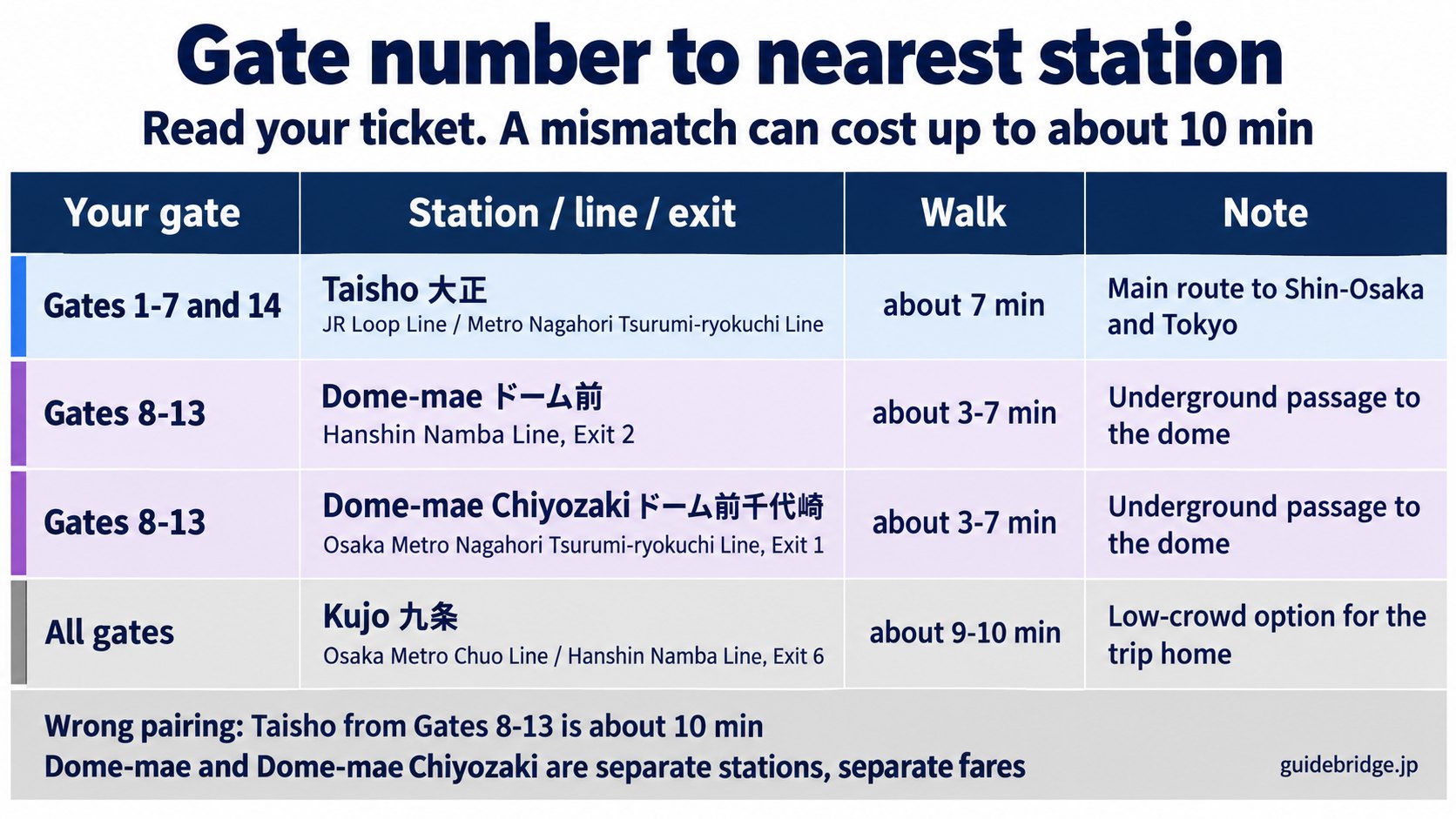
| Station | Line | Gates | Walk | Notes |
|---|---|---|---|---|
| Dome-mae (ドーム前) | Hanshin Namba Line | 8–13 | About 2–3 min (to Gate 5) | Underground passage to the dome |
| Dome-mae Chiyozaki (ドーム前千代崎) | Osaka Metro Nagahori Tsurumi-ryokuchi Line | 8–13 | About 3–5 min (to Gate 5) | Underground passage to the dome |
| Taisho (大正) | JR Loop Line / Metro Nagahori Tsurumi-ryokuchi Line | 1–7 and 14 | About 7 min (10 min from Gates 8–13) | Main route to Shin-Osaka and Tokyo |
| Kujo (九条) | Osaka Metro Chuo Line / Hanshin Namba Line | All gates | About 9–10 min | Low-crowd option for the trip home |
Do not memorize a flat “7 min walk.” The rule is to switch stations by the gate number on your ticket: Taisho for Gates 1–7 and 14, Dome-mae or Dome-mae Chiyozaki for Gates 8–13, and Kujo when you want to get around the crowd control. That alone makes a big difference to how far you walk and how packed the station is.
If you are coming in by Shinkansen from Tokyo, Nagoya or Fukuoka, arriving on the day of the show means your gate decision and the station crowds land at the same time, and that easily costs you time getting in. Stay the night before at a hotel right by Shin-Osaka Station and ride the JR Osaka Loop Line in the next morning, and you will have room to plan around the crowds at Taisho for Gate 14. You don’t need a room the night before if you are already staying in Osaka or elsewhere in the Kansai area: you can come in on the day by JR to Taisho or by Osaka Metro to Dome-mae Chiyozaki.
The main issue: the staged exit, station entry control and the last Shinkansen stack up
What strands visitors on the way home from Kyocera Dome is not distance but three delays stacking up. First, the staged exit right after the show (up to 1 hour). Second, station entry control at all 3 stations (waits of 30 min have been reported). Third, 20–30 min by train from there to Shin-Osaka. Added together, they run straight into the departure time of the last Shinkansen. Shin-Osaka is the Shinkansen station and is separate from JR Osaka Station, so this last leg is a real transfer.
What a staged exit of up to 1 hour looks like
At large Japanese venues, staff release the audience area by area after the show, and you cannot simply leave when you want to. At Kyocera Dome, the official estimate for this staged exit is reported to be 30 min to as long as 1 hour, starting right after the show ends. The order depends on the stage setup, but arena seats are often released last, and seats in the front rows of the stands or near the center are often in the held-back areas. If you have arena seats, the safe plan for the trip home assumes you will be among the last to leave the dome.
Station entry control of about 30 min (Dome-mae Chiyozaki, Taisho and Dome-mae alike)
Once the staged exit ends and you are out of the dome, the next hurdle is waiting outside the ticket gates. When platforms get crowded, station staff stop people before the ticket gates. At all 3 stations, Dome-mae Chiyozaki (ドーム前千代崎), Taisho (大正) and Dome-mae (ドーム前), long lines form at the ticket gates after a show, and waits of around 30 min under entry control have been reported. In some cases, walking 9–10 min to Kujo (九条) gets you onto a platform sooner. The crowding is different at each of the 3 stations.
- Taisho: direct to Osaka Station on the Loop Line. The main route toward Shin-Osaka, so crowds concentrate here
- Dome-mae (Hanshin Namba Line): well placed for Namba and points west. Connected to the dome by underground passage
- Kujo: 9–10 min on foot, but a little-used way around the gate control
To reach Shin-Osaka (新大阪), the fastest JR route takes about 20 min (Taisho, then Osaka, then Shin-Osaka). Via Osaka Metro it takes about 25–30 min (Dome-mae Chiyozaki, then Shinsaibashi (心斎橋), then Shin-Osaka). A taxi takes about 15 min and costs roughly ¥2,500–¥3,500. On the Midosuji Line platform, trains bound for different terminals stop at the same platform. Trains showing “Nakatsu (中津)” as the destination do not go as far as Shin-Osaka, so you need one bound for Shin-Osaka, Esaka (江坂) or Senri-Chuo (千里中央). Late at night, letting a single train go can change whether you make the last Shinkansen, so always check the destination display before you board.
The last Shinkansen, worked back from your end time
Under the timetable revised on March 14, 2026 (treat these as reference times), the last Shinkansen toward Tokyo is Nozomi No. 64, leaving Shin-Osaka at 21:24, followed by an extra train (leaving Shin-Osaka at 21:30, running on specific days only). No regular Shinkansen to Tokyo leaves at 22:00 or later. Whether you can be back in Tokyo the same night breaks down roughly as follows, by end time and by whether you are held in the staged exit.
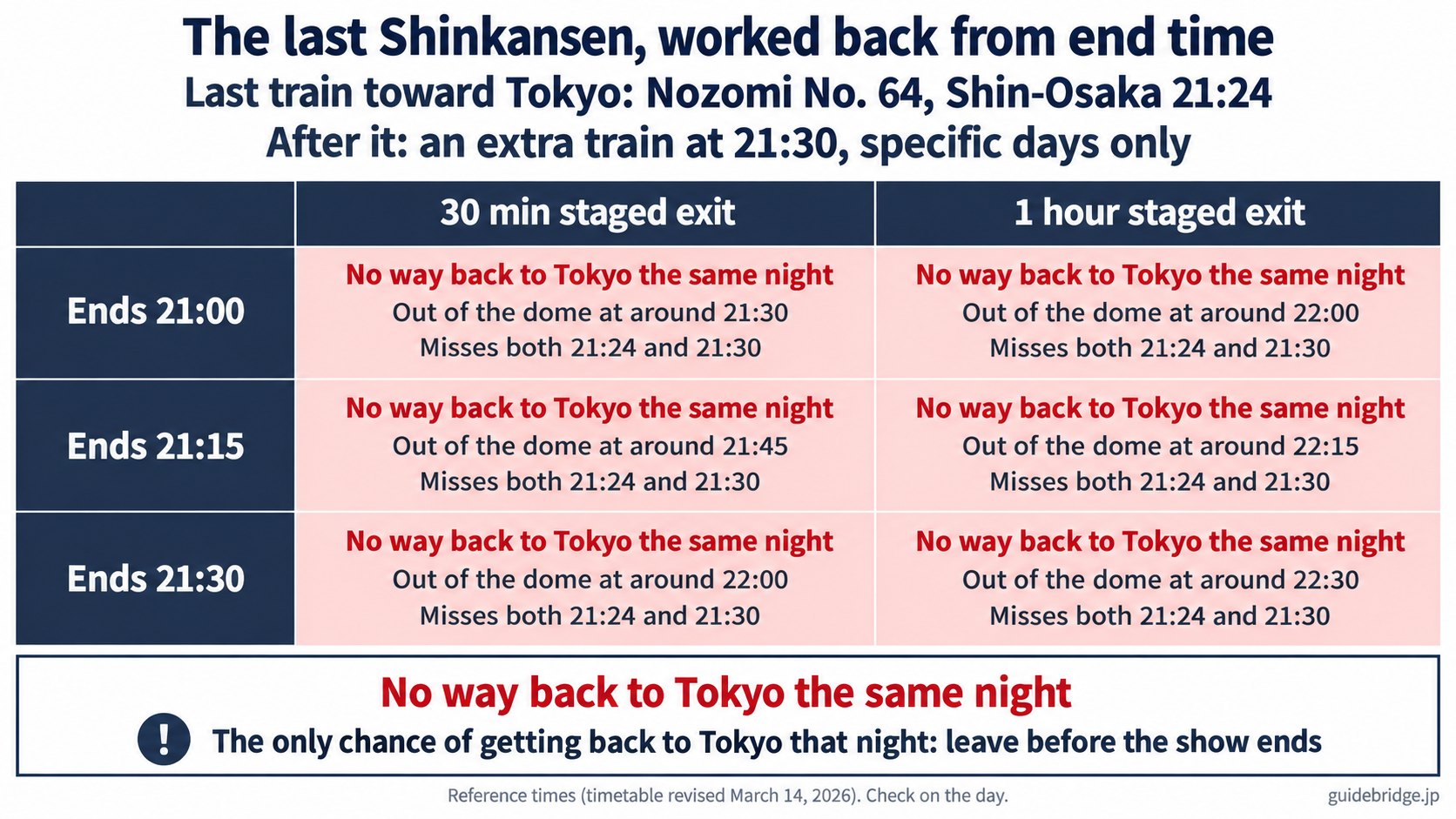
| End time | 30 min staged exit | 1 hour staged exit |
|---|---|---|
| 21:00 | Reach Taisho Station at around 21:37, Osaka Station at 21:49 or later. Misses both Nozomi No. 64 (21:24) and the 21:30 extra train (specific days only); only those who leave early can be back in Tokyo the same night | Out of the dome at 22:00. No Shinkansen to Tokyo that night |
| 21:15 | Out of the dome at around 21:45. No Shinkansen to Tokyo that night | Out of the dome at 22:15. No Shinkansen to Tokyo that night |
| 21:30 | No way back to Tokyo the same night | No way back to Tokyo the same night |
Note: the Osaka arrival times come from the JR West timetable as of October 2026 (JR Odekake Net, “Taisho Station timetable”, weekends and holidays / weekdays) and will change with timetable revisions.
Toward Hakata (博多), several Nozomi and Sakura trains run between 21:00 and 22:00. If the show ends at 21:00 and you can leave early, you still have a chance, but it gets hard if your seat is held back in the staged exit. Check the exact departure times on the day of the show with a Japanese route-search service such as Ekitan.
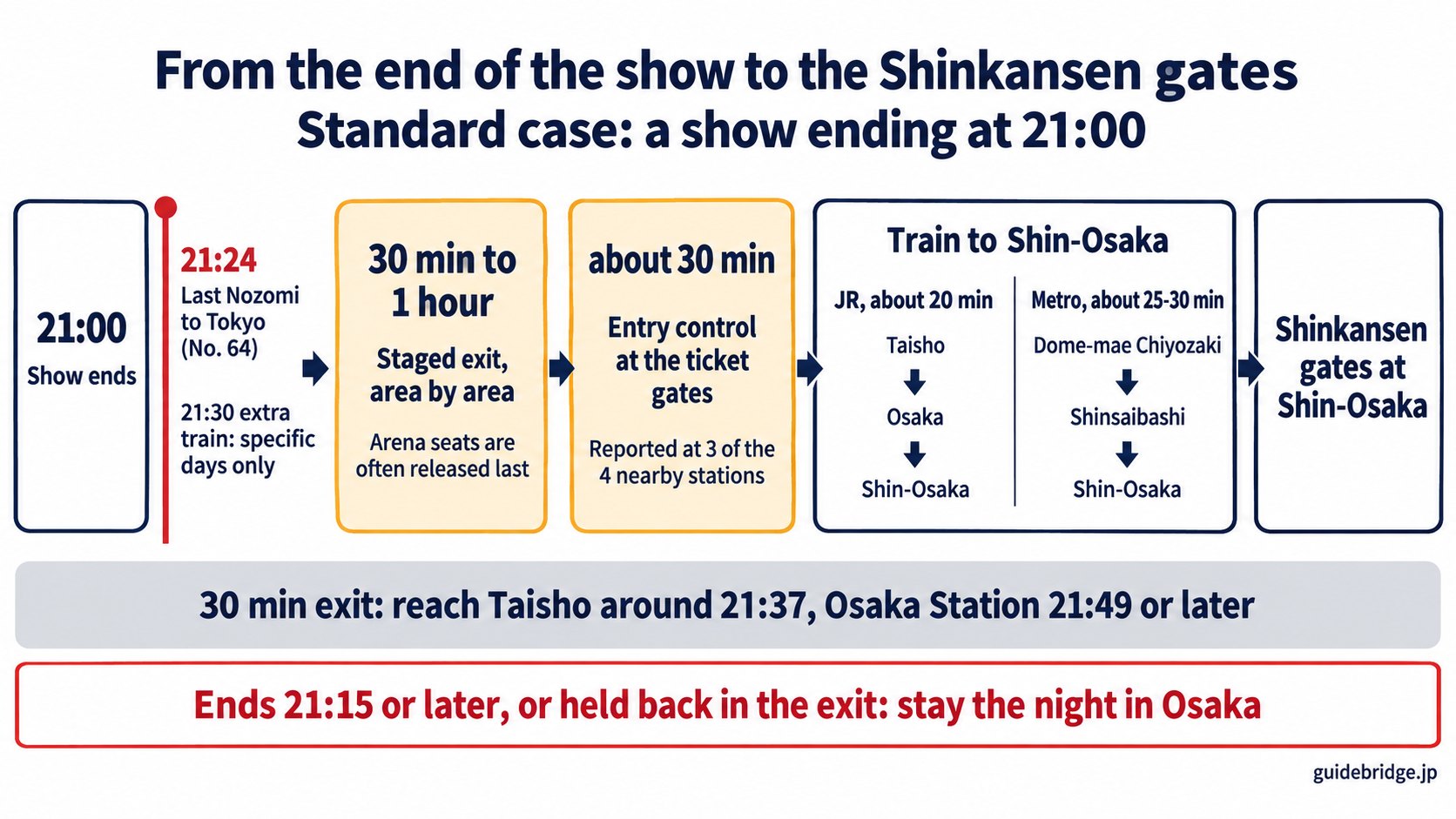
If the show ends at 21:15 or later, or your seat is held back in the staged exit, the realistic answer is to let the last Shinkansen go and switch to a night in Osaka. Competition for rooms rises sharply from 22:00, so hold a room on your phone before the show starts; then the decision after the show is a simple choice between going and staying. The first Nozomi from Shin-Osaka toward Tokyo the next morning does not leave before 6:00, so checking out at 5:30 and reaching Shin-Osaka Station at 5:45 gets you there with time to spare.
Three nearby hotels if you give up and stay, and the recommended plan by where you start
Once you decide to stay in Osaka, the next choice is between two options: keep everything around the dome, or move to the area by Shin-Osaka Station and take an early train home the next morning. With a woman traveling alone in mind, this section focuses on three hotels in the Dome-mae area where you can rest right after the show.
Three hotels near the station at Osaka Dome-mae (for a woman traveling alone)
- Toyoko Inn Osaka Dome-mae: 7 min on foot from Taisho Station and 7 min from Dome-mae Station. Right in front of the dome, breakfast included, suited to fans watching their budget
- Hotel Sobial Osaka Dome-mae: 1 min on foot from JR Taisho Station and about 10 min on foot from the dome. Its large shared bath is open until 25:00 (Japanese notation for 1:00 a.m.), so you can still get into hot water late after the show, and many women traveling alone have stayed here
- Hotel Livemax Osaka Dome-mae: about 5 min on foot from the dome. Clean, modern, understated design, with rooms laid out to make getting ready the next morning easy
If you are heading back toward Tokyo on an early train the next morning, a business hotel by Shin-Osaka Station (a few minutes on foot from the Shinkansen gates) is the better position. Toyoko Inn and Livemax are Japanese business-hotel chains. The Dome-mae area has become well developed for visitors, and it is relatively comfortable to walk around even for a woman alone. Late at night, though, the area around Taisho Station includes a strip of bars and restaurants, so the safe choice is to go straight to your hotel without stopping.
Recommended plan by where you start
| Starting from | Getting there | Getting home | Where to stay |
|---|---|---|---|
| Tokyo and Kanto | Shinkansen to Shin-Osaka, then to Taisho | Show ends at 21:00 and you leave early: a chance at Nozomi No. 64 (21:24) | Stay in Osaka if your seat is held back in the staged exit |
| Nagoya and Tokai | Shinkansen to Shin-Osaka, then to Taisho | A chance of getting home on a Hikari or Nozomi leaving between 21:00 and 22:00 | Stay in Osaka if the show ends at 21:30 |
| Osaka and Kansai | JR Taisho Station or Metro Dome-mae Chiyozaki | Home on the last JR or Metro train | You can get home the same night |
| Fukuoka and western Japan | Shinkansen to Shin-Osaka, then to Taisho | A chance of getting home on a Sakura or Nozomi leaving between 21:00 and 22:00 (check times on the day) | Stay in Osaka if the show ends at 21:15 or later |
At Kyocera Dome, the staged exit can last up to 1 hour, and the last Nozomi toward Tokyo leaves at 21:24, so you can easily get stuck. The shortest way to avoid rushing after the exit is to plan from the start on one night, either around Shin-Osaka, right by the Shinkansen, or in central Osaka, where getting around Umeda (梅田) or Namba (難波) the next morning is easy. You don’t need to book a room for this if you live in the Kansai area, or if your hotel is already in Umeda, Namba or Shin-Osaka and you can reach it on the last JR or Metro train.
To see how the trip home differs from Tokyo Dome side by side, read this together with the Tokyo Dome guide.
Frequently asked questions
Summary: how to get home from Kyocera Dome Osaka without a hitch
How the trip home from Kyocera Dome Osaka goes is decided by what you prepare before the show. There are three points. First, jumping during the show is officially prohibited, so learn the rule before the doors open. Second, switch your nearest station according to the gate number on your ticket (Gates 1–7 and 14 = Taisho; Gates 8–13 = Dome-mae). Third, allow for a staged exit of up to 1 hour and station entry control of about 30 min; if the show ends at 21:15 or later, or your seat is held back in the staged exit, let the last Shinkansen (Nozomi No. 64, Shin-Osaka 21:24) go and switch to a night in Osaka. Keep these three in mind and you can spend the hours after the show without rushing.
If you are going to Tokyo Dome, its routes and last-train decisions are in a separate guide:Tokyo Dome: gates, stations and the trip home.
There are only three decision points for getting home from Kyocera Dome without getting stuck. First, learn the no-jumping rule before the show. Second, switch your nearest station by the gate number on your ticket (Gates 1–7 and 14 = Taisho; Gates 8–13 = Dome-mae). Third, use the end time and whether you are held in the staged exit to check whether you can make the last Shinkansen; if not, switch to a night in Osaka. Have these three in your head before the show starts, and the hours after the show will remain part of the good memories of the night.
Related guides
This page was produced from the Japanese original with AI assistance. Every number, station name and time was machine-checked against the Japanese source and its official references. If something is wrong, tell us here -> /en/contact/.