
If hearing “a 3 min walk from Saitama-Shintoshin Station” makes you relax about getting to Saitama Super Arena, you are exactly the person most likely to run into trouble on the day. There are 3 reasons. First, the venue is closed from January 2026 and is scheduled to stay closed until March 2027. Second, there is the “mode trap”: a ticket you bought thinking it was a Main Arena seat ends up much farther from the stage when the show switches to Stadium mode. Third, the top tier, the 500 level, is built so high that you cannot make out your favorite artist’s face without 12x or stronger binoculars.
Compared with the 1-hour wait to get home that fans often face at other venues (KSPO Dome, Ariake Arena, K-Arena Yokohama), access to Saitama Super Arena really is good. There is only 1 ticket-gate area, and a second-floor deck through Keyaki Hiroba lets you walk straight to the venue without getting wet, even in the rain. But a well-designed venue is one thing, and a smooth trip for you is another.
To help you prepare for shows after the reopening scheduled for April 2027, this guide lays out the decisions that keep you from running into trouble on the day. Since April 2026, the venue has also had a nickname, “GMO Arena Saitama” (the official name is still Saitama Super Arena).
Structurally, this is an arena with a reconfigurable layout. The mode (such as Stadium, Main Arena or Hall) changes from show to show, so you need to check the announcement for your show. Our guide to concert venue types explains how to read each type (Japanese only for now).
- The closure from January 2026, scheduled to last until March 2027, and how the new nickname “GMO Arena Saitama” came about
- When to use each of the 3 nearest stations (Saitama-Shintoshin, Kita-Yono and Omiya)
- The trap in the 4 modes (Stadium, Main Arena, Hall and Theater) and how to avoid it
- Recommended binocular magnification for the 400 and 500 levels
- Nearby hotels you can walk back to in 3 min after the show
Travel times and seat counts in this guide are as of April 2026, when it was first published, and the closure dates are as of September 2026. For the latest train times, check JR East’s official timetable. For the closure and reopening, check the official Saitama Super Arena website.
Saitama Super Arena access beats most venues, but 3 traps can still trip you up
Saitama Super Arena is in an unusually convenient spot compared with other venues. It is a 3 min walk from the nearest station, Saitama-Shintoshin, which has only 1 ticket-gate area. A second-floor deck (a raised walkway) through Keyaki Hiroba, the plaza and shopping complex between the station and the arena, leads straight to the arena entrance, so you stay dry even in the rain. Many fans also say the crowding at the station after a show is lighter than at other venues.
Good access, however, does not mean your concert day will go smoothly. This venue has 3 traps of its own. Here they are, one by one.
Trap 1: the arena is closed from January 2026 and scheduled to stay closed until March 2027, so if you show up without knowing, you can’t get in
Saitama Super Arena is currently undergoing major renovation work. Since January 13, 2026, the arena areas (the Stadium, the Main Arena and the Community Arena) have been closed. The reopening is scheduled for April 2027, and the first show after the reopening, “GMO SONIC 2027,” is scheduled for April 3–4, 2027.
If you already have tickets for a show in April 2027 or later and plan to scout the venue during the closure, you can see the outside of the building, but you cannot go inside. Keyaki Hiroba next door and the shops inside the building are open as usual (per the official notice of March 30, 2026).
The official underground parking lot is also unavailable during the closure (scheduled to run until the end of March 2027). During that period, the venue officially directs drivers to the Keyaki Hiroba underground parking lot instead. How parking will work after the reopening will be officially announced in or after April 2027.
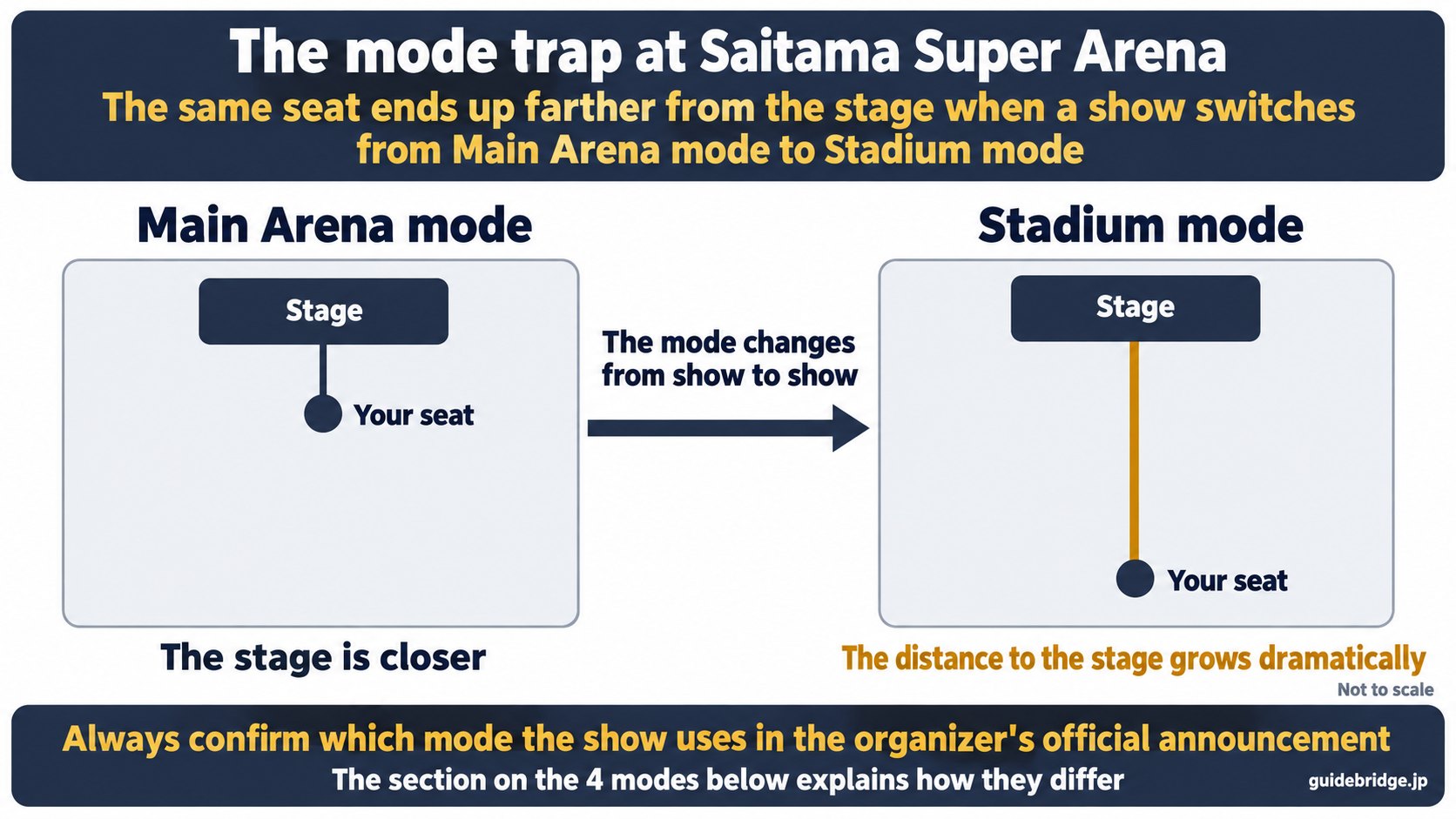
Trap 2: the mode trap, where a “Main Arena” seat turns into a seat at the back in Stadium mode
Saitama Super Arena has movable seating called the “Moving Block,” which lets it switch between 4 modes depending on the show. Even within the same seating block, how far you are from the stage and what you can see change a great deal with the mode.
Say you bought what you thought was a “second-floor A seat” (a typical Japanese ticket seat class) in Main Arena mode. If the show switches to Stadium mode on the day, the distance to the stage grows dramatically. After you buy a ticket, always confirm which mode the show uses in the organizer’s official announcement.
Important: the section on the 4 modes below explains in detail how Stadium, Main Arena, Hall and Theater modes differ.
Trap 3: from the 500 level, you can’t make out faces without 12x or stronger binoculars
Saitama Super Arena is built in tiers called levels (the arena floor, then the 200, 300, 400 and 500 levels). The top tier, the 500 level, is a steep upper section often described as a sheer cliff, and it is the farthest from the stage.
Seats are allocated by lottery in Japan, so you only learn your level once you win a ticket. If you land a 500-level seat, you will be too far away to make out your favorite artist’s face without binoculars. Binoculars of at least 12x are practically essential there, and in Stadium mode, image-stabilized binoculars (with built-in shake correction) are ideal. For the 400 level, 8–10x is recommended, or 10–12x in Stadium mode. The section on the 4 modes below goes through this mode by mode.
You don’t need a hotel near the venue if you already have a room near Tokyo Station or Ueno Station and don’t mind riding back with the post-show crowd. Saitama-Shintoshin Station is a 3 min walk away, Tokyo Station is about 30 min from there on the Ueno-Tokyo Line, and many fans say the crowds at the station are lighter than at other venues. If you do want to stay nearby, once you have tickets for a show after the April 2027 reopening, the safe move is to secure a hotel within a 3 min walk first.
The 3 nearest stations compared: Saitama-Shintoshin vs Kita-Yono vs Omiya
Saitama Super Arena has 3 nearest stations. They differ in walking time, lines and how strongly I recommend them, so pick one based on where you are coming from and what you need. All 3 are in Saitama City, the city just north of Tokyo, and they sit close together. Bottom line: Saitama-Shintoshin Station is the clear first choice.
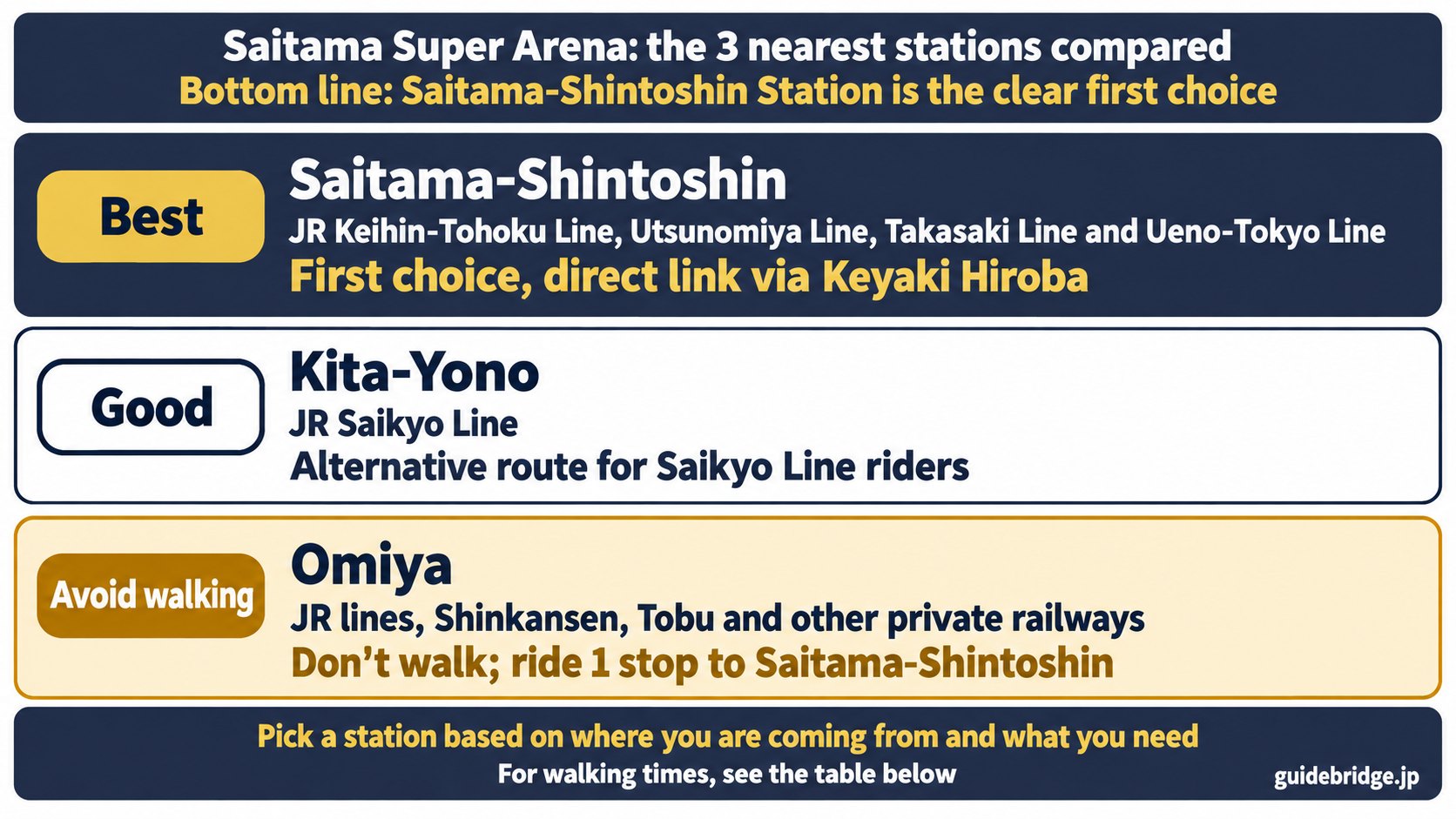
| Station | Walk | Lines | Recommendation | Use it for |
|---|---|---|---|---|
| Saitama-Shintoshin | About 3 min | JR Keihin-Tohoku Line / Utsunomiya Line / Takasaki Line / Ueno-Tokyo Line | Best | First choice, direct link via Keyaki Hiroba |
| Kita-Yono | About 7 min | JR Saikyo Line | Good | Alternative route for Saikyo Line riders |
| Omiya | About 20 min | JR lines, Shinkansen, Tobu and other private railways | Avoid walking | Don’t walk; ride 1 stop to Saitama-Shintoshin |
Saitama-Shintoshin Station, a 3 min walk (first choice, 1 ticket-gate area, direct link via Keyaki Hiroba)
Saitama-Shintoshin Station is served by the JR Keihin-Tohoku Line, Utsunomiya Line, Takasaki Line and Ueno-Tokyo Line. These are all JR East services, and the Ueno-Tokyo Line is the name for Utsunomiya and Takasaki Line trains that run through to Tokyo and Yokohama. The station has only 1 ticket-gate area, so it is easy to navigate. Head out of the gate toward the West Exit and Keyaki Hiroba opens up right in front of you, with the second-floor deck running straight to the arena entrance.
From Tokyo Station it is about 30 min on the Ueno-Tokyo Line, from Ueno Station about 20–25 min on the Keihin-Tohoku Line, and from Yokohama Station about 60 min on a through train on the Ueno-Tokyo Line.
One catch: Shonan-Shinjuku Line, Musashino Line and Saikyo Line trains do not stop at Saitama-Shintoshin. From Shinjuku, Ikebukuro or Shibuya, you can ride the Shonan-Shinjuku Line to Omiya Station and then go back 1 stop on the Keihin-Tohoku Line. From Shinjuku or Ikebukuro there is also the Saikyo Line straight to Kita-Yono Station, which means fewer transfers (see the next section).
Kita-Yono Station, a 7 min walk (JR Saikyo Line, an alternative route away from the main crowd)
Kita-Yono Station is on the JR Saikyo Line, and its advantage is a direct ride from Shinjuku Station. The arena is about a 7 min walk away, connected by a deck.
From Shinjuku or Ikebukuro, riding the Saikyo Line straight to Kita-Yono takes fewer transfers than taking the Shonan-Shinjuku Line and changing at Omiya. It is also a good alternative if you want to avoid the crowd at Saitama-Shintoshin Station after the show.
Omiya Station: walking 20 min is the wrong call (take the train 1 stop, about 2 min, to Saitama-Shintoshin)
Walking from Omiya Station to the venue is a mistake. It takes about 20 min, and after a show, when the streets are crowded, it may take even longer. If you get off at Omiya, always take the Keihin-Tohoku Line or the Utsunomiya Line 1 stop (about 2 min) to Saitama-Shintoshin Station.
Omiya is a major stop on the Shinkansen (bullet train) lines heading north from Tokyo. If you arrive at Omiya by Shinkansen, the quickest route is the same: transfer inside the station, without going out through the ticket gates, to the Keihin-Tohoku Line platform and ride 1 stop.
Travel times from major stations at a glance
| From | Route | Time |
|---|---|---|
| Tokyo Station | Ueno-Tokyo Line | About 30 min |
| Ueno Station | Keihin-Tohoku Line (Rapid, which skips some stations) / Utsunomiya Line | About 20–25 min |
| Shinjuku Station | Shonan-Shinjuku Line → Omiya → Keihin-Tohoku Line, 1 stop | About 35–40 min |
| Shinjuku Station | Saikyo Line to Kita-Yono Station → 7 min walk | About 40 min |
| Ikebukuro Station | Shonan-Shinjuku Line → Omiya → Keihin-Tohoku Line, 1 stop | About 35 min |
| Shibuya Station | Shonan-Shinjuku Line → Omiya → Keihin-Tohoku Line, 1 stop | About 45 min |
| Yokohama Station | Ueno-Tokyo Line through train | About 60 min |
The 4-mode trap: check the show’s seating mode before you buy a ticket
The biggest thing that makes Saitama Super Arena a tricky venue is its switch between 4 modes. The same seating block can feel completely different depending on the mode, so always check the mode before you buy a ticket. The organizer announces which mode a show uses.
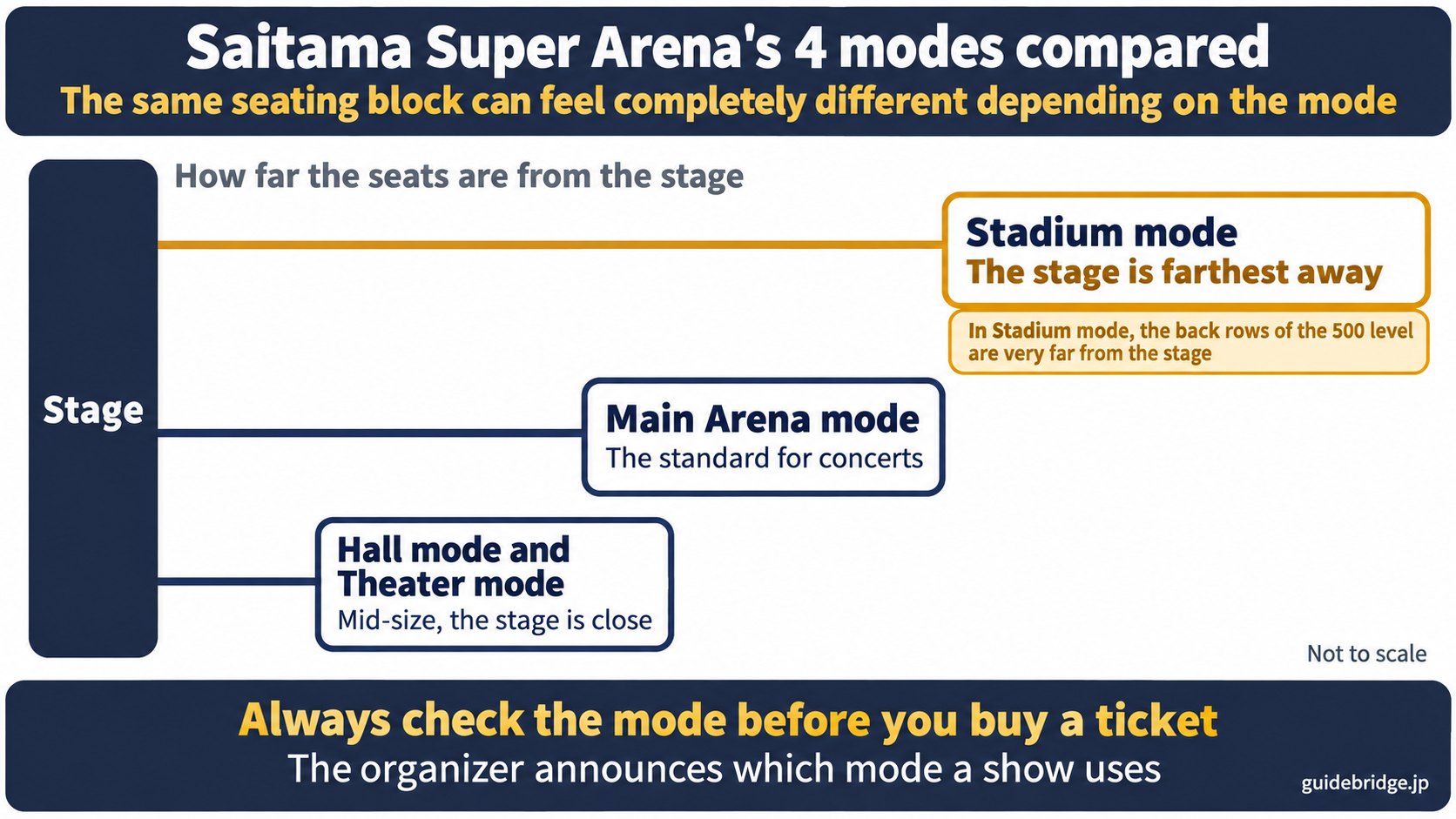
| Mode | Capacity | Used for | Stage position |
|---|---|---|---|
| Stadium mode | About 37,000 people | Large concerts, sports | North side / stage on the field |
| Main Arena mode | About 22,500 people | K-POP concerts, combat sports | North side / space adjusted with movable seats |
| Hall mode | About 6,000 people | Mid-size shows, ceremonies | Toward the center / compact space |
| Theater mode | About 5,000 people | Theater, ceremonies | Full proscenium (picture-frame stage) |
Stadium mode (capacity 37,000; the stage is farthest away)
Stadium mode is the largest layout, holding about 37,000 people. The stage is set up on the north side, on the field. At a K-POP concert held in Stadium mode, the back rows of the 500 level are very far from the stage, and it is hard to make out facial expressions without binoculars.
Main Arena mode (capacity 22,500; the standard for concerts)
Main Arena mode is the one K-POP concerts use most often. It holds about 22,500 people, and the movable seats are used to make the space more compact. Even with the same “second-floor A seat,” the stage is closer than in Stadium mode, but binoculars are still recommended from the 400 level up.
Hall mode / Theater mode (mid-size, the stage is close)
Hall mode holds about 6,000 people and Theater mode about 5,000, making them mid-size layouts. The stage moves toward the center and takes a proscenium (picture-frame) form, so your seat is closer to it. These modes are sometimes used for K-POP fan meetings and smaller shows.
How to choose binocular magnification for the 400 and 500 levels
Fans in Japan commonly bring binoculars to concerts. Decide on the magnification by combining your seat level with the show’s mode.
- 200 / 300 level: you can see without binoculars. They are just nice to have
- 400 level: 8–10x recommended. In Stadium mode, 10–12x
- 500 level: at least 12x is practically essential. In Stadium mode, image-stabilized binoculars are ideal
If you land a seat on the 400 or 500 level and show up without binoculars, you will spend the whole show knowing your favorite artist is right there without ever seeing their face. Preparing ahead is what makes the difference.
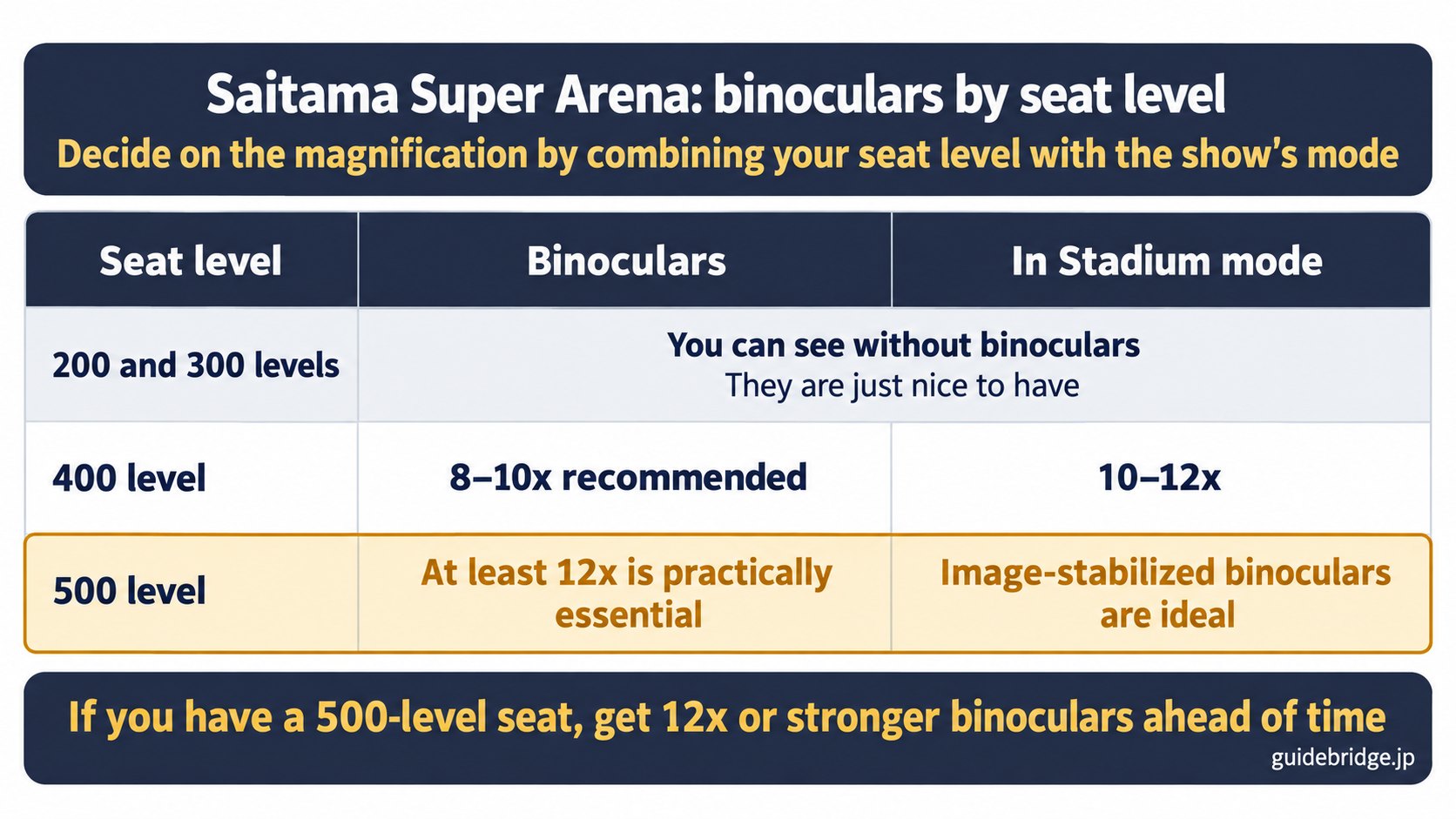
If you have a 500-level seat, getting 12x or stronger binoculars ahead of time saves you from regretting it on the day.
Hotels a 3 min walk away: how to skip the crowd after the show
Saitama Super Arena’s biggest strength is that several hotels are within a 3–7 min walk. If you skip the post-show crowd by heading straight to your hotel, you save a lot of energy on the day. You don’t need a hotel near the venue if you already have a room near Tokyo Station (about 30 min on the Ueno-Tokyo Line) or Ueno Station and are fine riding back with the post-show crowd from Saitama-Shintoshin Station, a 3 min walk away.
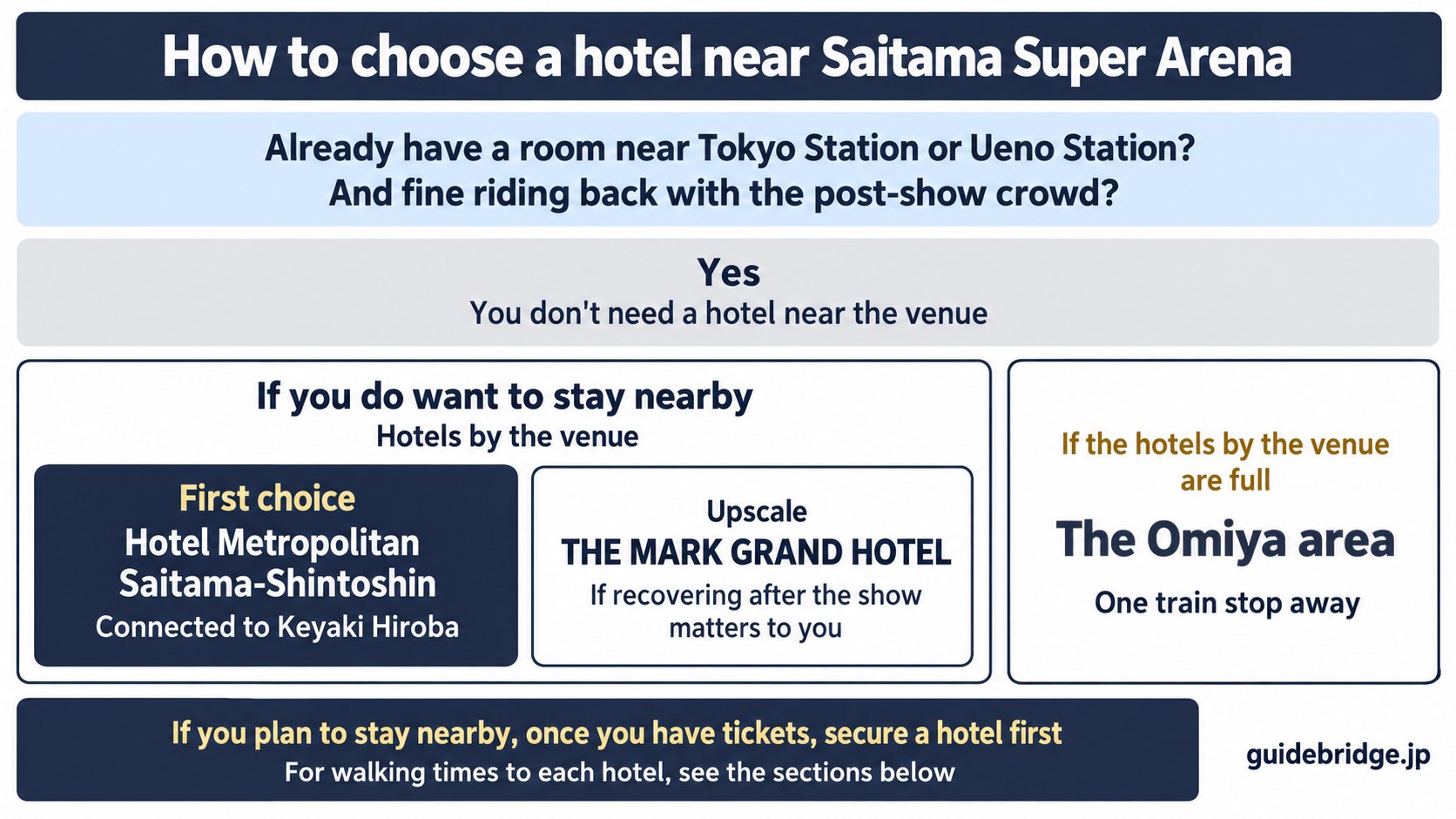
First choice: Hotel Metropolitan Saitama-Shintoshin (3 min walk, connected to Keyaki Hiroba)
Hotel Metropolitan Saitama-Shintoshin belongs to the JR East group and is just a 3 min walk from the arena, with a direct connection to Keyaki Hiroba. Its strength is that you can walk straight back to the hotel along the deck after the show. It also has a lot of rooms, so it tends to be comparatively easy to book even on K-POP concert days.
For the next morning, highway buses (airport limousine buses) to Haneda and Narita airports also run from Saitama-Shintoshin Station. That makes the hotel a handy stopover if you are heading to the airport.
Upscale: THE MARK GRAND HOTEL (formerly Rafre Saitama, rebranded in 2018)
THE MARK GRAND HOTEL, a 2 min walk from the arena, is an upscale hotel that was rebranded from its former name, Rafre Saitama, in 2018. It offers roomier guest rooms and a natural hot-spring bath on site, which suits you if recovering after the show matters to you. Searching for the old name, Rafre Saitama, often takes you to the same hotel, but its current official name is THE MARK GRAND HOTEL.
One train stop away: the Omiya area (Palace Hotel Omiya and others)
If the hotels around Saitama-Shintoshin Station are full, the realistic alternative is to widen your search to the Omiya Station area, 1 stop (about 2 min) away by train. The area around Omiya Station has plenty of shopping and places to eat, so you have more options at night too.
- Palace Hotel Omiya (3 min walk from Omiya Station)
- Urawa Royal Pines Hotel (5 min walk from Urawa Station)
If you stay at a hotel around Omiya Station, you go 1 stop back after the show on the Keihin-Tohoku Line or the Utsunomiya Line. The ride takes about 2 min.
Getting to the airport: highway buses from Saitama-Shintoshin to Haneda and Narita
Highway buses to Haneda Airport and Narita Airport run from Saitama-Shintoshin Station and Omiya Station. There are about 23 buses a day to Haneda and about 15 a day to Narita, which is a reasonable number of departures, and if you are heading to the airport the next morning you can board straight from near your hotel.
FAQ: quick answers for the “what do I do now?” moments on the day
Summary: 3 checks so Saitama Super Arena access doesn’t trip you up
Saitama Super Arena (nickname: GMO Arena Saitama) is scheduled to reopen in April 2027. Check these 3 points before and after you get your ticket, and you won’t run into trouble on the day.
- Station: the nearest is Saitama-Shintoshin (3 min walk). Walking from Omiya Station takes about 20 min, so if you get off at Omiya, take the train 1 stop (about 2 min)
- Mode: check the show’s mode before you buy a ticket. Even a seat you thought was in the Main Arena gets farther from the stage in Stadium mode (capacity about 37,000). On the 500 level, binoculars of at least 12x are practically essential
- Hotel: to skip the post-show crowd by going straight to your room, stay at Hotel Metropolitan Saitama-Shintoshin, a 3 min walk away, or in the Omiya area, 1 train stop away
You don’t need a hotel near the venue if you already have a room near Tokyo Station or Ueno Station and don’t mind the post-show crowd on the train back. If you plan to stay nearby, once you have tickets for a show after the April 2027 reopening, securing a hotel a 3 min walk away first gives you peace of mind.
Related guides: Tokyo Ariake Arena: getting home after a K-POP show / K-Arena Yokohama: getting home after a show
This page was produced from the Japanese original with AI assistance. Every number, station name and time was machine-checked against the Japanese source and its official references. If something is wrong, tell us here -> /en/contact/.