The show ends, and before you have had a moment to enjoy the afterglow, you are facing a wall of people that will not move. The official access guide puts Yokohama Station’s East Exit about 9 min from the venue on foot. After a show, that same walk typically takes 30-60 min, and in one case reported soon after the venue opened, reaching the ticket gates at Yokohama Station took 90 min. Miss your last train, and you can end up walking the night-lit Minatomirai waterfront looking for a restroom, then standing around until the first train of the morning. On top of that, the name “K-Arena Yokohama” is easy to confuse with two nearby venues, Yokohama Arena and Pia Arena MM, and each of the three has a different nearest station. So start with the one call that keeps you from heading for the wrong station.
This GuideBridge guide is a decision aid for getting home from K-Arena Yokohama without getting stuck. No hype and no guesswork: based on official information and several on-the-ground accounts, it sets out only what you need to decide your exit route, your timing and where to sleep. It also sorts out how this venue differs from Yokohama Arena and Pia Arena MM, which people often mix up.
- The 4 stations to choose from when you leave (Shin-takashima, Minatomirai, Takashimacho and Yokohama), with the real walking times and crowd levels for each
- How to decide whether to leave 30 min before the end of the show, or to stay 1 hour and head out later
- Where to go for the night in Minatomirai or around Yokohama Station’s East Exit if you miss the last train
- How this venue differs from Yokohama Arena and Pia Arena MM (all three say “Yokohama,” but the venues and nearest stations are different)
- Why a hotel with 24-hour check-in works as insurance, so a missed last train does not throw you
Structurally, this venue is an arena type: a flat arena floor surrounded by raked stands, so how easy it is to get home depends on how heavily the venue relies on a few stations and lines. I explain how to read each type of venue in our guide to concert venue types (Japanese only for now).
Getting home from K-Arena Yokohama: the 3 worst cases, and who they happen to
K-Arena Yokohama opened in September 2023. With 20,033 seats, it is one of the largest music-only arenas in the world. As a venue it is very well made, yet one weakness has come up again and again since it opened: getting home. Start by knowing the 3 worst cases that can happen.
I have been to a show at K-Arena Yokohama myself. On the way in, a long line ran around the back of the arena, and from reaching the building to getting through an entrance took me close to 30 min. After the show the crowd was even denser; however far I walked, I hardly seemed to move forward. In the end, someone happened to step out of a taxi right in front of me, so I jumped in and rode to Yokohama Station. Without that night, I might never have written this guide. Plan your way home the moment you get your ticket.
Why a 9-minute walk to Yokohama Station turns into 30-60 min or more
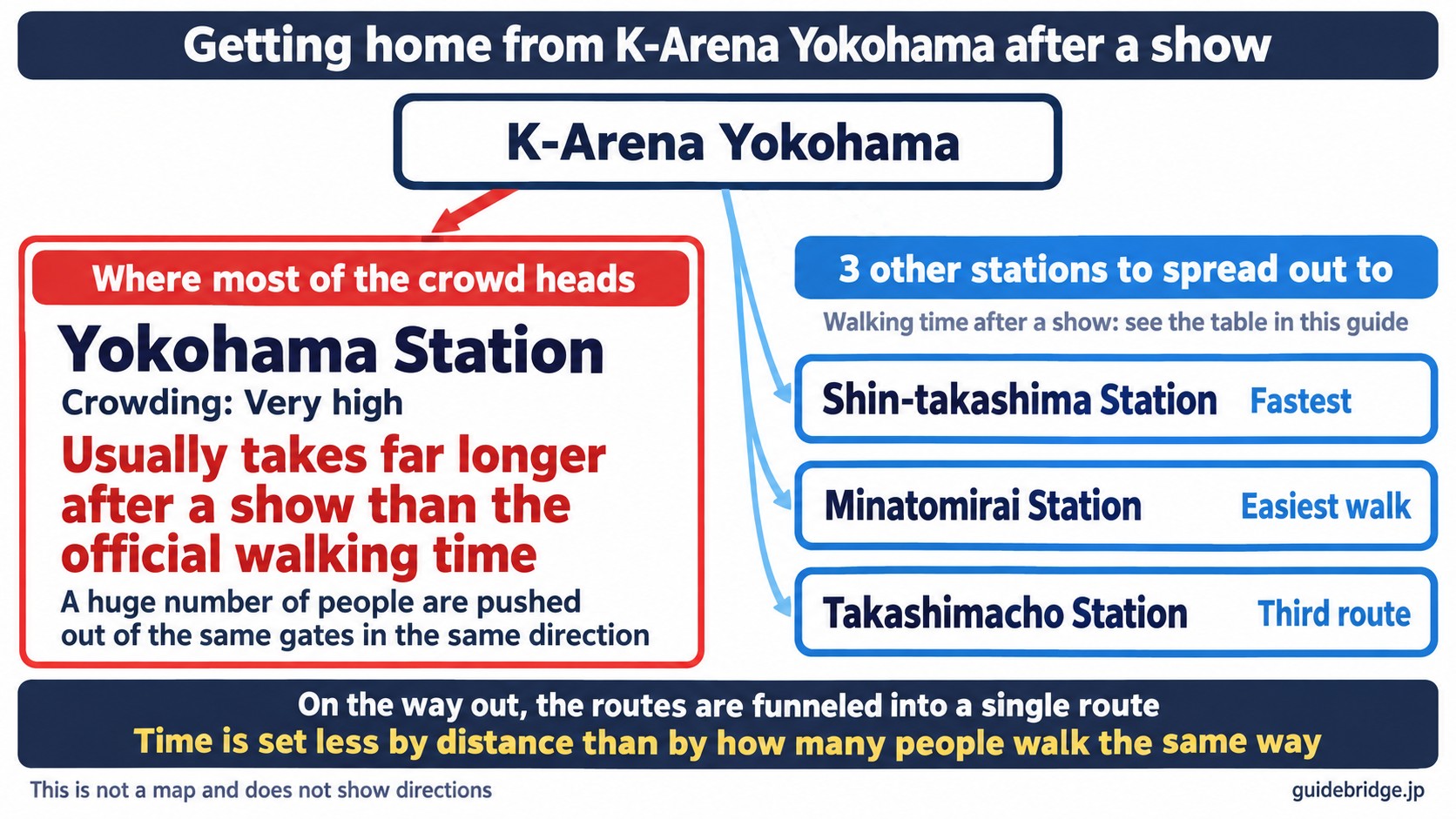
The official access guide says it is about a 9 min walk to the East Exit of Yokohama Station (JR and other lines). Yet when you compare several blogs that tested the route with fans’ own accounts, the real time straight after a show is usually 30-60 min, and in one case soon after the venue opened, reaching the ticket gates at Yokohama Station reportedly took 90 min.
The reason is simple. On the way out, the several routes you could use on the way in are funneled into a single route. On top of that, most of the crowd heads for Yokohama Station. So the time it takes is set less by the walking distance than by how many people are walking the same way as you.
With staggered exit, the upper seats (Level 7) wait the longest
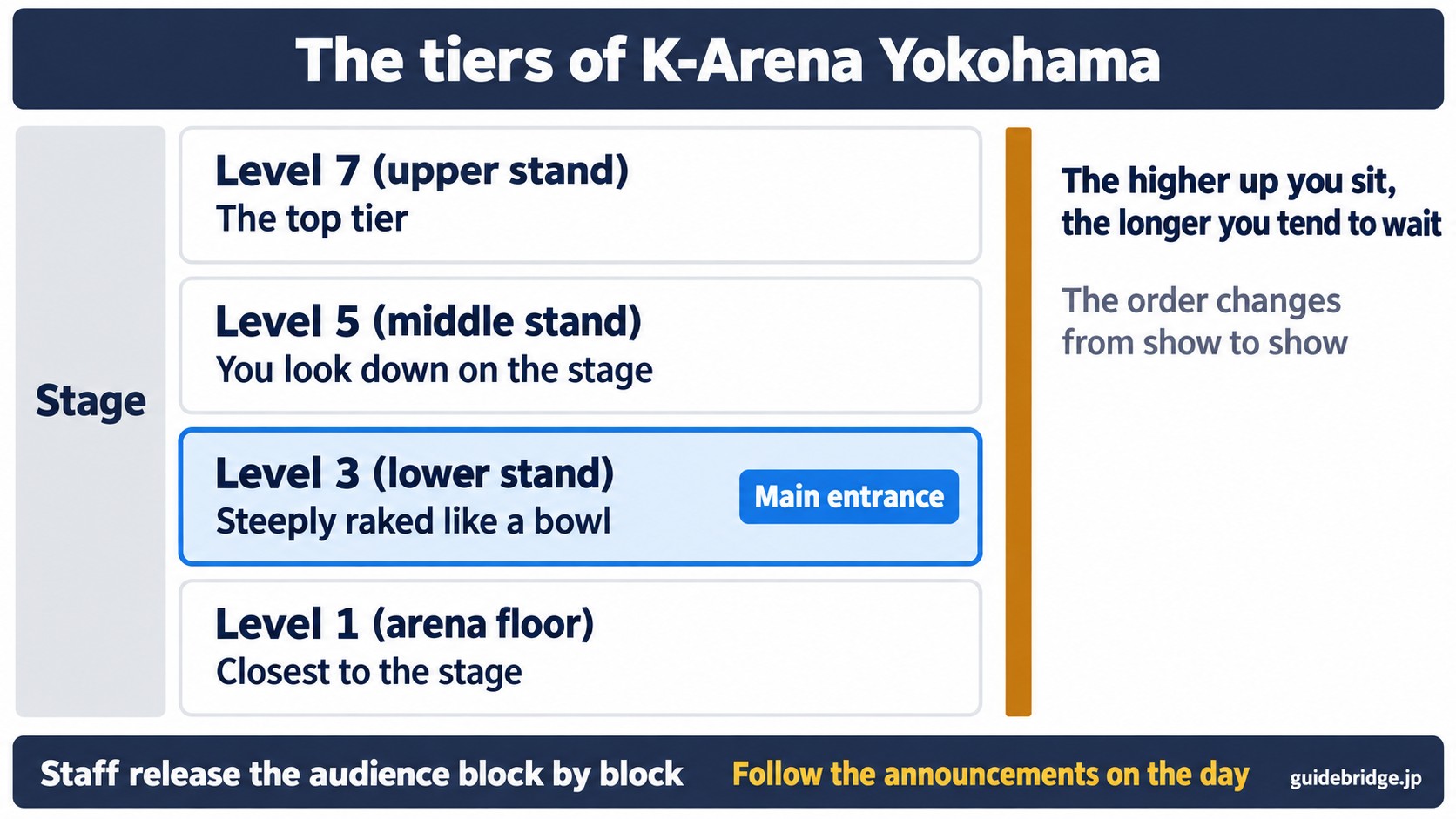
K-Arena Yokohama has 4 tiers: Level 1 (arena floor), Level 3 (lower stand), Level 5 (middle stand) and Level 7 (upper stand). Staff release the audience block by block, so the higher your seat, the later you tend to get out, and Level 7 is the highest. If your show ends close to the last train and your only plan is to walk from Level 7 to Yokohama Station, your margin shrinks fast.
Last train missed, no restroom, standing around until the first train
The other way to get stuck is having no plan once the last train is gone. Restrooms inside the venue are crowded before and after the audience leaves, and many stores in the shopping complexes on the Minatomirai side close around 22:00, so the restrooms you can use late at night disappear quickly. If 23:00 comes and you still have no room booked, whether a hotel with 24-hour check-in still has a room depends on the night, and you can end up standing around with no clear way forward.
What gets you stuck on the way home from K-Arena Yokohama is not distance. It is 3 layers stacked together: (1) one exit route with most of the crowd heading for Yokohama Station, (2) the exit order for Level 7, and (3) a missed last train with no room. The sections below take these 3 layers apart one by one.
Of these 3, the third (missed last train, then no room) cannot be fixed on the day itself. Decide before the show whether you will stay the night or go home, and that problem disappears entirely. Which is right for you depends on when your show ends, your seat level, your plans for the next morning and your budget. Before you read on about stations, timing and hotels, settle that one decision. Our separate guide on whether to stay overnight for K-Arena Yokohama is in Japanese only for now.
Venue basics, and the level layout that shapes how you get out
Before planning your exit, get the layout of the building in your head. K-Arena Yokohama is a music-only arena built so that every seat faces the stage, and both the exit route and the view change from level to level.
20,033 seats on 4 tiers (Levels 1, 3, 5 and 7)
- Level 1 (arena floor): closest to the stage. The floor is flat, so unless you are near the front, your sightline depends a lot on where you sit.
- Level 3 (lower stand): steeply raked like a bowl, with a good view of the whole stage. The main entrance is on this level.
- Level 5 (middle stand): you look down on the stage, which makes the whole show easy to take in.
- Level 7 (upper stand): the top tier. The performers look small, but you get the full beauty of the staging. Binoculars change everything up here.
Seating capacity is 20,033. The fact that the main entrance is on Level 3 is the key to understanding how the crowd leaves.
How the crowd leaves through the main entrance (Level 3)
Pedestrian routes outside the venue are laid out around the main entrance on Level 3. On the way in, you can enter from several directions. On the way out, though, the routes are narrowed for crowd safety, so a huge number of people are pushed out of the same gates in the same direction. This is the main reason the crowd on the Yokohama Station side gets so dense.
What staggered exit means for Level 7
Large Japanese venues often use staggered exit (kisei taijo): staff hold the audience in their seats and release them block by block. Under this system, the higher levels tend to be released later, so if you sit on Level 7, expect a longer wait before you can move. The order changes from show to show, so follow the announcements on the day. How you use that wait (merchandise, the restroom, packing away your binoculars) changes how efficiently you move once you are released.
Once your seat is assigned, half of your exit plan is already decided. On Level 7, plan your time on the assumption that you will stay behind. On Levels 1-3, choose your station on the assumption that you can move as soon as the show ends. The next section turns that station choice into specifics.
The heart of this guide: 4 stations compared, and the case for skipping Yokohama Station
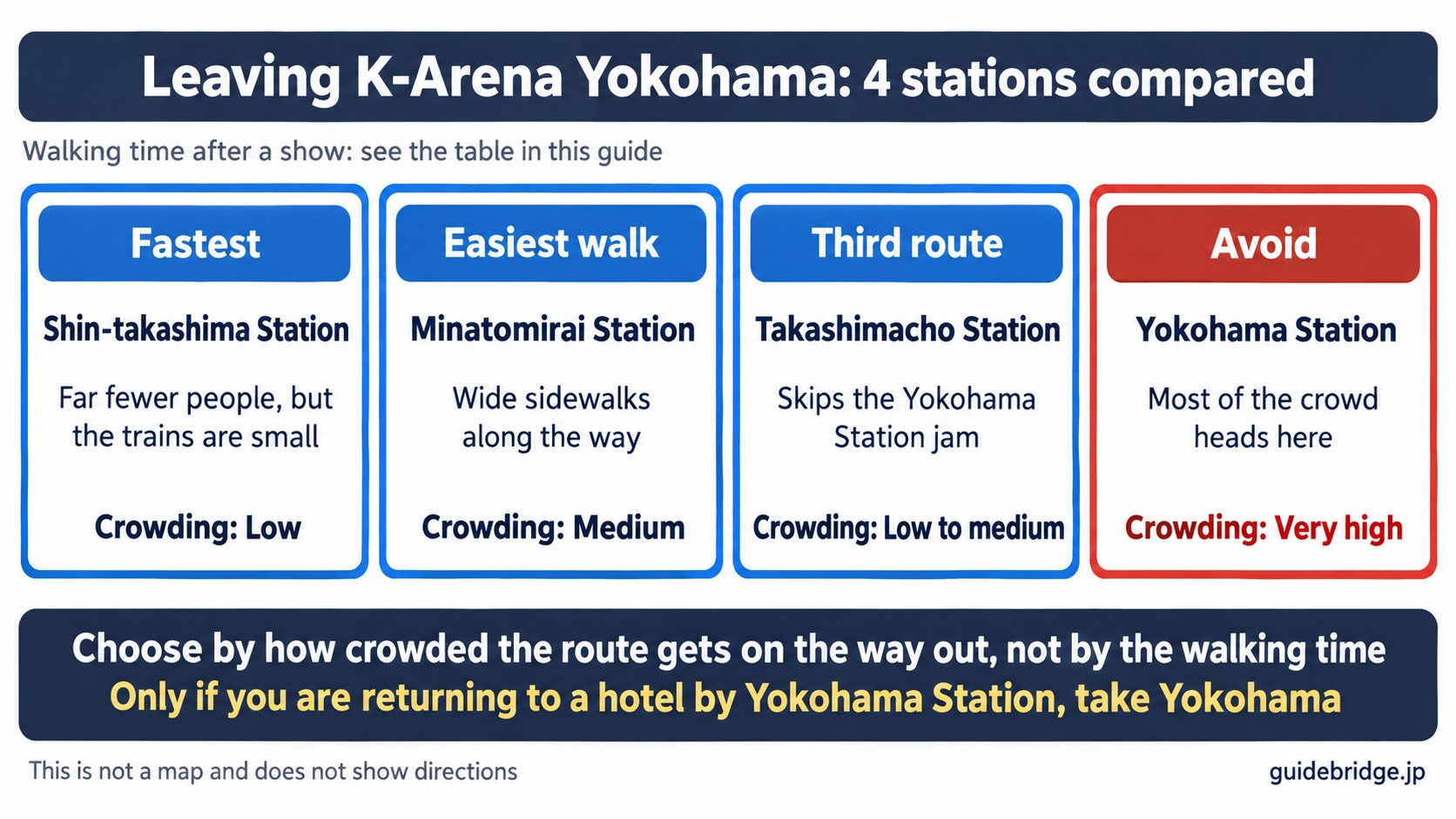
The single most effective move for getting home from K-Arena Yokohama is to not choose Yokohama Station. For orientation: Minatomirai is the redeveloped waterfront district where the venue stands, and Yokohama Station is the big terminal where JR and several private railways meet. The official access guide lists 3 stations (Yokohama Station’s East Exit, Shin-takashima and Minatomirai). In practice, though, the real decision is how to use 4 stations, adding Takashimacho Station on the Yokohama Municipal Subway Blue Line.
| Station | Walk after a show | Crowding | Train capacity | Line | Verdict |
|---|---|---|---|---|---|
| Shin-takashima | about 8 min | Low | Small | Minatomirai Line | Fastest |
| Minatomirai | 10-12 min | Medium | Medium | Minatomirai Line | Easiest walk |
| Takashimacho | about 15 min | Low to medium | Medium | Blue Line | Third route |
| Yokohama | 30-60 min+ in practice | Very high | Large | JR / Keikyu / Sotetsu and others | Avoid |
Shin-takashima (新高島): about 8 min and overlooked, but the trains are small
The official guide puts it about 5 min on foot from Exit 4 (the Rinko Park exit) of Shin-takashima Station, and even when leaving after a show it takes about 8 min, the shortest of the 4. It is a stop partway along the Minatomirai Line, and its strength is that far fewer people head this way than toward Yokohama Station. On the other hand, the platform and the trains are not large, so if a big crowd arrives at once, you may have to let one train go before you can board. It suits people who can move before the encore, or who sit on Levels 1-3 and can join the exit flow early.
- At the show on your own and traveling light
- On Levels 1-3, able to move ahead of the staggered-exit wave
- Trying to make a last train with very little margin
- Just heading back to a hotel on the Minatomirai side
Who should avoid it: anyone with a large suitcase, and groups who want to keep pace with each other.
To walk there, leave the main entrance (Level 3), turn your back on Rinko Park and the sea, and head inland, going left along Icho-dori (いちょう通り). The sidewalk is fairly wide, and at the fork, look for signs to “Shin-takashima Exit 4.” Covered stretches are few, so bring an umbrella if it rains; rain makes the walk feel about 10% longer. The crowd is heaviest from the end of the show to 30 min after, and once 40 min have passed, the line on the platform has mostly cleared.
Minatomirai (みなとみらい): wide sidewalks and one of the easiest walks of the 4
The official guide says about 12 min on foot, and when leaving after a show it takes 10-12 min. It is farther than Shin-takashima, but the sidewalks are wide and there are restrooms and convenience stores in the shopping complexes along the way, so it is among the easiest walks of the 4. It suits people heading back toward Shibuya (the Tokyu Toyoko Line runs through from the Minatomirai Line), people staying in Minatomirai, and groups with older people or children.
- In a group that wants to walk at the same pace
- Carrying a lot (light sticks, photo cards, merchandise) and wanting your hands free
- Heading back toward Shibuya or Ikebukuro on the Tokyu Toyoko Line through service
- On Levels 5-7, where you will be released later
It also suits anyone who cares more about having energy left the next morning than about making the last train.
To walk there, start from the front of the main entrance and follow Icho-dori toward the high-rises around Landmark Tower. While the covered deck through Queen’s Square and Landmark Plaza is open (until about 23:00), less of the walk is out in the rain. The crowd is heaviest from the end of the show to 40 min after. The wide sidewalks keep it from feeling jammed, and after 40-50 min it is mostly back to normal.
Takashimacho (高島町): the third route, past the Yokohama Station jam to the Blue Line
Takashimacho Station on the Yokohama Municipal Subway Blue Line is a little far at about 15 min on foot, but as a third route it lets you skip the Yokohama Station jam, where the Minatomirai Line, JR and Keikyu all converge. It is a strong option if you want to head toward Shin-Yokohama or Kannai, or if you plan to catch a Shinkansen the next morning. (The Shinkansen stops at Shin-Yokohama, not at Yokohama Station, and the Blue Line takes you there without changing trains. Shin-Yokohama is also the station for Yokohama Arena, a different venue.)
- Taking an early Shinkansen home from Shin-Yokohama the next morning
- Staying on the Kannai or Sakuragicho side
- More interested in staying clear of the Yokohama Station jam than in catching the last train
- At the show on your own and happy to walk
The Blue Line’s first and last trains run at different times from the Minatomirai Line, so check the official timetable again on the day of the show.
To walk there, start out in the direction of Minatomirai Station, then follow the main road south toward the Takashimacho intersection. The sidewalk is paved the whole way, but there is almost no cover. In the rain, plan on the walk feeling close to 20 min. Crowds here build later than at Shin-takashima and Minatomirai, with a second wave 30-50 min after the show ends.
Yokohama (横浜): 9 min officially, 30-60 min in practice, and why not to choose it
Finally, here is the case for not choosing Yokohama Station. The official access guide puts the East Exit about 9 min away on foot. After a show, though, you hit 4 choke points in a row: staggered exit, then a single exit route, then the traffic lights around the East Exit, then the jam in front of the ticket gates. In practice it takes 30-60 min, and at worst there is a report of 90 min.
The exception: if you booked a hotel near Yokohama Station because you are heading for a Shinkansen (from Shin-Yokohama), the Sotetsu Line or Shonan the next morning, going straight back to it at the East Exit is the right call (more on this in the section on where to stay).
- Just heading back to a hotel within walking distance of Yokohama Station’s East Exit or YCAT (the airport bus terminal at the East Exit)
- Heading somewhere only Yokohama Station serves after the show (a stop on the Sotetsu Line, or toward Shonan)
The usual detour route runs via the Portside district and the Takashima Waterfront Deck (高島水際線デッキ), but conditions change over time, so the signs posted on the day of your show come first.
The crowd is thickest from the end of the show to 60 min after, and if you aim for that window, you join a wait of 30-60 min or more. If instead you leave 30 min before the end, or stay 60 min or longer before moving, the same Yokohama Station route feels very different.
Three things decide your station: (1) your seat level (will you be released late?), (2) how fast your companions walk, and (3) where you are heading the next morning. On Levels 1-3 and on your own, take Shin-takashima. With companions, take Minatomirai. For a Shinkansen, take Takashimacho. Only if you are returning to a hotel by Yokohama Station, take Yokohama. These 4 cases cover what you need.
After-show timeline: leave 30 min early, or stay 1 hour?
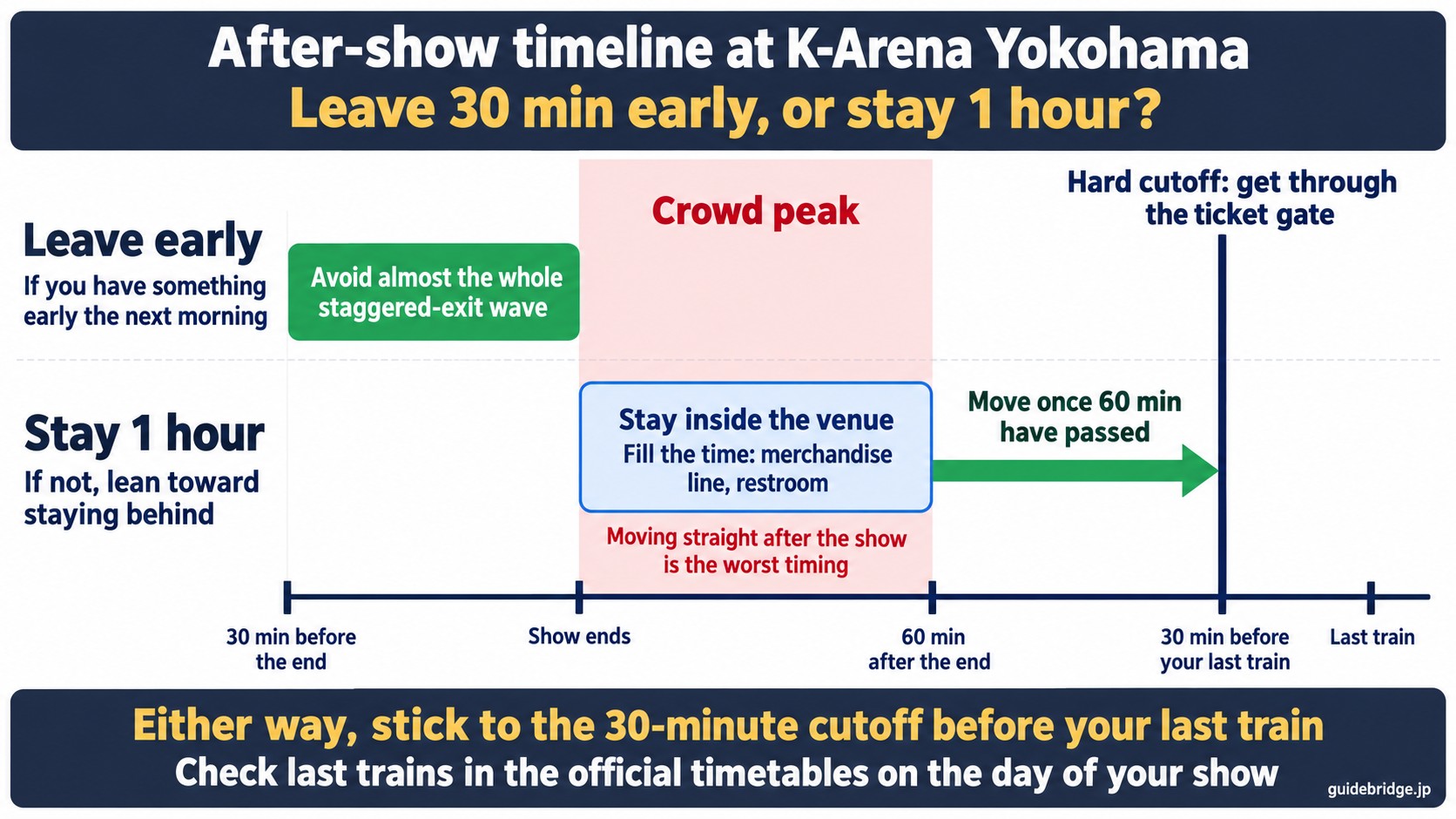
Once your station is chosen, plan the timing. In Japan, the last train (shuden) is the final train of the day on each line; miss it, and there are no trains until the first one the next morning. Getting home from K-Arena Yokohama comes down to 2 strategies: leave 30 min before the show ends, or spend 1 hour inside the venue after it ends and head out later. Know one thing first: moving straight after the show, the middle option, is the worst timing of all.
Leaving 30 min before the end: is the encore worth giving up?
Leave your seat 30 min before the show ends, and you avoid almost the whole staggered-exit wave. The upside is clear: whichever station you choose, crowding drops by 1-2 notches, and the worry about the last train almost disappears. The downside is the emotional cost of walking out during the encore. The safe way to decide is mechanical: do you have something early the next morning (a first-train trip or a Shinkansen)? If yes, leave early; if no, stay behind. Decide in advance and you will not waver.
Staying 60 min after the end: how to use the time inside
If you stay 1 hour instead, do not just sit in a daze. Fill the time with things to do: the merchandise line, the restroom, packing away your binoculars, posting on social media, online check-in for your flight the next morning. After 60 min, the worst of the crowd has passed. Staying behind suits people on Levels 5-7 who will be released late anyway, people not leaving until midday or later the next day, and people staying in Minatomirai within walking distance.
How to stick to the 30-minute cutoff before your last train
Check the last weekend and holiday trains on the Minatomirai Line, JR and Keikyu in the official timetables on the day of your show. Whichever line you use, the simple, reliable rule is this: get through the ticket gate at your station no later than 30 min before your last train, and treat that as a hard cutoff. If it looks like you will miss it, stop waiting at that point and switch to a hotel.
If it rains, or staggered exit runs late
Covered routes are few, and in the rain, walks feel 1.2-1.5 times longer. A folding umbrella or a rain poncho is essential. If staggered exit runs later than expected and you are about to miss your 30-minute cutoff, decide on the spot: a taxi (taxis are available late at night on the Yokohama Station East Exit side), or switch to a hotel within walking distance of the venue. The longer you hold out, the fewer options you have.
Moving with the crowd straight after the show is the worst move. If you have something early the next morning, lean toward leaving early; if not, lean toward staying behind. Either way, stick to the 30-minute cutoff before your last train. Settle these 3 points in advance, and you will not lose time deciding on the day.
Where to stay if you miss the last train, or want to avoid racing for it
This section is for anyone staying the night in Yokohama. The strongest insurance for getting home from K-Arena Yokohama is to keep “not heading back tonight” on the table from the start. Especially when the show ends close to the last train, or you have something early the next morning, planning around a hotel from the start beats chasing the last train on sleep, luggage and getting around.
Staying in Minatomirai: walk back from the venue, take the train in the morning
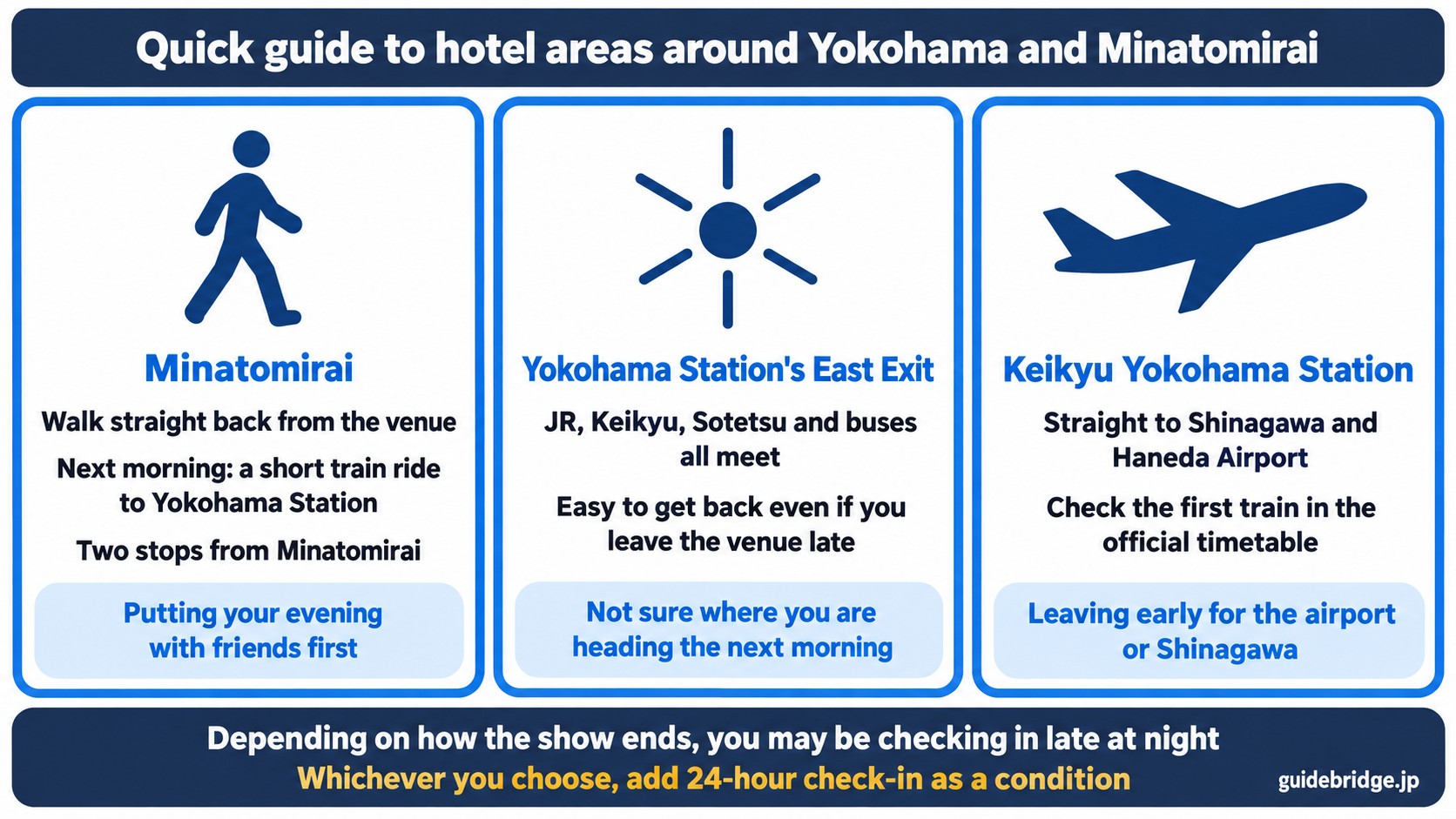
The big advantage of a hotel within walking distance of Minatomirai or Shin-takashima Station is that you can walk straight back from the venue. Check in right after the show, and you can drop your bags and go out to eat in the shopping complexes. The drawback: heading to Yokohama Station or a JR line the next morning means a short train ride (two stops from Minatomirai, one from Shin-takashima). If you are leaving early, build that ride into your plans when you choose the hotel.
Staying by Yokohama Station’s East Exit: a hub for every direction the next morning
Yokohama Station’s East Exit is a hub where JR, Keikyu, Sotetsu and buses to many places all meet. Whichever way you are heading the next morning (a Shinkansen from Shin-Yokohama, the airport, somewhere along the Sotetsu Line), it is easy to get there, and even if you leave the venue late, it is easy to get back. A hotel within walking distance of Yokohama Station is the first choice for anyone not yet sure where they are heading the next morning.
Staying near Keikyu Yokohama Station: the fastest start toward Shinagawa and Haneda
From Keikyu’s Yokohama Station, Airport Express and KAITOKU trains (two of Keikyu’s service types) run straight to Shinagawa and Haneda Airport. If you need to leave early for the airport or Shinagawa, a hotel within walking distance of Keikyu Yokohama Station suits you. Check the first train in the official timetable.
Why 24-hour check-in matters
If staggered exit runs late and you eat on the Minatomirai side before going back, checking in at 23:00-24:00 or later is not unusual. Some hotels in Japan stop accepting check-in after a set time, so when you choose, make 24-hour check-in one of your conditions, and a late finish will not throw off your plans.
Depending on how the show ends, you may be checking in late at night. Just knowing you have somewhere to sleep even if you miss the last train makes a big difference to how calm you feel on the day. Book your room at the same time you secure your ticket.
Not sure where you are heading the next morning: stay within walking distance of Yokohama Station’s East Exit. Putting your evening with friends first: stay within walking distance of Minatomirai. Leaving early for the airport or Shinagawa: stay within walking distance of Keikyu Yokohama Station. Whichever you choose, add 24-hour check-in as a condition.
You don’t need a hotel near the venue if you leave 30 min before the end, or wait out the crowd, and still get through the ticket gate 30 min before your last train. Otherwise, the search below covers hotels around Minatomirai, a walk from the venue. Check each hotel’s check-in hours before you reserve.
If you are still torn on whether to stay or go home: K-Arena Yokohama is a venue where most of the crowd heads for Yokohama Station after the show, which is what makes getting home hard. Whether to stay in Minatomirai (right by the venue), around Yokohama Station or in Shin-Yokohama, or to skip the hotel and go home, depends on when your show ends, your plans for the next morning and your budget. Our separate stay-or-go guide for K-Arena Yokohama is in Japanese only for now.
What to pack: gear for the trip home and for the show
The best gear does two jobs: it helps on the walk home from K-Arena, and it makes the show itself more comfortable. Every extra item makes the crowded walk after the show heavier.
What helps on the way home
- Power bank: light-stick effects during the show, photos, and navigation on the way home all drain your battery. Bring one rated at 10,000mAh or more.
- Folding umbrella or rain poncho: the covered stretches from K-Arena to each station are few.
- Travel slippers or thick socks: whether you can rest your feet the moment you get back to your room affects how much energy you have the next morning.
- A small tote bag: carrying merchandise in the paper bags it came in slows you down at the ticket gates. Sling a bag over your shoulder and keep both hands free.
Binoculars (for the upper levels and Stand by Me seats)
If your ticket is on Level 5 or 7, or in the extra rear seats K-Arena Yokohama calls “Stand by Me” seats, binoculars make a real difference to the whole show. A light model with image stabilization will not weigh down your bag.
Light sticks and a photo card case
Light sticks and photo cards are the things most likely to get bent or crushed in your bag on a crowded walk home. Choose a small hard case from the start, one that other things in your bag cannot press on, and you will have fewer problems getting them home.

Power bank (about 10,000mAh)
From light-stick effects during the show to a night walk around Yokohama and navigation home, it keeps your phone from dying over a long day. About 10,000mAh with fast charging (USB PD) is the standard choice. These are Japanese stores: prices are in yen and delivery is within Japan.

Binoculars (image-stabilized, lightweight)
Essential gear for seeing your favorite’s face from Levels 5-7 at K-Arena Yokohama. Most popular models weigh about 200 g, light enough to keep around your neck all show. These are Japanese stores: prices are in yen and delivery is within Japan.

Photo card case (carry-on size)
A hard case that keeps your favorite photo cards from bending or getting dirty. Pick a size that does not take up much room in your bag. These are Japanese stores: prices are in yen and delivery is within Japan.
Choose what to bring for both a comfortable trip home and a better show. A power bank, a folding umbrella, binoculars and a photo card case are the 4 items worth bringing to any show. Keeping your load light is your insurance for having energy left after the show.
FAQ: 5 common questions
Summary
Getting home from K-Arena Yokohama is not a question of distance. It comes down to 3 calls: (1) your station (avoid Yokohama Station), (2) your timing (do not move straight after the show), and (3) a hotel as insurance (24-hour check-in). And K-Arena Yokohama, Yokohama Arena and Pia Arena MM may have similar names, but they are different venues with different routes. Match the venue name with its nearest station at the start, and you will not head for the wrong station on the day.
Plan the way home first, so you carry the afterglow home with you. That one step is always the key to getting the most out of a night at K-Arena Yokohama.
The station and hotel information in this guide is as of October 2026. For the latest, check stations on the access page of the K-Arena Yokohama official website and in the official timetables of the Minatomirai Line, JR, Keikyu and the Yokohama Municipal Subway Blue Line, and check hotels on each hotel’s booking page.
Note: once you have missed the last train, whether a room is still free depends on the night. Looking at one fallback hotel before you go is insurance that works even if you do not plan to stay.
Note: if you have traveled from farther away in Japan, such as the Kansai or Tokai regions, an overnight bus from Yokohama or Tokyo is another way home that does not depend on the last train.
Related guides
Our guides to getting home from Pia Arena MM, and our comparison of the trip home from 12 arenas across Japan, are in Japanese only for now.
This page was produced from the Japanese original with AI assistance. Every number, station name and time was machine-checked against the Japanese source and its official references. If something is wrong, tell us here -> /en/contact/.