The hard part of a Belluna Dome show is the 1–1.5 hours between the last song and the moment you are on a train at Seibu-Kyujo-mae (西武球場前). Concerts end around 20:30. Exit is released block by block; at one show that took about 45 min. The single road to the station jams, and you queue again outside the ticket gates. On the platform you watch 2–3 packed trains leave without you. Both lines here are single-track, so about 8 trains an hour is the ceiling even with extra services.
The building is what makes this different from Japan’s other big domes. It has a roof, but open sides and no air conditioning. Tokyo Dome, Kyocera Dome, Vantelin Dome, PayPay Dome and Sapporo Dome are all sealed, climate-controlled buildings. Here you wait in the weather: a sauna in a humid Japanese summer, close to the outside temperature on a winter night. Behind both problems sits a deadline — the last train, and the Leo Liner, which finishes earlier still.
This guide runs the trip home on one timeline: Seibu-Kyujo-mae or Shimoyamaguchi (下山口), the post-show clock, the choice between travelling home the same night, staying the night after or arriving the night before, what to carry, and where to sleep in Tokorozawa (所沢) or Ikebukuro (池袋).
- The standard timeline from the last song to boarding
- Seibu-Kyujo-mae or Shimoyamaguchi: the “can you wait” test
- Taxis, shuttle buses and leaving early as ways to cut the wait
- Working backwards from the last train and the Leo Liner’s early finish
- Summer and winter kit, graded by how long you stand still
- Hotels in Tokorozawa and Ikebukuro, and a flow by where you start
The last-train times for the Seibu Sayama Line and the Leo Liner, and the usual finishing time of shows, are a guide as of May 2026, when the Japanese original was first published. For the latest, check the timetables on Seibu Railway’s official website. These times change with timetable revisions, and you can check any extra trains on show days from the station’s notices on the day.
Start here: three reasons the way home is unlike the other domes
Belluna Dome opened in 1979 as the Seibu Lions’ ground; the roof came in 1997. It stands in Tokorozawa, Saitama — north-west of central Tokyo, not in the city. Capacity is about 28,000 for baseball, and moves with the stage layout for concerts. The name has changed repeatedly: as of May 2026 it is Belluna Dome, and the naming-rights contract ends at the end of February 2027. Older signs and search results still carry earlier names, so check the current one before you travel.
Three things make the way home structurally different from Japan’s other 5 big domes. First, the semi-open build: a roof, open sides where the walls would be, and no air conditioning. Second, Seibu-Kyujo-mae is a single-track terminus, so the main route out is one channel. Third, a 21:00 sound curfew fixes the finish at around 20:30. These are not three problems. They are one timeline.
For the same question venue by venue, see Japan’s 5 big domes, compared on the trip home.
A semi-open building with no air conditioning, a single-track terminus, and a finish around 20:30. The next section turns that into a clock.
After the show: the standard 1–1.5 hours to a train at Seibu-Kyujo-mae
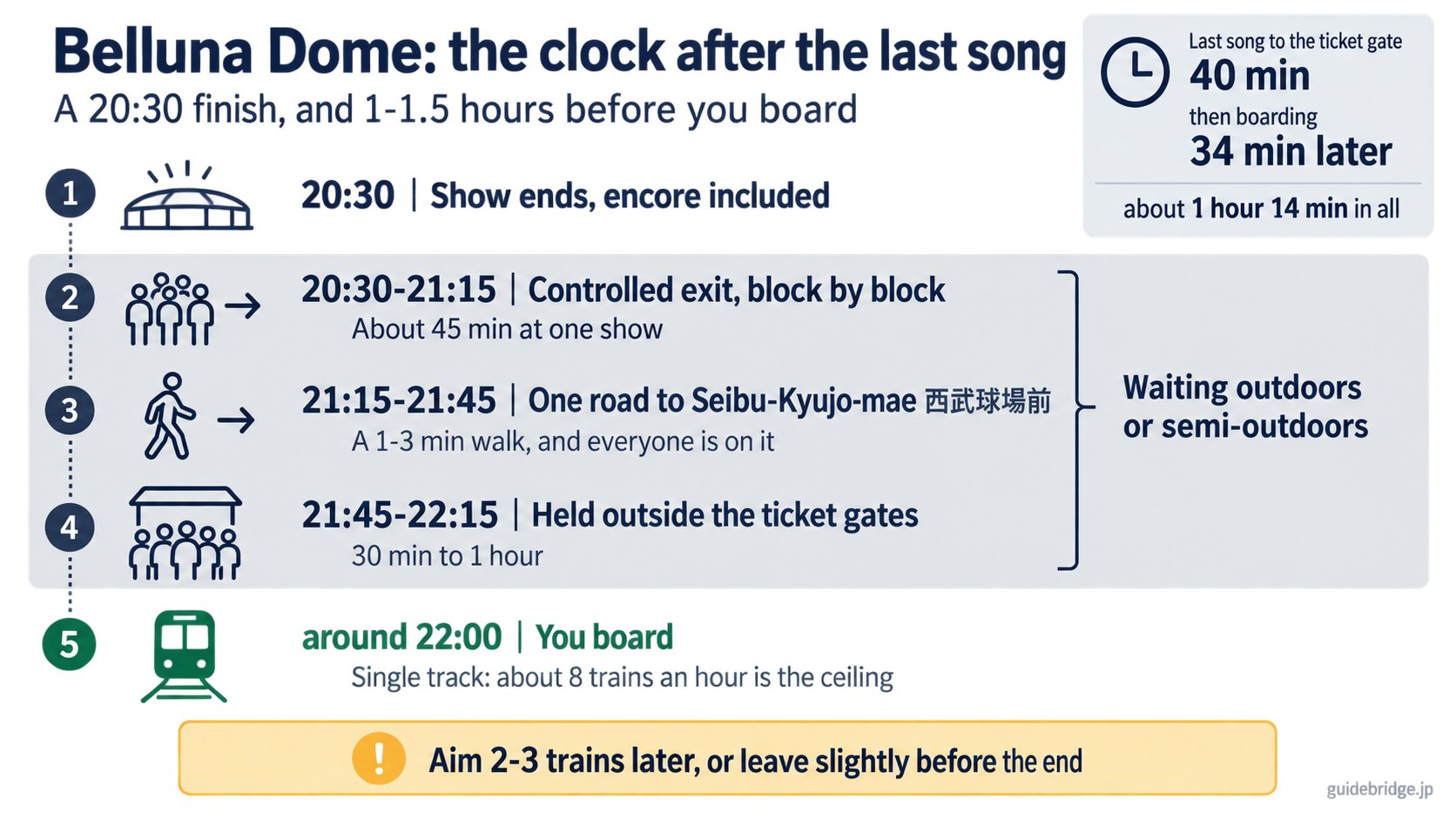
Put the finish at 20:30 and the standard is 1–1.5 hours before you board at Seibu-Kyujo-mae. That time has four stages: controlled exit, the single road, the gate queue, and the platform.
Controlled exit holds you in your seat for about 45 min
Large Japanese venues empty block by block: an announcement calls each seating section in turn, and you stay put until yours is called. You cannot simply walk out when the lights come up. At one show the full sequence took about 45 min. The order follows the announcements on the day, so assume you are not moving straight away.
The single road and the gate queue: 30 min to 1 hour
The venue is a 1–3 min walk from Seibu-Kyujo-mae along one road, and tens of thousands of people funnel onto it at once. At the station you are held outside the ticket gates, commonly 30 min to 1 hour. Seibu-Kyujo-mae is a single-track terminus, so even with extra services the ceiling is about 8 trains an hour. Rapid services to Ikebukuro are laid on, but no timetable moves tens of thousands of people quickly.
One measured example: about 1 hour 14 min to boarding
In one first-hand account, the last song to the ticket gate took 40 min, and boarding came 34 min later — about 1 hour 14 min in all. Two things shorten it: letting 2–3 trains go and taking a later one, or leaving slightly before the end and skipping the controlled exit. About an hour and a half after the finish the station calms down, so shift the wait rather than endure it.
Controlled exit of about 45 min, plus the road, the gate queue and the platform, adds up to 1–1.5 hours. Aiming 2–3 trains later cuts that more than queueing harder does.
Seibu-Kyujo-mae or Shimoyamaguchi: the answer depends on whether you can wait
Many pages say “walk to Shimoyamaguchi to avoid the crowd” and stop there. The answer actually moves with two things you can check yourself: whether you can wait 1–1.5 hours after the show, and whether you can walk 15–20 min at night.
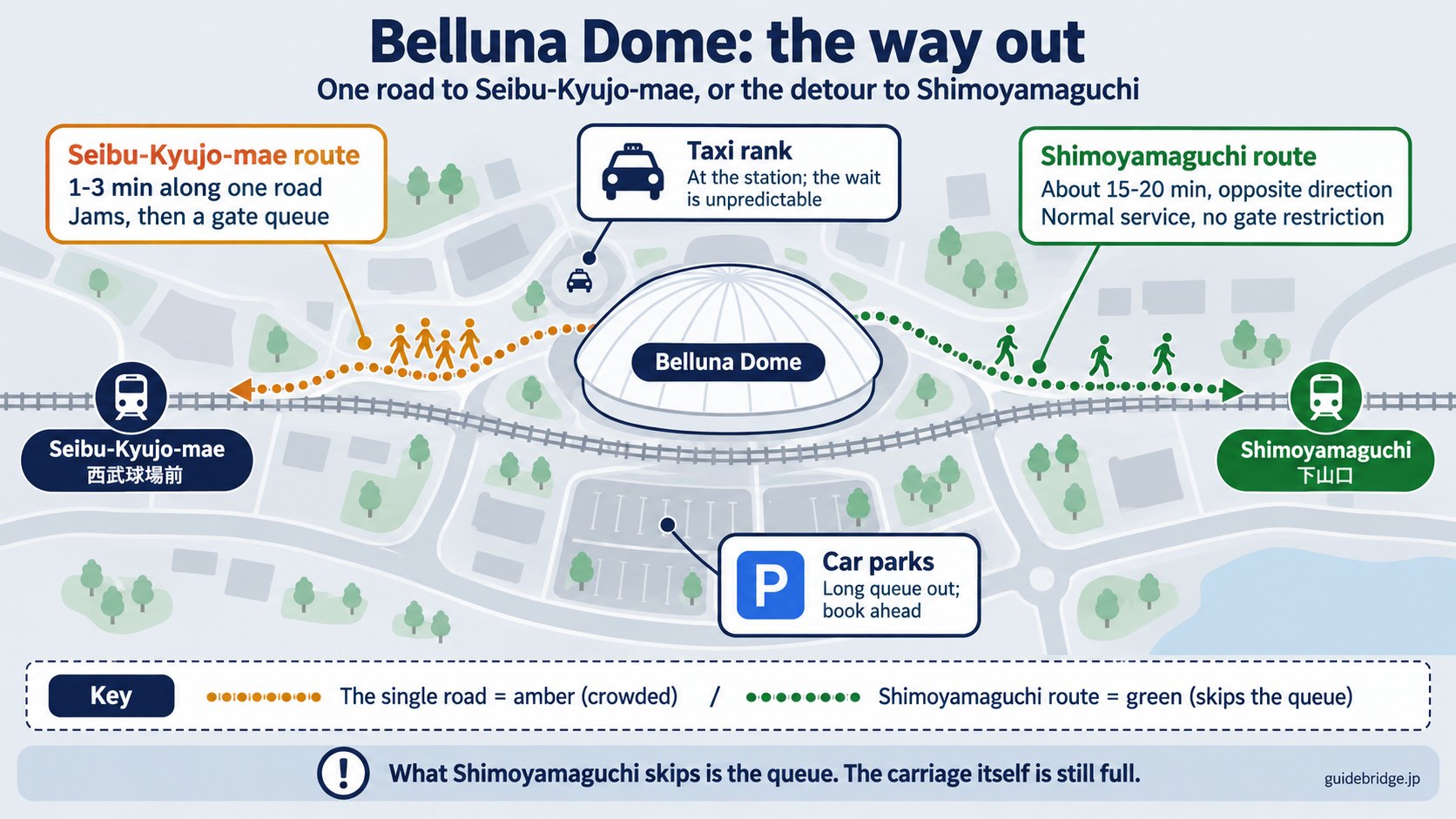
The two stations side by side: 1–3 min against 15–20 min
Seibu-Kyujo-mae is 1–3 min from the venue and is the terminus of both lines, which is exactly why crowd control lands there. Shimoyamaguchi is about 15–20 min on foot in the opposite direction, 1 stop away on the Seibu Sayama Line. It runs a normal service, so you are simply outside the restricted area. What you avoid there is the queue in front of the ticket gates, not the crush on the train. The Seibu Sayama Line is single-track and has only three stations — Nishi-Tokorozawa, Shimoyamaguchi and Seibu-Kyujo-mae — and every train towards Nishi-Tokorozawa starts from the terminus, Seibu-Kyujo-mae (Nishi-Tokorozawa 0.0 km, Shimoyamaguchi 1.8 km, Seibu-Kyujo-mae 4.2 km; source: Seibu Railway). The train that pulls into Shimoyamaguchi is therefore the one that left Seibu-Kyujo-mae 2.4 km earlier, and there is no route by which an emptier train reaches this station. You board a carriage that is already full, and you may end up letting one go.
| Station | Walk from the venue | Lines | Crowding after the show | Who it suits |
|---|---|---|---|---|
| Seibu-Kyujo-mae | 1–3 min along one road | Seibu Sayama Line and Leo Liner (terminus) | Very high: gate restriction, 1–1.5 hours to board | People who can wait |
| Shimoyamaguchi | About 15–20 min, opposite direction | Seibu Sayama Line (1 stop away) | No queue: you skip the 1–1.5 hour wait / the carriage itself is still full | People who would rather walk than queue, who can take a full carriage and a walk at night |
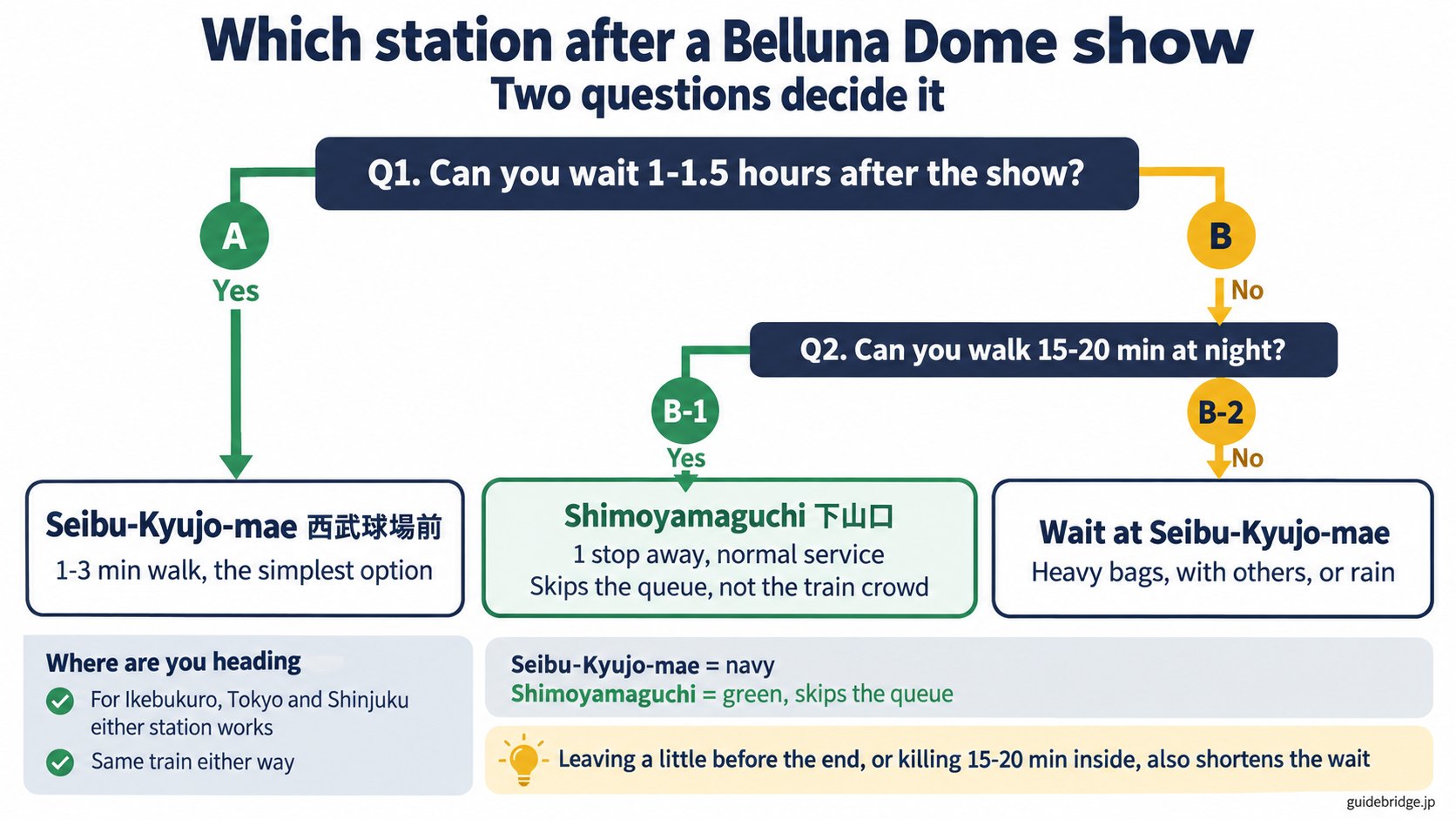
If you can wait, Seibu-Kyujo-mae; if you cannot, Shimoyamaguchi
If you can spend 1–1.5 hours in the venue or at the station, queueing at Seibu-Kyujo-mae is the simplest choice. If not, and you can walk 15–20 min, Shimoyamaguchi takes you around the restriction. Your destination does not split the decision. On a normal timetable, Ikebukuro, Tokyo and Shinjuku — and Tokorozawa as well — are served by the same train on the same Seibu Sayama Line whichever of the two stations you board at; Shimoyamaguchi is simply one stop earlier on it. What is easy to miss at Shimoyamaguchi is the fallback if you cannot get on. Seibu-Kyujo-mae manages boarding order and numbers through the gate restriction and has a taxi rank outside (covered later in this guide); whether Shimoyamaguchi offers the same, we have not been able to confirm on site. Nishi-Tokorozawa, the next station along from Shimoyamaguchi, is the interchange with the far more frequent Seibu Ikebukuro Line (1.8 km apart by track; we have not checked a walking route between them). The route to Shimoyamaguchi runs through a residential area where street lighting and foot traffic vary block to block. With heavy bags, in rain, or if walking alone at night worries you, wait at Seibu-Kyujo-mae instead.
Two other ways to shorten the wait
Leave a little before the end, during the encore say, and controlled exit never applies to you. Or stay inside the dome or near the stands for 15–20 min, let the peak pass, and aim 2–3 trains later. Leaving early works if you keep the manners: do not block anyone’s view, move while the crowd is cheering rather than during the quiet, and do not stop in the aisles.
Where taxis, shuttle buses and private cars fit
There is a taxi rank at Seibu-Kyujo-mae, but the wait for cars is unpredictable after a show; check fares and queues on site. Shuttle buses run towards Tachikawa, Tamagawajosui and Kamikitadai on baseball days, but concert operation differs show by show, so check the official notice for your date. Private cars face a long queue out of the car parks, and a pre-booked space is the baseline. Treat all three as support, not as a replacement for the train.
Two questions decide the station: can you wait 1–1.5 hours, and can you walk 15–20 min at night. What Shimoyamaguchi avoids is the queue; the carriage is just as full. Leaving early or killing time inside also shortens the wait.
You do not need a hotel near the venue if you live along the lines into Ikebukuro, Tokyo or Shinjuku and the wait does not bother you. What a room in Tokorozawa or Ikebukuro buys is a calm morning: arrive early, queue for merchandise without watching the clock. Trip.com compares both areas by date and price in one list.
The last train and the Leo Liner’s early finish: same night, night after, or night before
Add 1–1.5 hours of crowd time to a 20:30 finish and you board around 22:00. Japan has no overnight rail service, night buses are few, and a long taxi ride is expensive, so the last train is a hard deadline rather than a soft one.
The route to Ikebukuro and how long it takes
The standard route is the Seibu Sayama Line to Nishi-Tokorozawa (西所沢), then the Seibu Ikebukuro Line: about ¥450, about 40 min, 1 transfer. These are Seibu Railway lines, a private operator separate from JR, so fares are calculated separately when you change to JR; Suica and PASMO work without a paper ticket. A direct train to Ikebukuro is sometimes laid on for concerts. For Shinjuku (Seibu-Shinjuku) change at Tokorozawa; for central Tokyo pick up JR via Tokorozawa or Nishi-Tokorozawa.
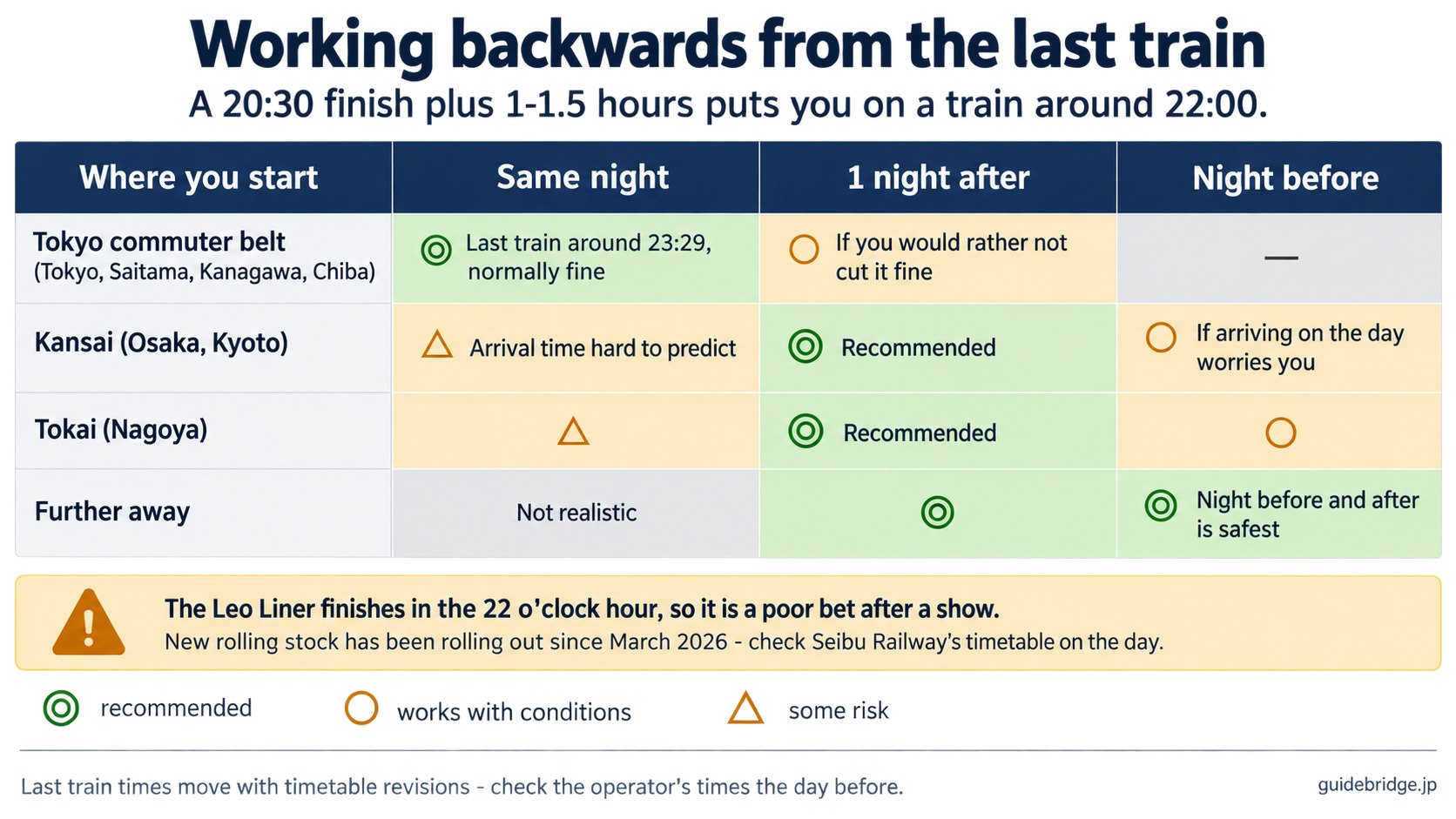
The Seibu Sayama Line’s last train is around 23:29
The last train towards Nishi-Tokorozawa leaves around 23:29, so a 20:30 finish plus 1–1.5 hours normally still gets you to Ikebukuro, Tokyo or Shinjuku the same night. It becomes a close call when three things stack: a block called late, an encore that runs long, and 2–3 packed trains you let go. Timetables change at revisions and extra late services are sometimes added, so check the operator’s current timetable the day before.
The Leo Liner stops some time after 22:00
The Leo Liner (Seibu Yamaguchi Line) runs between Seibu-Kyujo-mae and Tamako, and its last train is some time after 22:00 — earlier than the Seibu Sayama Line. Since you board around 22:00, going home towards Kokubunji, Tamako or Seibuen on it is a poor bet; use the Seibu Sayama Line towards Tokorozawa and Nishi-Tokorozawa instead. New rolling stock has been rolling out since March 2026 and times can move with it, so confirm the final service on Seibu Railway’s timetable on the day.
The three-way choice by where you live
Same night works from the Tokyo commuter belt with access to Ikebukuro, Tokyo or Shinjuku; you will normally make the last train, but move early. A night after — atomari in Japanese fan shorthand, sleeping near the venue that night — is realistic when your arrival time is hard to predict. A night before, zenpaku, is insurance for anyone travelling far who does not want the journey in to decide whether they make the doors.
Tokyo Dome, by contrast, has several lines and spreads the crowd across them: the Tokyo Dome guide covers that comparison.
You will normally make the last train around 23:29, but the Leo Liner finishes some time after 22:00. Tokyo commuter belt: same night. Kansai, Tokai and further: 1 night after.
You do not need a room if the last train gets you home and a late arrival suits you. A night after earns its cost when your arrival time is hard to predict, or when you would rather not spend the encore doing arithmetic. Tokorozawa is closer; Ikebukuro has the wider choice.
Heat, cold and what to carry at a dome with no air conditioning
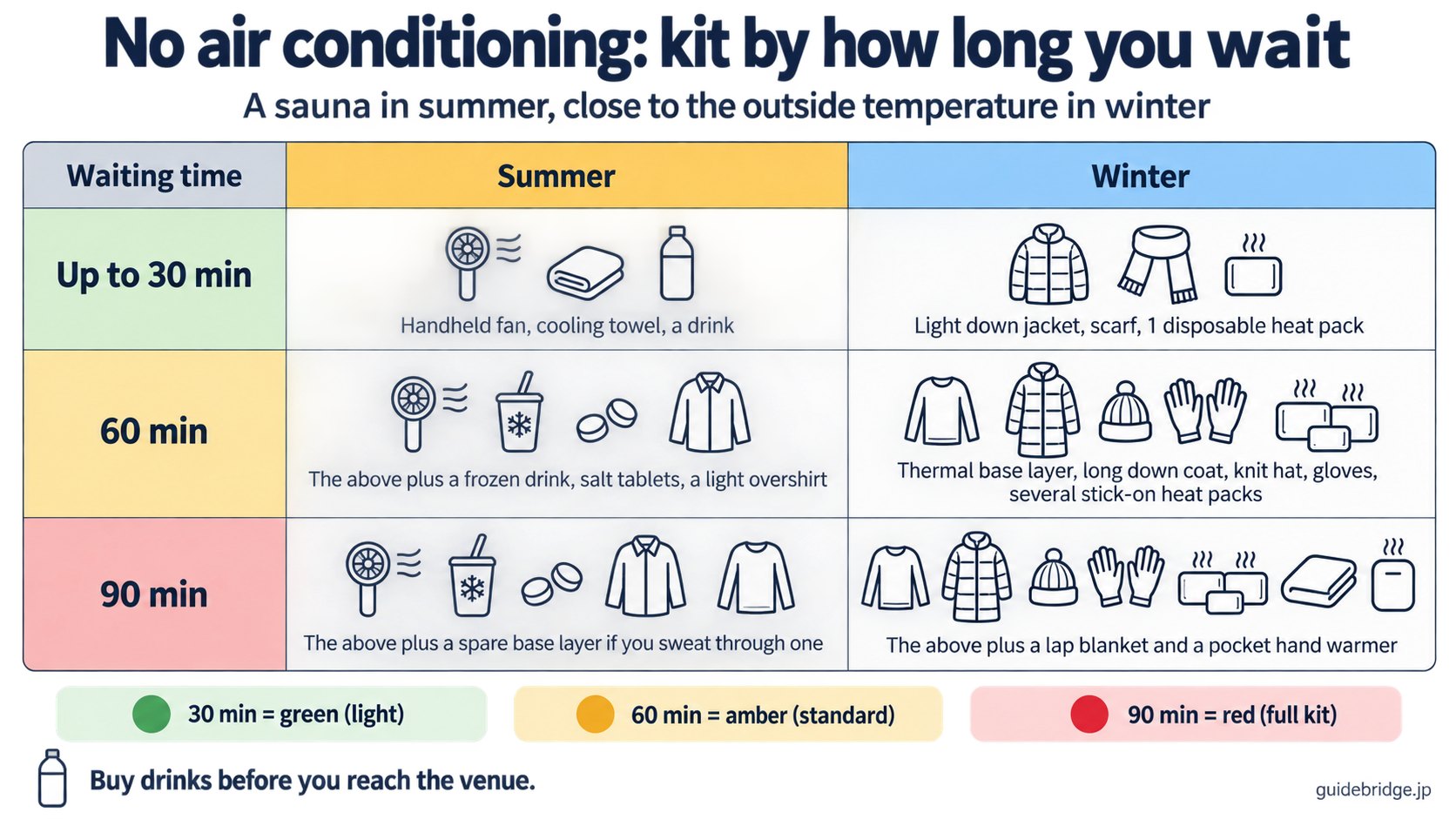
What you pack turns on one variable: how long you stand still. There are no walls between roof and stands and no air conditioning, so you are in the outside air. The shape is deliberate — sealing the building would have put it in a stricter building-code category and raised its property-tax valuation — and you wait in those conditions.
Summer is a sauna; winter is close to the outside temperature
Japanese summers are hot and humid, and here the outside air comes straight in while the roof radiates heat. On spring, autumn and winter nights the stands sit close to the outside temperature; the ground has a long-standing reputation for cold. There is also a swing within one evening: warm during the show from the crowd, cold the moment you are outside. Layers you can add and remove are the starting point.
Kit by waiting time
One rule holds for both seasons: buy drinks before you reach the venue. The stands and the convenience stores nearby are busy once the show ends, so stock up at a convenience store on the way in.
| Waiting time | Summer | Winter |
|---|---|---|
| Up to 30 min | Handheld fan, cooling towel, a drink | Light down jacket, scarf, 1 disposable heat pack |
| 60 min | The above plus a frozen drink, salt tablets, a light overshirt | Thermal base layer, long down coat, knit hat, gloves, several stick-on heat packs |
| 90 min | The above plus a spare base layer if you sweat through one | The above plus a lap blanket and a pocket hand warmer |
In summer, one light overshirt stops you getting chilled between the heat outside and an air-conditioned train. In winter, layer first and add blankets and heat packs as the wait grows. Framing kit by waiting time makes the gaps in your bag obvious before you leave. The same approach works at Sapporo Dome, where the outdoor wait is the winter version of this problem.
These are suggestions, not requirements. If you own something that does the same job, bring that instead of buying.
No air conditioning means a sauna in summer and outside temperature in winter. Pack for a 30-, 60- or 90-minute wait: cooling and fluids in summer, insulation and heat packs in winter. Buy drinks before you arrive.
Staying alone in Tokorozawa or Ikebukuro, and a flow by where you start
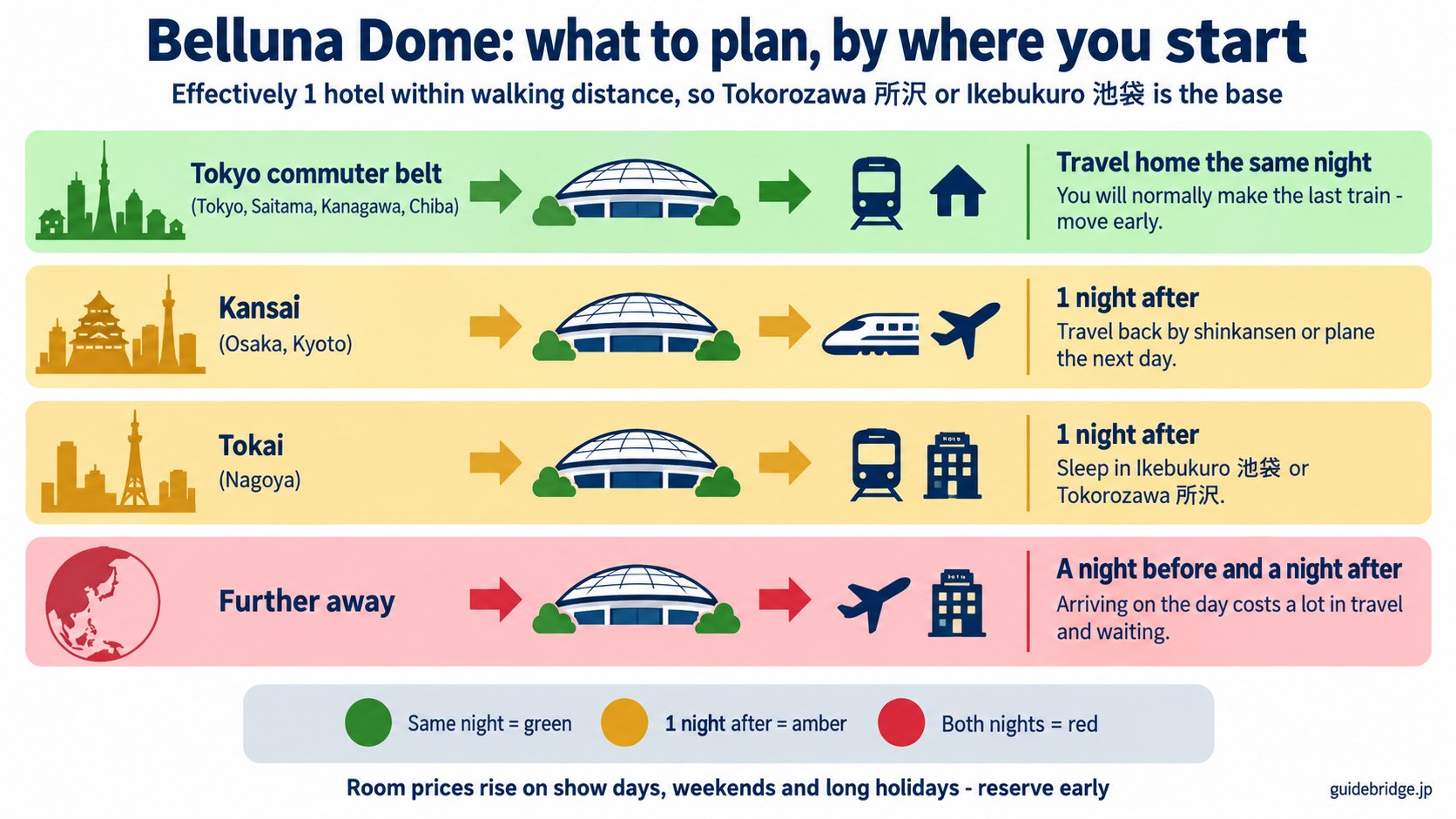
Within walking distance there is effectively 1 hotel, Hotel Kannonkaku, and it sells out early for concerts. That leaves the Tokorozawa Station area or the Ikebukuro area. Tokorozawa balances price against access; Ikebukuro gives you more rooms to choose from and doubles as a sightseeing base.
Tokorozawa: price and access in balance
Tokorozawa is just over ten minutes from Seibu-Kyujo-mae by train and about 30 min from Ikebukuro and Shinjuku, which works for the night before or the night after. The streets around the station still have people about late on, and something close to the station is easy to reach alone.
Ikebukuro: more choice, and a base for the next day
Ikebukuro has far more hotels, including ones with women-only floors and properties that make a point of their security, and it suits anyone adding shopping or sightseeing. It is about 40–50 min from Seibu-Kyujo-mae. Avoid walking through the middle of the nightlife district alone late at night, and choose something near the station.
Hotel Kannonkaku if you want to be beside the venue
Hotel Kannonkaku is within walking distance of both Seibu-Kyujo-mae and the dome, so neither the wait nor the last train matters. The room count is small and it sells out early, so reserve once your date is fixed. Small independent Japanese hotels may carry little English on their booking pages or at the desk, so confirm when you book.
Recommended flow by where you start
These four cases assume you start from inside Japan. If you are flying in, treat Narita or Haneda to central Tokyo as a separate leg and add a night before. Room prices rise on show days, weekends and long holidays, so reserve early either way; the return legs assume a shinkansen or domestic flight booked in advance.
- Tokyo commuter belt (Tokyo, Saitama, Kanagawa, Chiba): travel home the same night. You will normally make the last train; if you would rather not cut it fine, move early or take a room.
- Kansai (Osaka, Kyoto): the same night is hard to predict once the wait is counted, so plan 1 night after and travel home by shinkansen or plane.
- Tokai (Nagoya): 1 night after. Sleep in Ikebukuro or Tokorozawa and travel back the next day.
- Further away: a night before and a night after. Arriving on the day costs a lot in travel and waiting.
Hotel Kannonkaku is effectively the only hotel within walking distance and sells out early, so Tokorozawa or Ikebukuro is the practical base. Same night from the Tokyo belt; 1 night after from Kansai and Tokai; a night before as well from further out.
You do not need a room at all if you live along the Ikebukuro, Tokyo or Shinjuku routes and the last train works for you. If you are staying, the choice is simple: Tokorozawa for access and price, Ikebukuro for range and women-only floors. Trip.com compares both areas on price, location and reviews in one list.
Frequently asked questions
Bottom line: the wait, the open building and the last train are one problem
Seibu-Kyujo-mae is a single-track terminus, and after the show about 45 min of controlled exit, the jam on the single road, the gate queue and the platform add up to a standard 1–1.5 hours before you board. Pick your station against that: Seibu-Kyujo-mae if you can wait, Shimoyamaguchi 15–20 min away if you would rather walk than queue. What Shimoyamaguchi saves you is the queue in front of the gates; the train itself is the full one that has just left Seibu-Kyujo-mae, and the fallback if you cannot board is thinner than at the terminus.
You spend that wait in a muggy Japanese summer or in something close to the outside temperature in winter, because there is no air conditioning. Pack around the waiting time and you keep the energy you have left. The point is to run crowding, weather and the last train on one clock rather than as three separate topics.
Then work that clock backwards. From the Tokyo commuter belt you will normally make the Seibu Sayama Line, but the Leo Liner finishes some time after 22:00, so rework any route that depends on it. Kansai, Tokai and anywhere further out are better served by a night after. Decide this in advance and the evening stops asking you questions.
Related guides
To read your block number off the ticket and work out whether you are on the first-base side, the third-base side or behind home plate, see the Belluna Dome seating chart and sightlines. For the venue-by-venue comparison, see Japan’s 5 big domes, and for other venues Tokyo Dome and Sapporo Dome.
This page was produced from the Japanese original with AI assistance. Every number, station name and time was machine-checked against the Japanese source and its official references. If something is wrong, tell us here -> /en/contact/.