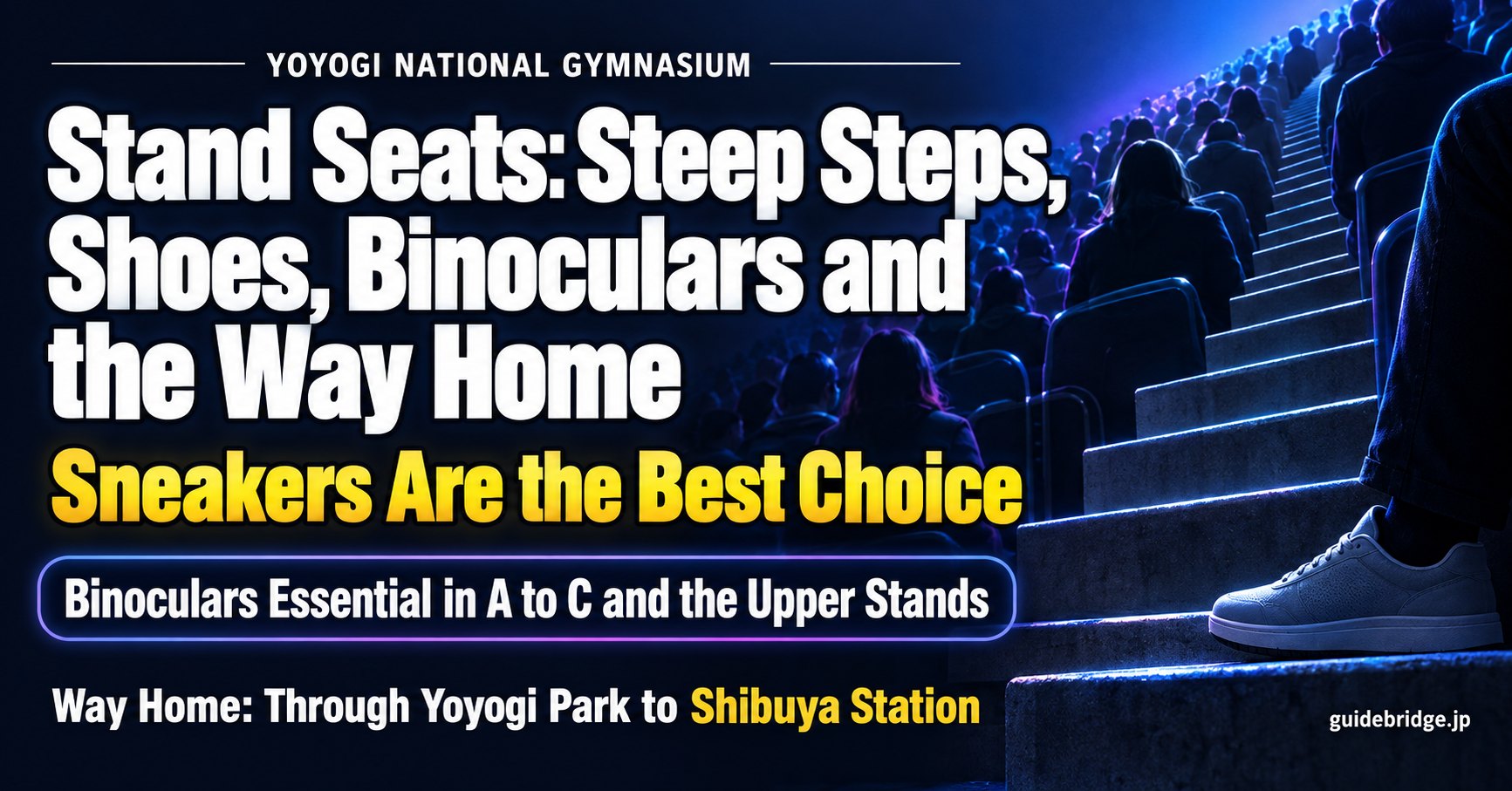
The stands at Yoyogi National Gymnasium are far steeper than those at other arenas. They were designed for the 1964 Tokyo Olympics, with the steep rake of a venue built for watching sports. At concerts, some fans in the back rows of the upper stands have had trouble in heels. When the artist came out and the crowd around them stood up, they could not keep their balance. Once you know your seat is in the steep stands, choose your shoes and plan how you will move around your seat.
The building, an Important Cultural Property designed by Kenzo Tange, is beautiful. But when its steep stands are used for a concert instead of a sports event, the same slope that gives you a clear view also makes the seats feel frightening. This is truest in the middle and back rows of the upper stands. After the house lights go down, you can see even less, and in the excitement of the encore it is easy to stop watching your feet.
This guide is only for people who have found out they have a seat in the steep stands at Yoyogi National Gymnasium. It sticks to that one subject: why the rake is so steep, which shoes to wear, how to judge your seat block and which routes home avoid the worst crowds. Concerts here are held in the First Gymnasium of the Yoyogi National Stadium complex (国立代々木競技場 第一体育館), which fans in Japan call 代々木第一体育館. It sits next to Yoyogi Park and Meiji Jingu Shrine, on the walk from Harajuku Station south to Shibuya Station. Shibuya is the large rail terminal to the south, and Shinjuku the large terminal to the north.
A few terms first. On Japanese tickets, “arena” (アリーナ) means seats on the flat main floor, and “stand” (スタンド) means the fixed, sloped seats around it. The stands here have 2 tiers, the lower stands (1階スタンド on your ticket) and the upper stands (2階スタンド), and they are divided into lettered blocks from A to L. In Japan you often learn your seat only when the ticket is issued, close to the show. This guide is written for fans who live in Japan and go home by train the same night. If you are visiting from abroad, read “home” as the hotel where you are staying tonight.
- Why the stands at Yoyogi National Gymnasium are so steep (the structural reason)
- The 3 risks that actually happen in the steep stands (standing up, a blocked view and a stage far away)
- Which shoes work in the steep stands and how to move safely (rated best / acceptable / not suitable)
- Whether you need binoculars, block by block (blocks A to L)
- Getting home: routes toward Shibuya that avoid the entry restrictions at Harajuku Station
The venue is called a “gymnasium,” but by its structure it is an arena-type venue: a bowl under a suspended roof. The age of its facilities matters less than its structure. I explain how to read each type of venue in my concert venue type guide (Japanese only for now).
Check this first: why fans find the steep stands at Yoyogi National Gymnasium scary
Yoyogi National Gymnasium was built as the swimming and diving venue for the 1964 Tokyo Olympics. It was designed by Kenzo Tange, and its roof is suspended from cables. In 2021 it was designated an Important Cultural Property under Japan’s national heritage system. Maximum capacity is 12,934 (8,636 in the stands and 4,124 on the arena floor). The stands have 2 tiers: the lower stands (1階) and the upper stands (2階).
The basic reason for the steep steps is that the building was designed first of all for watching sports. Spectators looked down on a pool and diving boards from high up, so the rake had to be steep enough that seats at the back still had a clear view. Concerts came later, and the rake has not changed from the original design.
The arena floor is flat, with no steps at all. You only need to prepare for the steps if your seat is anywhere from the back rows of the lower stands up through the upper stands. The middle and back rows of the upper stands are where the slope feels steepest.
The 3 risks that actually happen in the steep stands at Yoyogi National Gymnasium
The steps help you see over the people in front of you, but at a concert they create other risks. Here are the 3 to plan for.
Risk 1: You lose your footing when you stand up or sit back down
Several fan blogs and social media posts describe the back rows of the upper stands as “steep enough to be scary.” In higher heels, it is hard to shift your weight as you stand, and your footing becomes unsteady. The time to be most careful is when you move after the house lights go down. In the dark you can see much less, so if you stand up or move along the row, you may miss the step at your feet and stumble. Make it a habit to look at the steps in front of and behind you as soon as you sit down, before the show starts.
Risk 2: When the people in front stand up, staying seated means you cannot see
It is true that the steps make it easier to see from the back. But when the arena floor stands up all at once for a standing part of the show, the front blocks of the lower stands feel it too. If you stay seated there, the people standing on the floor can block your view. A steep rake does not mean you will always see over the heads in front of you.
Risk 3: In some blocks, the stage looks tiny
The stage is often set at the L-block end, which puts Block A at the far end. In blocks A to C, at the far end from the stage, the performers look tiny, so binoculars are essential. Blocks along the sides of the hall look at the stage at an angle, and some of them have seats with a partly obstructed view.
The steps do have one clear benefit: the head of the person in front is less likely to block you. From around the middle of the upper stands, you get an unusual view looking down over the whole crowd.
Shoes and how to move in the steep stands at Yoyogi National Gymnasium
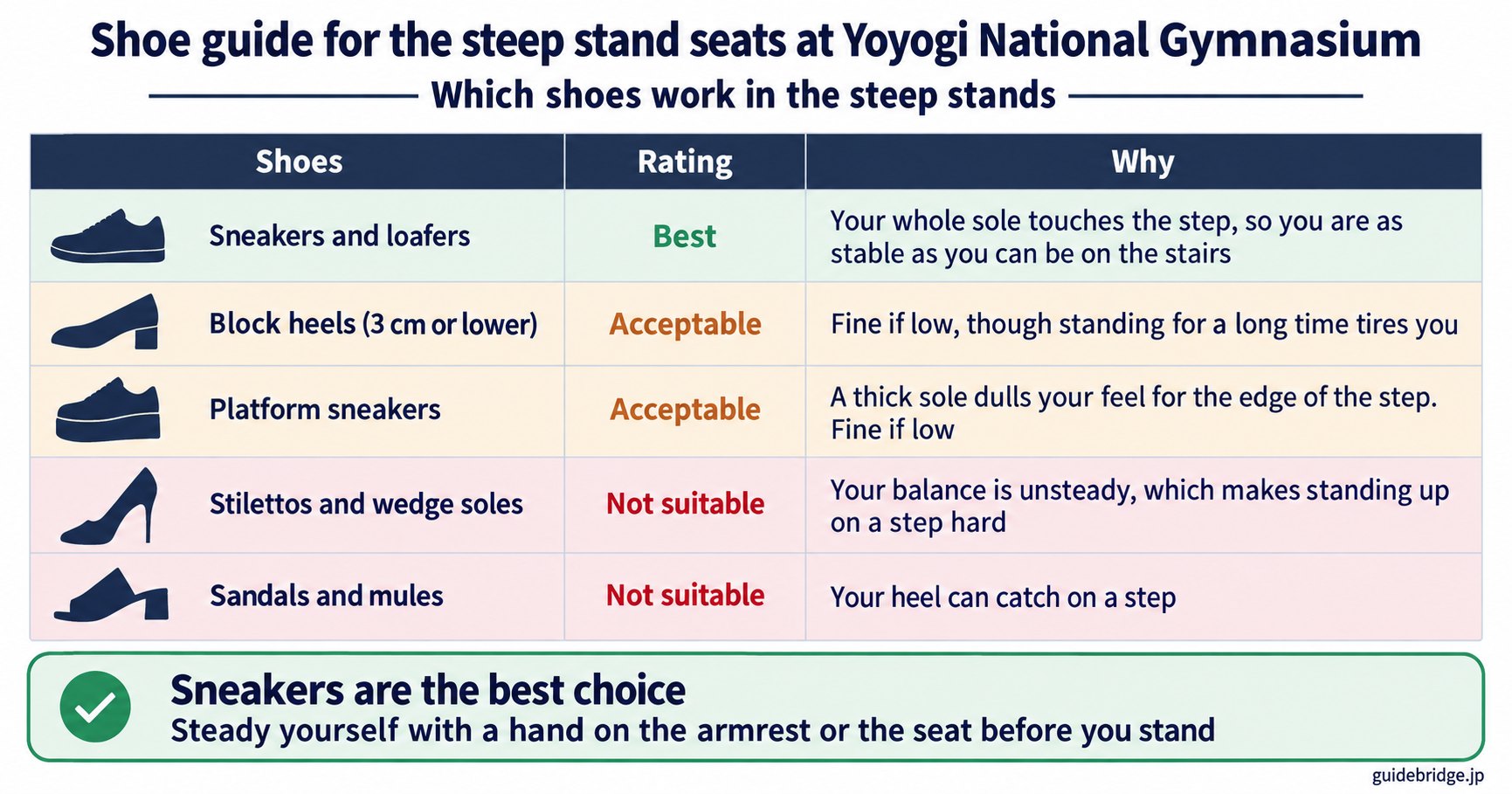
As soon as you find out your seat is in the steep stands, check your shoes first. Use the table below.
| Shoes | Rating | Why |
|---|---|---|
| Sneakers / loafers | Best | Your whole sole touches the step, so you are as stable as you can be on the stairs |
| Block heels (3 cm or lower) | Acceptable | Fine if low, though standing for a long time tires you |
| Stilettos / wedge soles | Not suitable | Your balance is unsteady, which makes standing up on a step hard |
| Platform sneakers | Acceptable | A thick sole dulls your feel for the edge of the step. Fine if low |
| Sandals / mules | Not suitable | Your heel can catch on a step |
Along with your shoes, keep these 3 habits on show day.
- Check the steps as soon as you sit down. Look at the steps in front of and behind you right after you take your seat. Getting a feel for them before the lights go down is the first step toward standing up safely once the show starts.
- Stand up slowly and use the armrest. If you jump up quickly when the cheering starts, your footing becomes unsteady. Make it a habit to steady yourself with a hand on the armrest or the seat before you stand.
- Stay put when the lights go down before the encore. The blackout when the main set ends is the riskiest moment. Do not move while you cannot see, and wait until the lights come back up.
Judging your seat block: in A to C, binoculars are essential
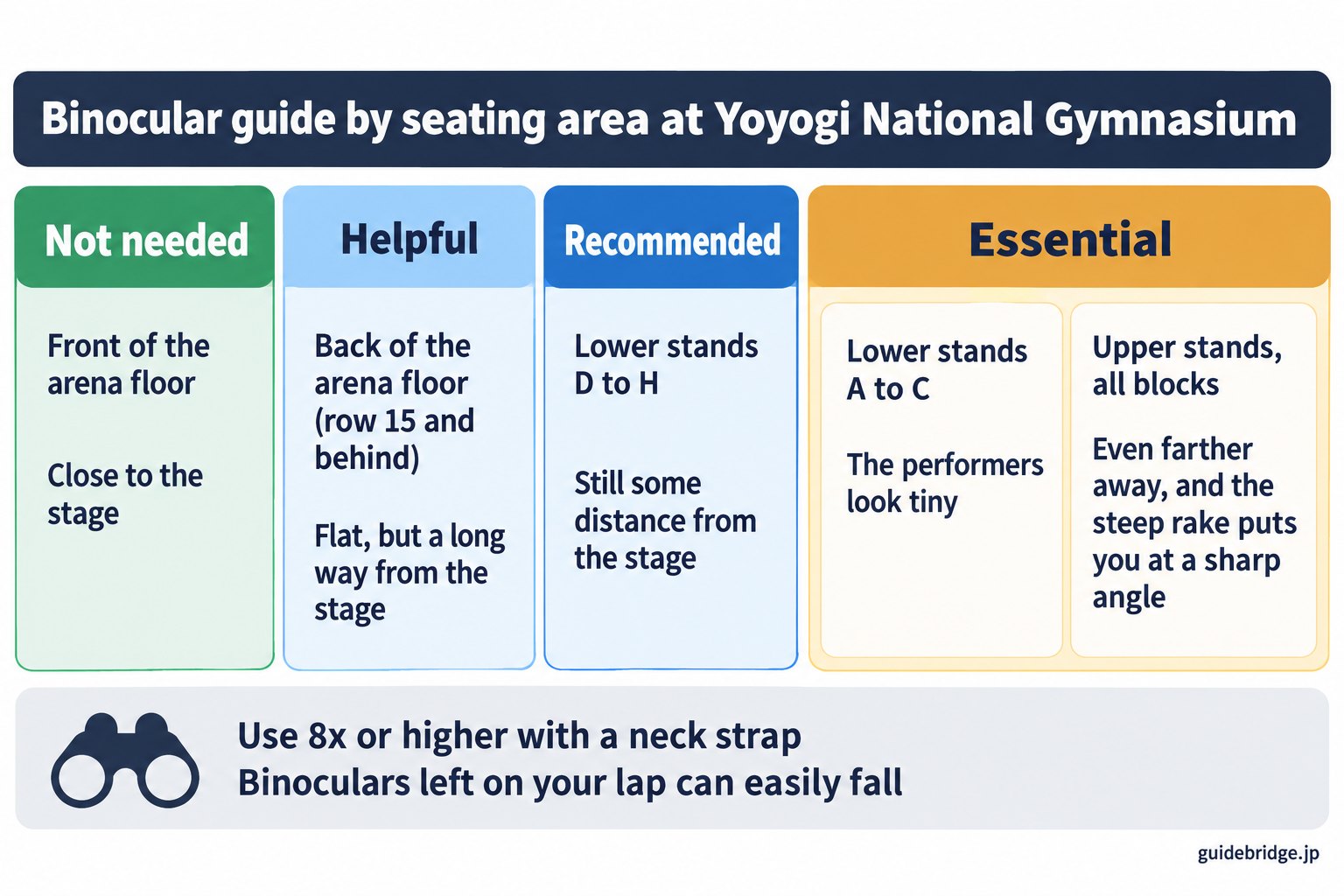
| Block / area | Binoculars | Notes |
|---|---|---|
| Front of the arena floor | Not needed | Close to the stage. Flat floor with no steps |
| Back of the arena floor (row 15 and behind) | Helpful | Flat, but a long way from the stage |
| Lower stands D to H | Recommended | Still some distance from the stage, even in these blocks |
| Lower stands A to C | Essential | The far end from the stage. The performers look tiny |
| Upper stands, all blocks | Essential | Even farther away, and the steep rake puts you at a sharp angle |
As a rule of thumb, choose binoculars with 8x magnification or more. At higher magnification, every small movement of your hands shows, so a model with image stabilization is more comfortable to use. Because the steps are steep, binoculars left on your lap can easily fall. A neck strap is essential.
Preparing for the steep stands is not only about the day itself. Staying the night before and arriving with time to spare also makes a big difference. If you go in right after the doors open, you have plenty of time to check the steps around your seat.
You don’t need a hotel near the venue if you live in the Tokyo area and can get home by train after the show, or if you already have a room elsewhere in Tokyo. If you are coming from farther away, staying the night before gives you that time to spare. The Trip.com link opens a hotel search around the venue.
Getting home: avoid the entry restrictions at Harajuku Station by walking through Yoyogi Park to Shibuya
After the show, Harajuku Station on the JR Yamanote Line (the loop line around central Tokyo) is the most crowded station. Waits of 30–60 min have been reported, with entry restrictions and a long line on the pedestrian bridge in front of the station. Under entry restrictions, the station stops letting people through the ticket gates and holds the crowd outside. After a show spent on steep steps, a long wait on your feet leaves you twice as tired. On show day, check the organizer’s notices and JR’s train service information. Decide your route home before show day.
The nearby stations are separate stations run by different operators, each with its own ticket gates and fares. Harajuku Station is JR. Meiji-jingumae Station is Tokyo Metro (Chiyoda Line and Fukutoshin Line). Shibuya Station is served by JR, Tokyu and Tokyo Metro, including the Fukutoshin Line. The Fukutoshin Line runs to Shinjuku-sanchome and Ikebukuro with no transfer, but it does not stop at JR Shinjuku Station.
| Heading toward | Suggested route | Notes |
|---|---|---|
| Shibuya / Yokohama | Through Yoyogi Park to Shibuya Station (Tokyu / Fukutoshin Line) | 15–20 min on foot. Crowds are thinner |
| Ikebukuro / Shinjuku | Through Yoyogi Park to Shibuya Station, or Meiji-jingumae Station (Fukutoshin Line) | Meiji-jingumae is less crowded than Harajuku |
| Tokyo Station / Ueno | Harajuku Station (expect crowds), or Shibuya and then the Yamanote Line | If you use Harajuku, allow 30 min or more for the crowds |
| Tokaido Shinkansen | Shibuya → Shinagawa | Going by way of Shibuya keeps you out of the most crowded area |
For a stay the night before or after, Shibuya is the most convenient area. Several lines meet there. If you stay over because the last train has gone (Japan’s trains stop running late at night), early departures the next morning are easy to catch. The streets are busy even late at night. Harajuku and Jingumae are within 10 min on foot of the venue, but they have few hotel rooms, and those fill up early on concert days. Shinjuku’s strength is access to highway buses at Busta Shinjuku, the long-distance bus terminal at the south exit of Shinjuku Station. The Shinkansen does not stop at Shinjuku, so for the Shinkansen use Shinagawa, as in the table above.
For planning the way home, a comparison with Pia Arena MM in Yokohama (Kanagawa) is useful: Yoyogi gives you more flexibility, because it has several ways out. My Pia Arena MM guide is in Japanese only for now.
You don’t need a hotel near the venue if you can reach home, or the room you already have, by one of the routes above. If you are staying the night before or after, the link works the same way as the one above.
Summary: 3 things to do today if your seat is in the steep stands
If you go into the steep stands at Yoyogi National Gymnasium unprepared, you will be left with nothing but worries about your footing and frustration with your view. Check these 3 things today, and there will be fewer surprises on show day.
- Check your shoes. If you planned on heels, switch to sneakers. Sneakers are the single best way to deal with the steps.
- Bring binoculars. They are essential in lower stands A to C and throughout the upper stands. Don’t forget a neck strap.
- Skip Harajuku Station on the way home. Know the route through Yoyogi Park to Shibuya Station before you go.
The steep stands are nothing to fear. With some preparation, you can fully enjoy this venue. It has been in use since the 1964 Tokyo Olympics, and I hope your concert there is a great one.
Switch to sneakers, put a neck strap on your binoculars, and head home through Yoyogi Park to Shibuya Station. These 3 steps take care of most of the risk of the steep stands before you arrive.
This page was produced from the Japanese original with AI assistance. Every number, station name and time was machine-checked against the Japanese source and its official references. If something is wrong, tell us here -> /en/contact/.