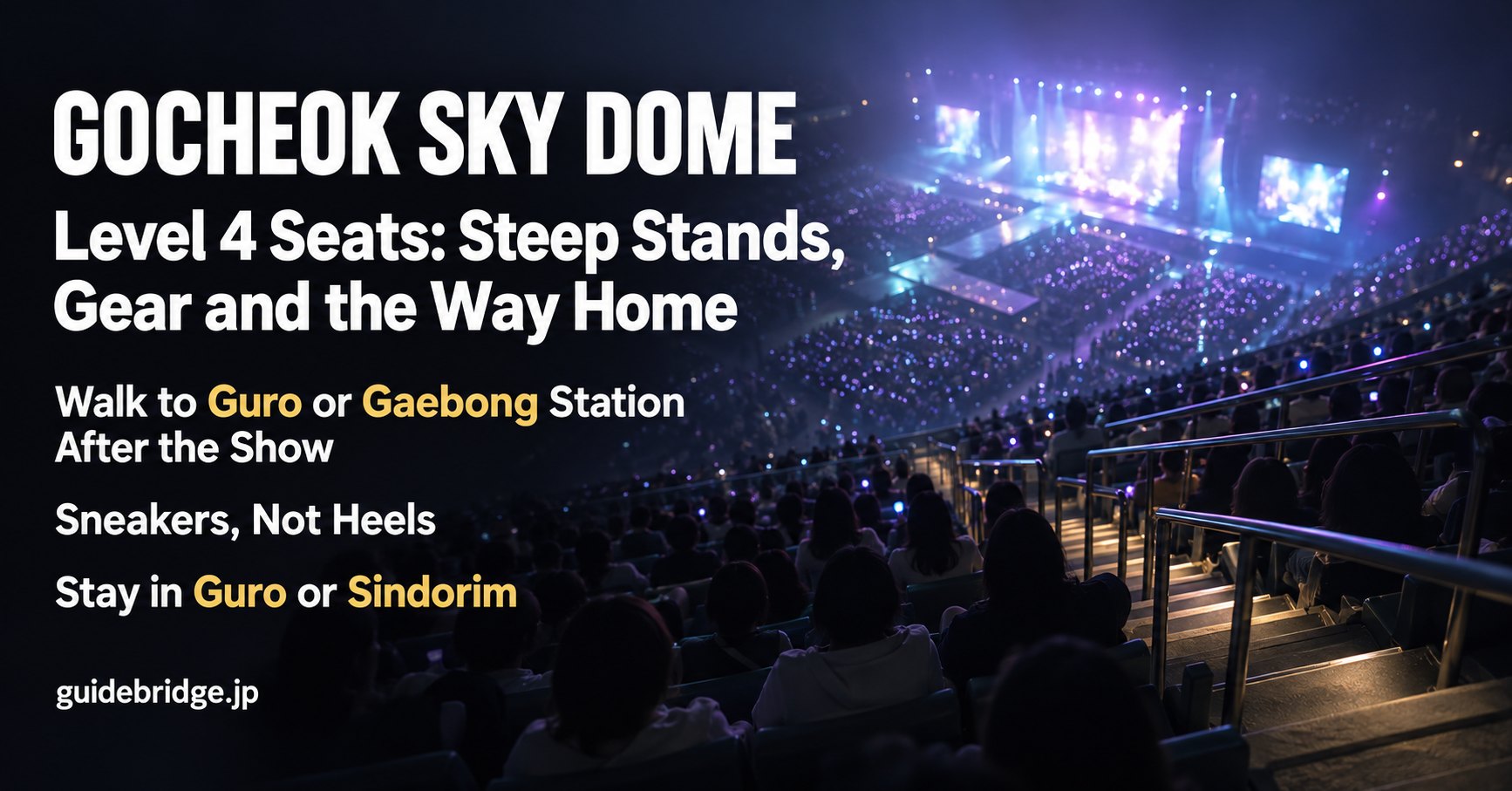
When people see “Level 4” on their ticket, many of them say they freeze for a moment.
Fans call this area the “sky seats” (haneul-seok, 하늘석). It really is a long way from the stage, and if it is your first time up there, you may have no idea what to expect.
“Will I be able to see anything at all?” “Will the slope be so scary that I can’t enjoy the show?”
If that is what you are worried about, this guide is for you. GuideBridge will not brush it off with a pep talk, or with a line such as “just have fun and it will all work out.”
The Level 4 seats at Gocheok Sky Dome are an area you can handle well, as long as you bring the right gear and know what you are walking into.
This guide lays out the physical facts about the Level 4 seats. Then it gives you concrete options for gear that brings the stage closer, and the routes that get you home safely while avoiding the crowds.
It is a practical prep guide, so show day doesn’t turn into “the day the stage was just too far away.”
Structurally, Gocheok is a dome venue. In a dome, the seating rises high, so the upper seats tend to end up far from the stage. I explain how to read a venue’s type and spot the trouble ahead of time in my concert venue type guide (Japanese only for now).
The seat count and capacity in this guide were checked against the official figures from the Seoul Facilities Corporation in July 2026. The walking times from stations and the taxi and bus times are rough figures as of publication in December 2025, and they vary with traffic. For the latest capacity, check the Seoul Facilities Corporation’s official information. For the seating layout of each show, check its ticketing page.
Gocheok Sky Dome basics: what changes when the venue is a ballpark
Gocheok Sky Dome (고척스카이돔) is Korea’s first domed ballpark. It seats about 16,600 for baseball, and it holds up to about 25,000 people for concerts and other shows (official figures from the Seoul Facilities Corporation).
Unlike KSPO Dome, another major Seoul venue that is now used as a dedicated concert arena, Gocheok was designed as a baseball stadium. That means there are a few things about the setting you should know before a concert.
The key difference: arena floor seats and stand seats
Seats at Gocheok fall into two broad groups: the “arena” seats set up on the playing field, and the stand seats on Levels 1 to 4.
- Arena seats: The floor is flat. You are close to the stage, but toward the back, the crowd in front can easily block your view.
- Stand seats: The stands are raked, so your view is open. But each level up puts you physically farther from the stage.
Level 4 in particular sits very high because of how the building is designed. Many fans say it feels less like looking down at the stage and more like peering over an edge into it.
The reality of Level 4: stands that slope at up to 35 degrees
If you have a Level 4 ticket, the thing to prepare for most is the height.
What a 35-degree slope really feels like
The Level 4 stands at Gocheok are said to slope at up to about 35 degrees. The number alone does not tell you much. Once you sit down, though, the angle is steep enough that the head of the person in front of you sits well below your knees.
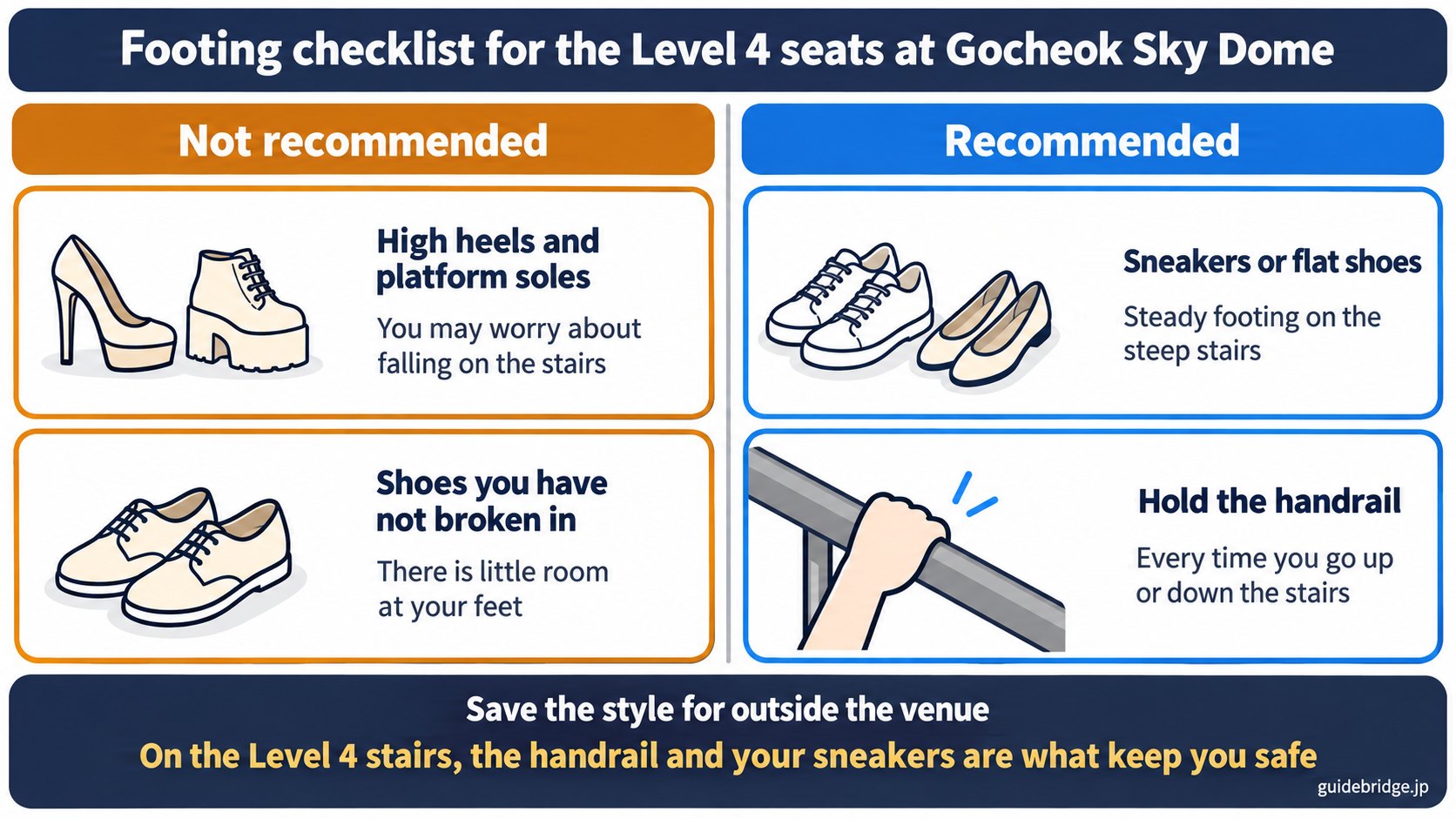
- The aisles are narrow: There is little room at your feet, so take care when you move around.
- Use the handrail: Hold the handrail every time you go up or down the stairs.
GuideBridge’s call: get your footwear right
In this setting, the smart call is to put safety ahead of fashion.
- Recommended: Sneakers, flat shoes
- Not recommended: High heels, platform soles, shoes you have not broken in
Worrying that you might fall takes your focus away from the show. Steady footing alone makes a big difference to how relaxed you feel.
About the “shaking” during the show
Because of how the dome is built, fans on the upper levels can feel the stands shake when the whole crowd jumps or moves hard at once. At past shows, staff have announced a “no standing” rule (seated viewing only) for safety. On show day, follow the staff’s instructions and put safety first while you enjoy the show.
Seeing the stage: choosing the gear that closes the distance
To be honest with you: from Level 4, the artists on stage look so small that it is hard to make out their faces with the naked eye.
These are great seats for taking in the full staging, the lighting and the sense of the whole crowd as one. But if your goal is to see your favorite member’s face, the naked eye can only take you so far. That is simply a fact.
What GuideBridge suggests here is this: let gear do the work.
Option 1: Rent a Galaxy S23/S24 Ultra
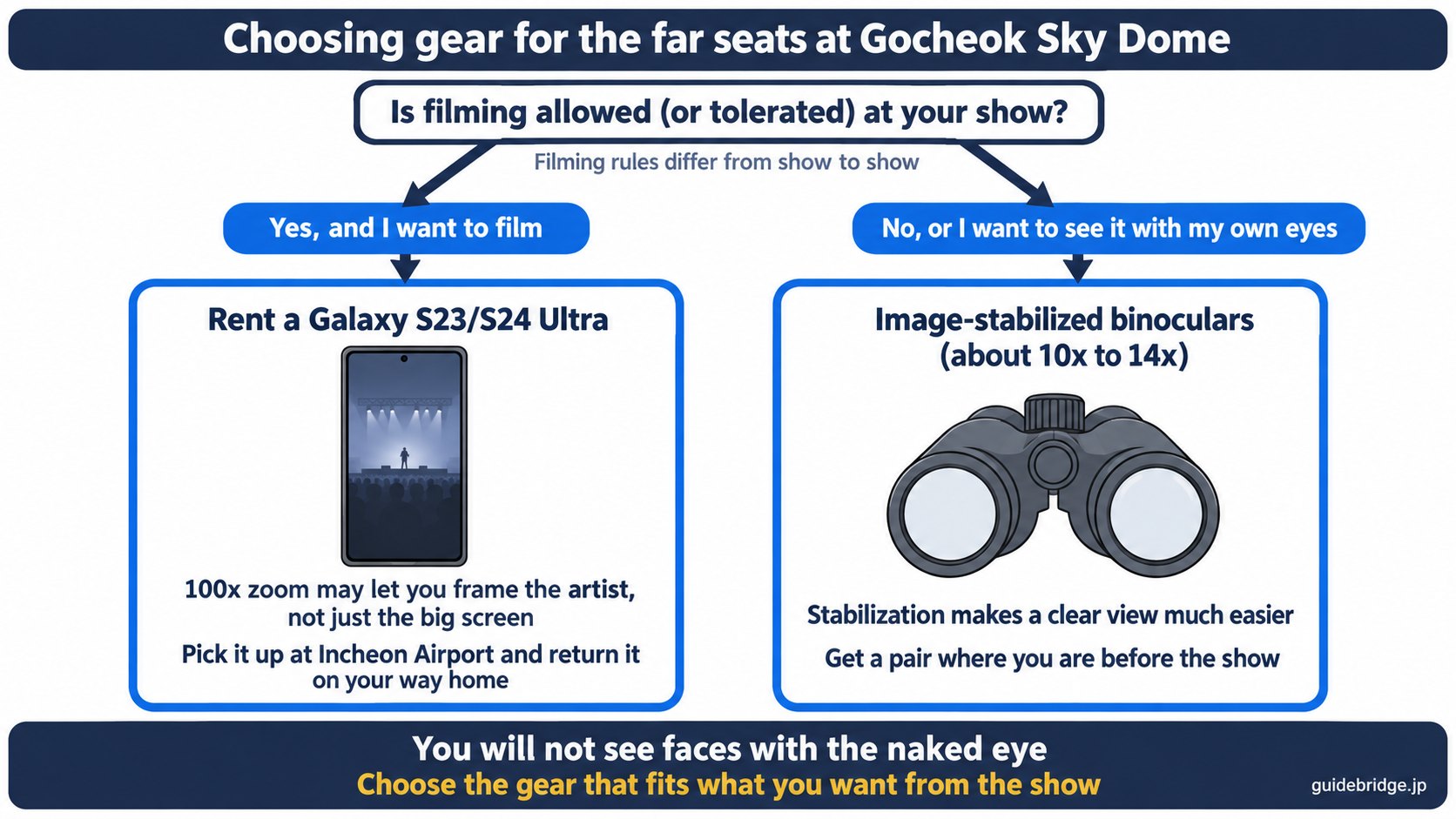
At Korean concerts, when filming is allowed (or quietly tolerated), your phone’s camera can shape the whole experience. Filming rules differ from show to show, so check yours before you go.
With an iPhone or another typical phone, zooming in from Level 4 tends to give you a grainy picture. The 100x zoom on Galaxy’s “Ultra” series, by contrast, may let you frame the artist themselves, not just their image on the big screen, even from the sky seats.
- Pros: You can capture a sharp record of your favorite artist, even from far away.
- Cons: Buying one outright is expensive (in Japan, for example, it costs ¥200,000 and up).
GuideBridge’s suggestion: Don’t buy one. Renting one in Korea gives you much better value for the money.
Pick the phone up at Incheon Airport, use it at the venue, and return it on your way home. Compared with that price, a rental of a few thousand yen is a small investment, and it may make your Level 4 seat far more rewarding.
Film your favorite K-pop star with a top-end smartphone camera
Option 2: Image-stabilized binoculars
If filming is not allowed at your show, or you simply want to see it with your own eyes, image-stabilized binoculars (binoculars with built-in shake correction) work well.
About 10x to 14x is a safe range. With ordinary binoculars, the higher the magnification, the more your hands shake the image and the easier it is to feel queasy. With stabilization, you can get a clear view much more easily, even from Level 4.
You can compare stabilized concert models across 3 stores below. These are Japanese shops that deliver within Japan. If you are not starting your trip from Japan, or you live in Korea, get a pair where you are before the show.
Getting there and back: the risk of a venue away from central Seoul
Gocheok Sky Dome is some distance from central Seoul (areas such as Myeongdong and Hongdae, where many visitors stay). The Han River (한강) divides Seoul into north and south, and the venue is south of the river, in southwest Seoul.
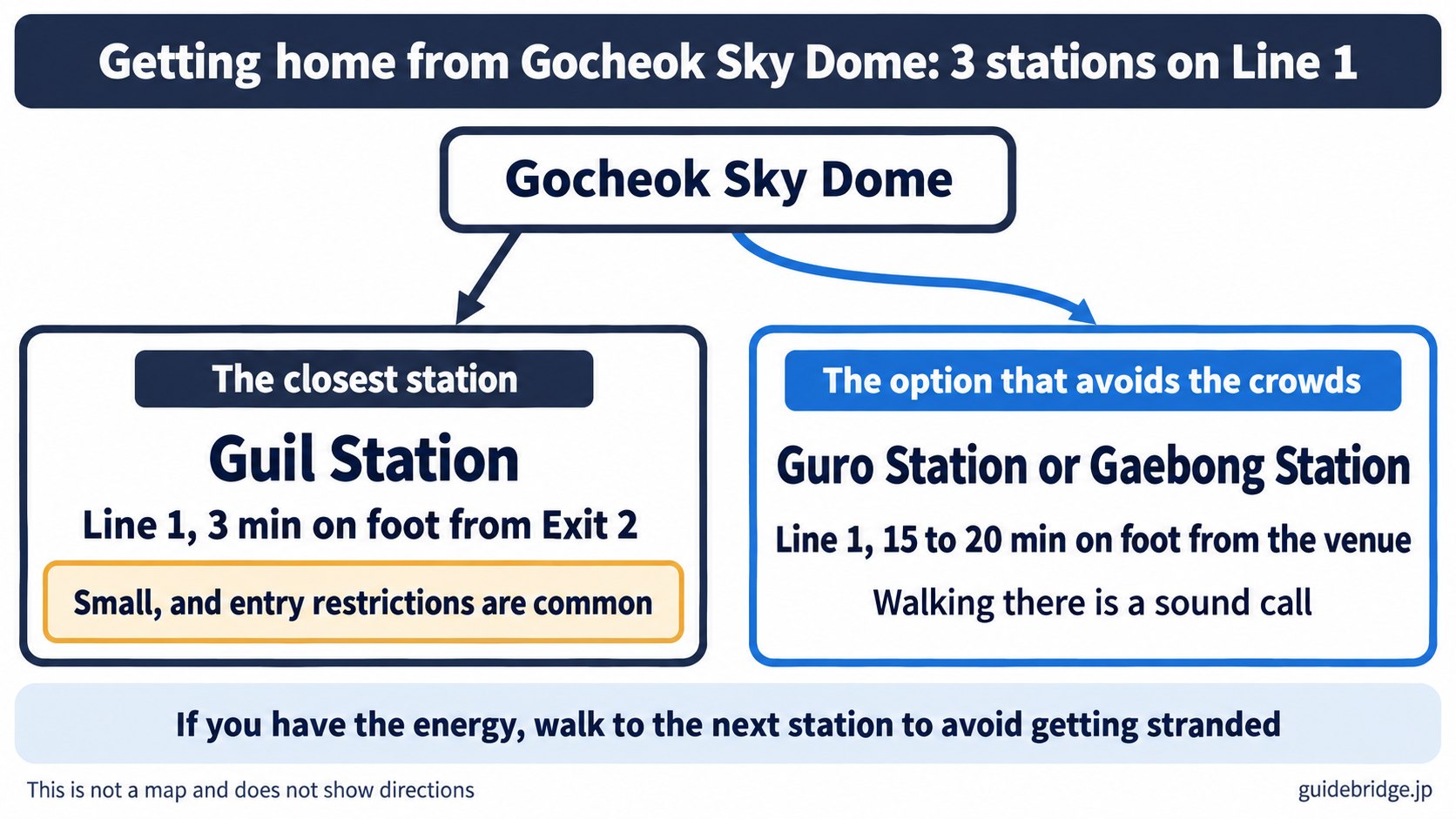
- The closest station: Guil Station (구일역) on Subway Line 1, 3 min on foot from Exit 2
Note: This is the station to use by default, but it is small, and the station often limits entry after shows. - The option that avoids the crowds: Guro Station (구로역) or Gaebong Station (개봉역) on Subway Line 1
Note: They are 15 to 20 min on foot from the venue, but walking there is a sound call if it keeps you from being shut out of the station after the show.
The same “walk to the next station” call works just as well if you plan to take a taxi. A ride-hailing app cannot get you a car in places cars cannot reach, or at a station entrance packed with buses. Rather than holding out in front of the venue, you will get home sooner if you move to a spot where a car can reach you, then request one. If you still cannot get a ride, my guide to getting a taxi when the app fails lists what to try, in order (Japanese only for now).
The risk of getting stranded after the show
After a show with a crowd of more than 20,000, the closest station gets extremely crowded. It is not unusual for the station to limit entry, and getting a taxi through a ride-hailing app becomes hard as well.
GuideBridge’s call: don’t wait it out in the line. Rather than standing in the crowd for a long time, keep options like these in mind. They give you room to breathe.
- Walk one station: Walk to the next station and board there.
- Shift your timing: Spend a little time around the venue, then head off.
Where to stay: to save your energy, don’t cross the river
This section is for those staying the night in Seoul. When choosing a hotel for a concert trip, GuideBridge recommends one thing: factor in how much energy you will have left for the trip back.
After the show, riding a packed train all the way back to Myeongdong or Gangnam while you are worn out drains far more energy than you expect.
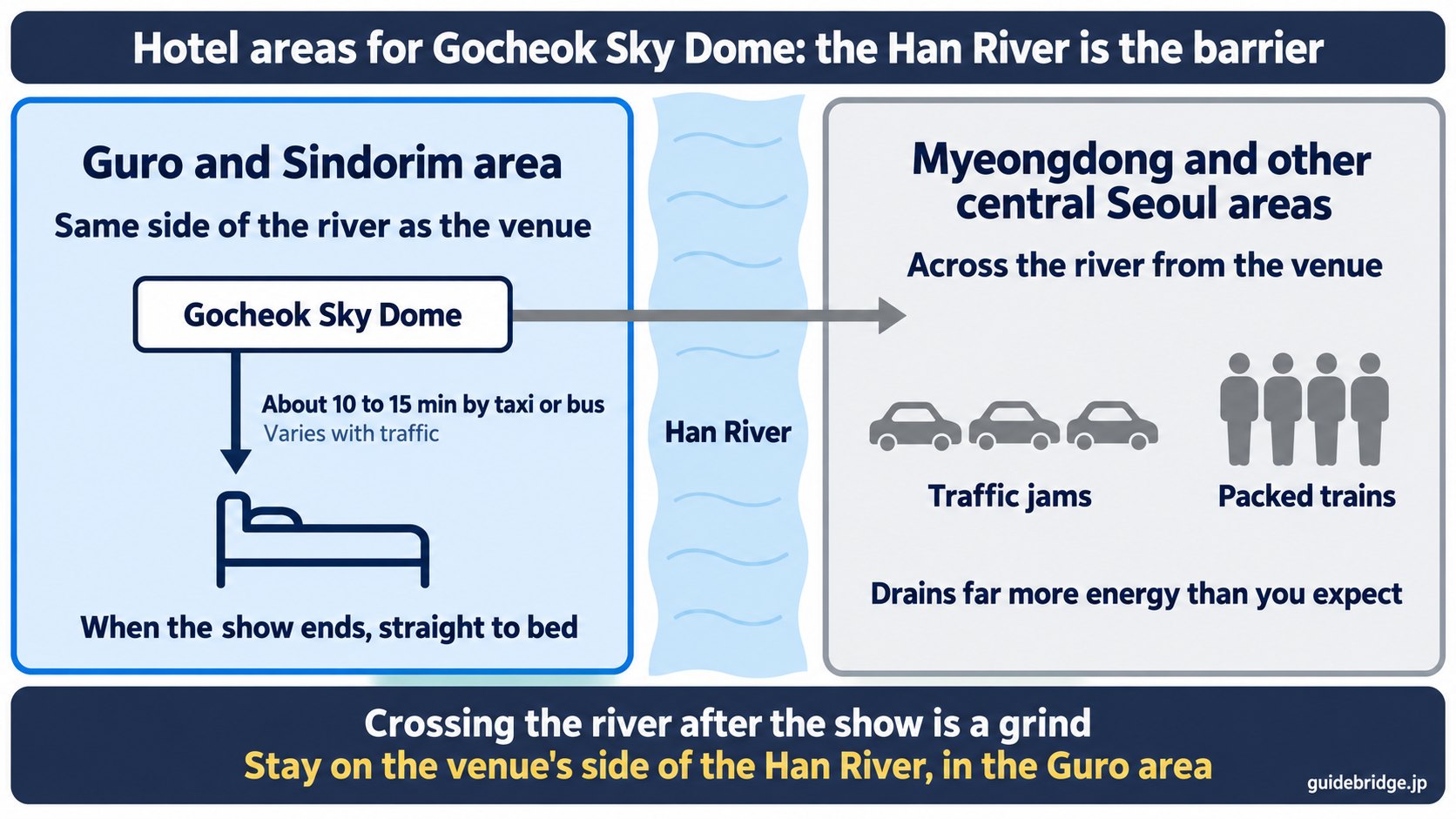
Our suggestion: the Guro and Sindorim area
Consider making the Guro (구로) or Sindorim (신도림) area your base. It is about 10 to 15 min from the venue by taxi or bus.
- The upside: After the show, you can be back at your hotel in about 10 to 15 min.
- The area: There are plenty of shopping malls and places to eat, and the area is considered relatively safe.
“When the show ends, straight to bed.” That comfort helps you recover for the next day’s sightseeing or your trip home.
You don’t need a hotel near the venue if you live in Korea and are heading home the same night. In that case, the station tips in the previous section are all you need.
Save your energy by staying near Gocheok Sky Dome
Frequently asked questions
Summary: Level 4 comes down to preparation
There is no denying that Level 4 at Gocheok Sky Dome is a physically demanding area. But if you accept the height and the distance in advance and prepare properly, it is by no means a “bad seat.”
- Footing: Stay safe in sneakers.
- View: Bring the stage closer with a rented Galaxy or image-stabilized binoculars.
- The trip back: Stay in a nearby area to ease the journey.
Make these calls one by one, and your concert trip should be more comfortable and safer. Go fully prepared, and enjoy everything Gocheok has to offer.
This is a popular model, so it is often out of stock close to show dates. Once you have your ticket, reserve the phone before you book your hotel.
If you are torn over which area to stay in for a trip to this venue, my guide comparing 5 areas is the place to start. Written for women traveling alone, it compares areas including Myeongdong, Hongdae, Gangnam/Jamsil, and Incheon/the airport (Japanese only for now).
This page was produced from the Japanese original with AI assistance. Every number, station name and time was machine-checked against the Japanese source and its official references. If something is wrong, tell us here -> /en/contact/.