Your first show at KSPO Dome in Seoul. Getting the ticket felt wonderful. Then you started reading up, and the questions began.
- The grounds look huge. Will I get lost?
- Will I make it through the restroom line in time?
- Can I actually get back to my hotel after the show?
- What do I do with my luggage?
Worries like these tend to pile up one after another.
Social media and blogs are full of posts saying the show was amazing or the seats were perfect. Specific advice on how to avoid mistakes is much harder to find in one place.
GuideBridge does not stop at “you got to the venue, so you’re fine.” Our goal is for you to be in the best possible shape at the moment you see the artist you came for.
To get there, we try to keep three things to a minimum:
- Travel that pushes you too hard
- Choices with a high chance of going wrong
- Anything that drains your energy or nerves on show day
This is the principle we care about most.
This guide follows GuideBridge’s “no hard sell” pledge, the charter that sets out how we write (Japanese only for now).
Here are the 3 things you will learn from this guide.
- How to reach KSPO Dome without getting lost, and how to avoid the meeting-point trap
- Realistic ways to keep restrooms, crowds and the rush home from stopping you in your tracks
- How to plan show day and the day after without strain, from choosing a hotel to recovery care
If you don’t want to wing it and regret it later, this is for you. I have kept only the information that helps you make decisions on the spot.
The venue has “Dome” in its name, but structurally it is an arena, built as a gymnastics hall. Judge it by how it is built, not by its name, and you can see where the trouble spots are. I explain how to read each type of venue in my concert venue type guide (Japanese only for now).
The capacity, show end times and wait times at station entry restrictions in this guide are rough figures as of publication in December 2025. Check the capacity on the official KSPO DOME website. For exits and routes home, follow the venue staff directing the crowd on the day. I measured the walking times to and from the stations on foot in August 2026.
KSPO Dome seating: capacity, the seating layout and what you can really see
KSPO Dome (pronounced “kay-spo”; its official name is the Olympic Gymnastics Arena) is an indoor arena in Seoul, South Korea. Its maximum capacity is about 15,000.
The venue at a glance
- Seats run all the way around the hall, a full 360 degrees
- The stands have a fairly steep rake
- On the arena floor, though, some spots leave you buried in the crowd
KSPO Dome is built so that even the stands do not feel far from the stage.
In particular:
- Even from the second-floor stands, you can take in the whole stage
- There is none of the cliff-edge feeling of the fourth-floor seats at Gocheok Sky Dome, another Seoul venue
For a first-timer, both points are reassuring.
An arena-floor seat is not always the best seat
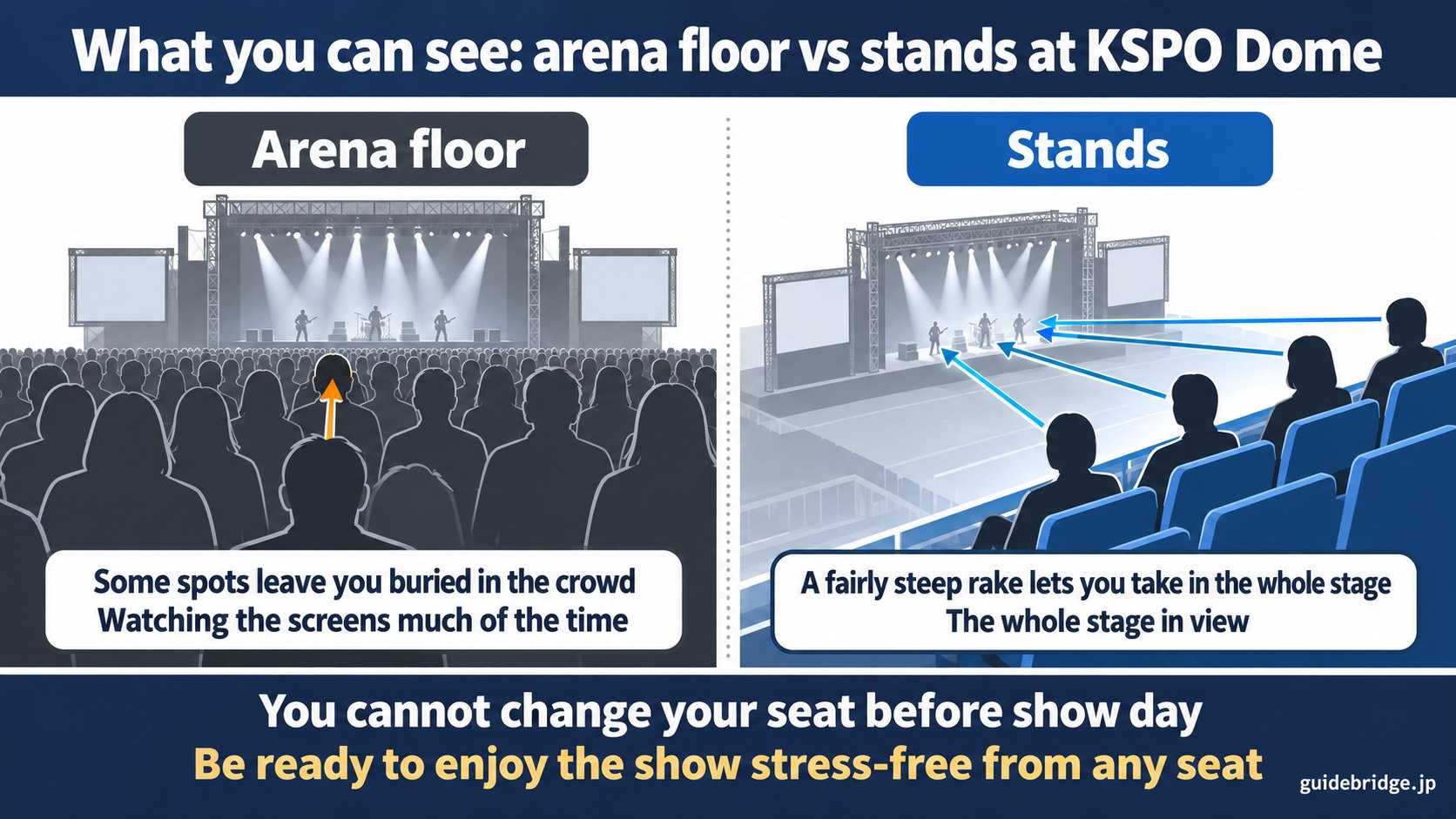
On social media, the arena floor has a reputation as the best place to be. At KSPO Dome, that is not always true.
Toward the back of the arena floor in particular:
- What you see depends on the height of the people in front of you
- It is hard to see the full staging
- You end up watching the screens much of the time
All of these are common.
GuideBridge’s verdict
Which seat is the luckiest matters less than this: are you prepared to enjoy the show stress-free from any seat?
You cannot change your seat before show day. What you can change is this:
- No panic over the restroom
- No getting lost
- No getting stuck after the show
Get these 3 points right, and your whole experience of the show changes a great deal.
Start here: don’t let the luck of your seat draw run your trip. That is the first step to a trip that goes well.
Getting there: the subway route that keeps you from getting lost, and the meeting-point trap
The nearest station to KSPO Dome is Olympic Park Station, on subway Lines 5 and 9.
On show day, most people use this station.
If you are coming from the airport, start with the next paragraph. If you are already in Seoul, start from the station nearest your hotel and use Line 9 or Line 8 as described here.
Heading straight from Incheon Airport? Take AREX (the airport railroad) to Gimpo Airport and change to a Line 9 express train. Get off at Olympic Park Station (올림픽공원역, 936), where the express stops. Line 9 runs both express and local trains. From a hotel in Gangnam or Sinnonhyeon, ride the same express train to Olympic Park Station.
Staying in the Jamsil area? Ride Line 8 for 1 stop to Mongchontoseong Station (몽촌토성역, 813) and walk from there.
On the way back, walking to Hanseong Baekje Station (한성백제역, 935) on Line 9 takes you out of the main crowd (I cover this in the getting-home section). Express trains do not stop at this station, so take a local train.
The walk from Olympic Park Station to the venue took me about 14 min, stopping to take photos (August 2026, under a heat wave warning, so treat it as the upper end). How station names appear varies from station to station and exit to exit. Some signs also show Japanese, and some are mostly in Hangul (Korean script). What works at every station is to match the station number (813, 935, 936) and the line color.
The basic route from the station to the venue
When you leave Olympic Park Station, use Exit 3 or Exit 4.
At recent shows, Exit 3 has often been the main route. On the day, follow the directions of the staff guiding the crowd.
Once you are outside, there is a steady flow of people. As a rule, following it takes you toward the venue.
The trouble starts after that.
What usually happens on show day
- Your phone signal drops in and out
- With so many people around, your location on the map drifts
- “Where are you?” messages in your chat app keep crossing, and you can’t work out where the other person is
And then comes the classic problem: you cannot find each other at the main gate.
GuideBridge’s verdict
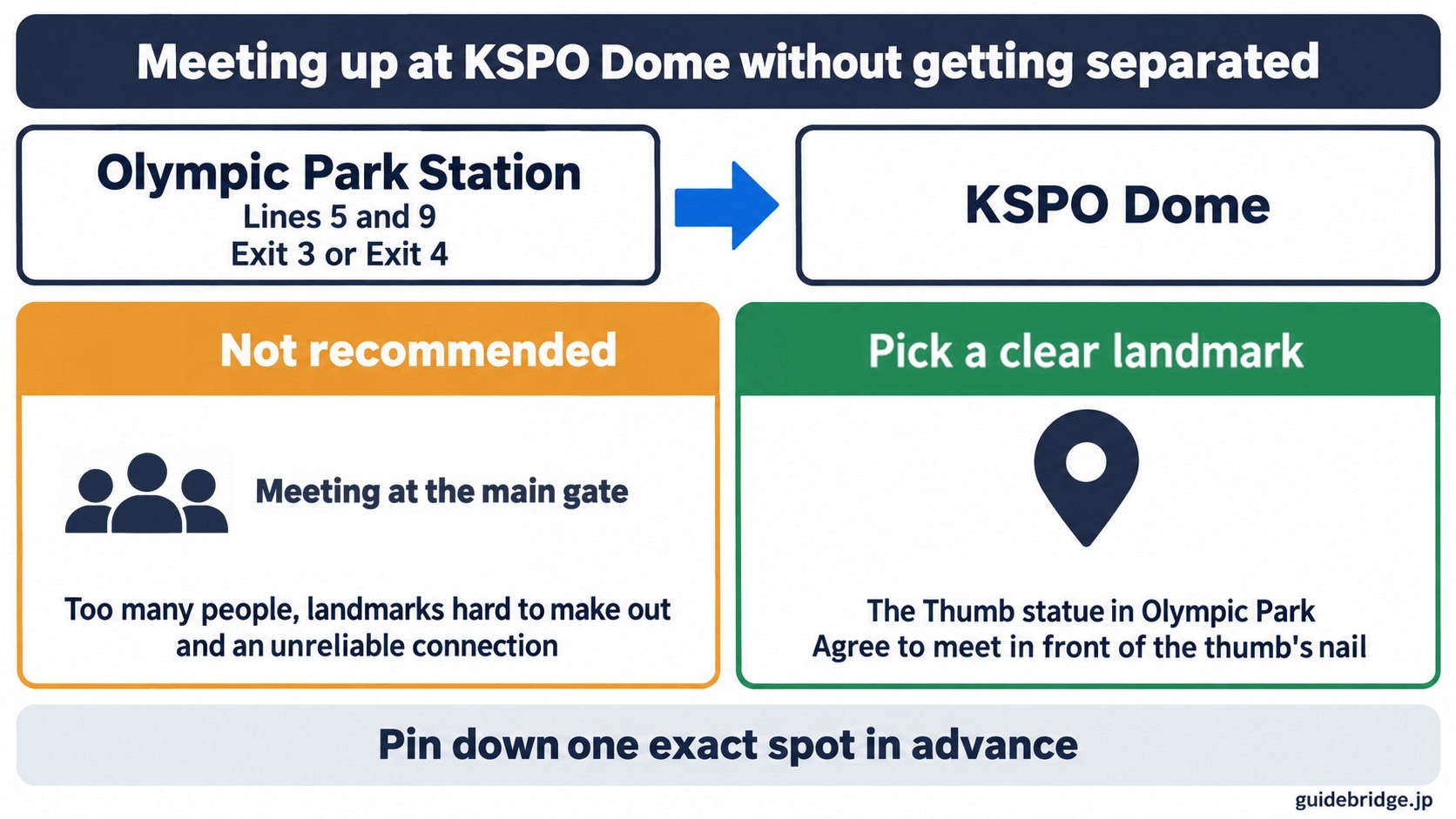
On show day, I do not recommend agreeing to meet at the main gate.
The reasons are simple:
- There are too many people
- The landmarks are hard to make out
- Your connection is unreliable
Put these 3 problems together, and meeting up becomes much harder than you expect.
What works is to agree in advance on a clear landmark a little away from the crowd.
For example:
- The huge golden Thumb statue (The Thumb) inside Olympic Park. You can spot it from far away, and if you agree to meet “in front of the thumb’s nail,” you will rarely end up in the wrong spot.
- Around the Paris Croissant bakery inside the station. The front gets crowded, so the trick is to say “behind the shop.”
Don’t settle for “somewhere near the front.” Pin down one exact spot in advance.
If you are visiting from abroad, you will need mobile data in Korea to send those messages. An eSIM is one option, and roaming on your home plan is another. If you live in Korea, your usual plan already covers this.
That alone takes a surprising amount of stress out of the time before you go in.
What comes next
So far, you have covered:
- How big the venue is
- How to think about your seat
- How to get there and avoid meeting-point mistakes
You have those covered.
Next, I cover luggage and lockers, the most common source of trouble, and how to get home without getting stuck after the show.
The luggage problem: the lockers will be full, so what do you do with your suitcase?
Luggage trips up more KSPO Dome visitors than you would expect.
- You start looking for a locker only after you reach the station
- You walk around the venue looking for somewhere to leave your bags
- You are worn out before the show even starts
This happens a lot.
The reality of the station lockers
I will be honest.
Do not expect much from the lockers around Olympic Park Station.
The reasons are simple:
- Seasoned concert travelers grab them as early as the first train of the day
- For a show with a crowd of 15,000, there are nowhere near enough
- If you arrive from early afternoon onward, you will find nearly all of them taken
Hoping one might still be free is a risky bet at KSPO Dome.
You have 2 real options
Option 1: Leave it at your hotel (the best choice)
The best plan is to leave your bags at your hotel, even before or after check-in.
Even if it means a small detour, you get these benefits:
- You arrive at the venue with nothing to carry
- You don’t bump into people in the crowd
- Restroom trips and getting around become far easier
That is a big difference on show day.
Option 2: Use a delivery service (the next best choice)
If you really cannot get back to your hotel, the practical answer is a delivery or storage service you can reserve in advance.
In Korea, delivery apps such as T luggage can move your bags like this:
- Airport or station → hotel
- Station → hotel
That way, your luggage moves without passing through the places where crowds gather.
Note: apps like these are easier to use on the day if you have a working data connection, such as an eSIM.
GuideBridge’s verdict
On a KSPO Dome trip, I do not recommend betting on the lockers at the venue.
For your luggage, plan on one of these:
- Don’t bring it with you at all
- Leave it or send it ahead of time
Pick one and build your plan around it.
A concert takes a lot of stamina.
Not wearing yourself out before you go in is what decides whether the day goes well.
Restrooms: the quieter routes that get you past the long lines before the show
On a KSPO Dome trip, the thing that wears on your nerves most is the restroom.
- It is 30 minutes before the show, and the line is huge
- The line does not move
- Your heart rate climbs while you wait
This is no exaggeration.
The station restrooms usually have a long line
The first thing to know:
The restrooms at the nearest station, Olympic Park Station, are close to useless on show day.
Here is why:
- People arriving and people about to go in all crowd in at once
- The line moves slowly
- Even when the line is long, it is hard to step out of it halfway
As a result, it becomes the worst place to be, costing you both time and energy.
The less crowded spots inside the venue
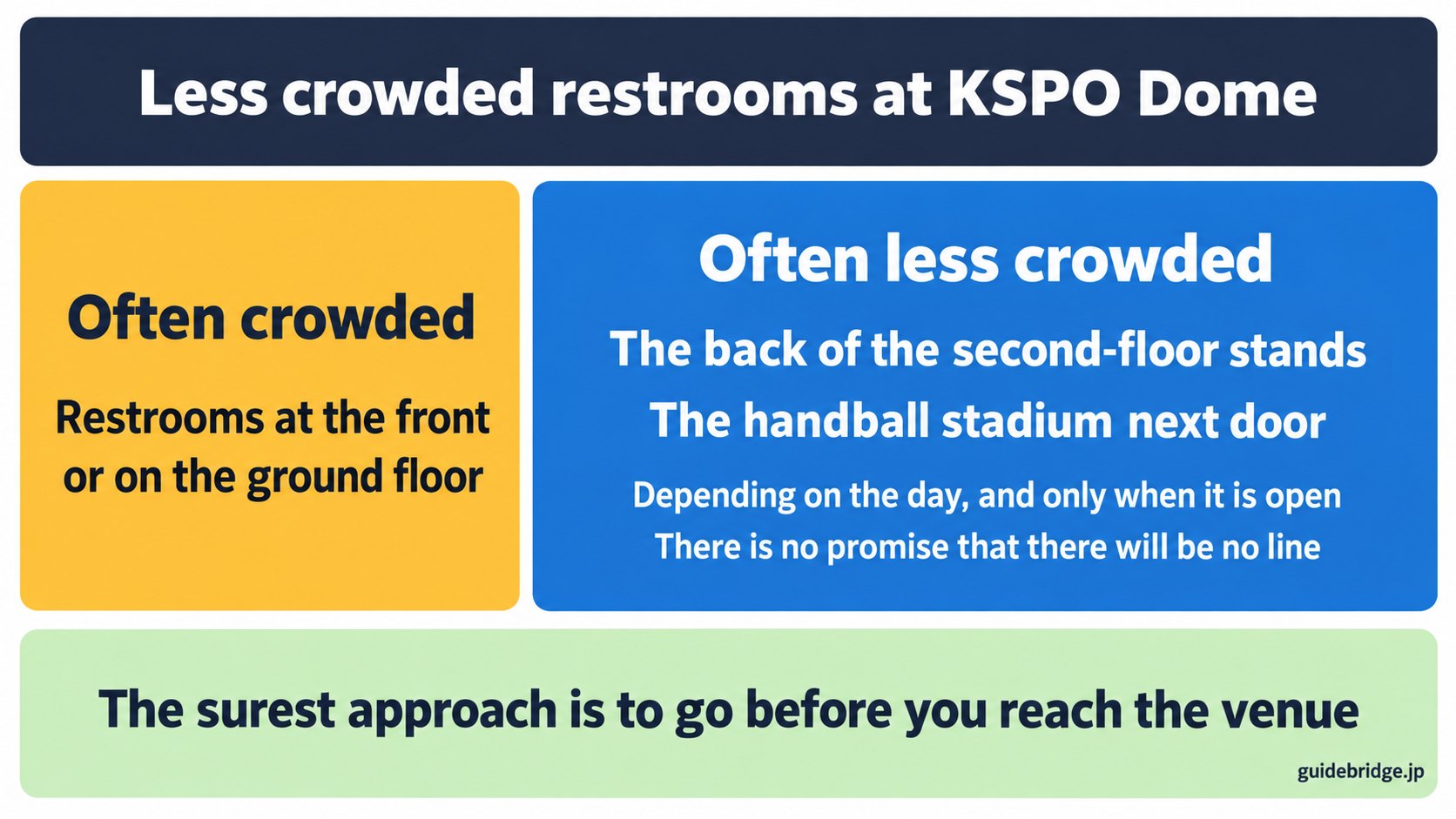
If you still need to use a restroom inside the venue, try these:
- The back of the second-floor stands
- Depending on the day, the neighboring SK Handball Stadium (only when it is open)
These are often less crowded than the restrooms at the front or on the ground floor.
That said, there is no promise that there will be no line.
One more thing. In Korean restroom stalls, whether you can flush toilet paper depends on the place. Rules on this differ by country, so do not assume it works the way it does at home. There are only 2 things to check: the posted sign and whether a plunger is in the stall. I walk through how to decide in my guide to restrooms in Korea (Japanese only for now).
The most reliable fix
Here is the bottom line.
The surest approach is to go before you reach the venue.
Specifically:
- At the station where you change trains
- At a mid-sized station where crowds do not build up
- Before you leave your hotel
Going at one of these points is the least stressful way.
GuideBridge’s verdict
The restroom is not something to deal with once you are there. It is something to settle while you plan.
Rather than draining your energy in a line, go ahead of time and walk in with time to spare.
Getting home: the routes out that keep you from getting stranded after the show
The moment the show ends, the next challenge begins: the rush to get home.
At KSPO Dome in particular, three things pile up at once:
- The whole crowd leaving at once
- Entry restrictions at the station, where staff hold the crowd outside the gates
- Too few taxis
Together, they make getting home take far longer than you expect.
Take taxis off your list
Let me be clear up front.
I do not recommend trying to get a taxi after the show.
Here is why:
- You can hardly ever get one
- Even if you do, there is a high chance of heavy traffic
- You wait a long time in the cold (or the heat)
Every one of these costs you energy and time.
That verdict stands. Still, in case your luggage or how you feel makes the subway too much for you, here is the one way out. If you call a taxi, do it after walking away from the venue, toward Hanseong Baekje Station (한성백제역, 935) or the next station over. After the show, buses fill the turnaround in front of the venue and traffic restrictions go into effect. You cannot even get a ride through a ride-hailing app there. If you still cannot get a car, my guide to what to do when no car comes walks through the steps in order (Japanese only for now).
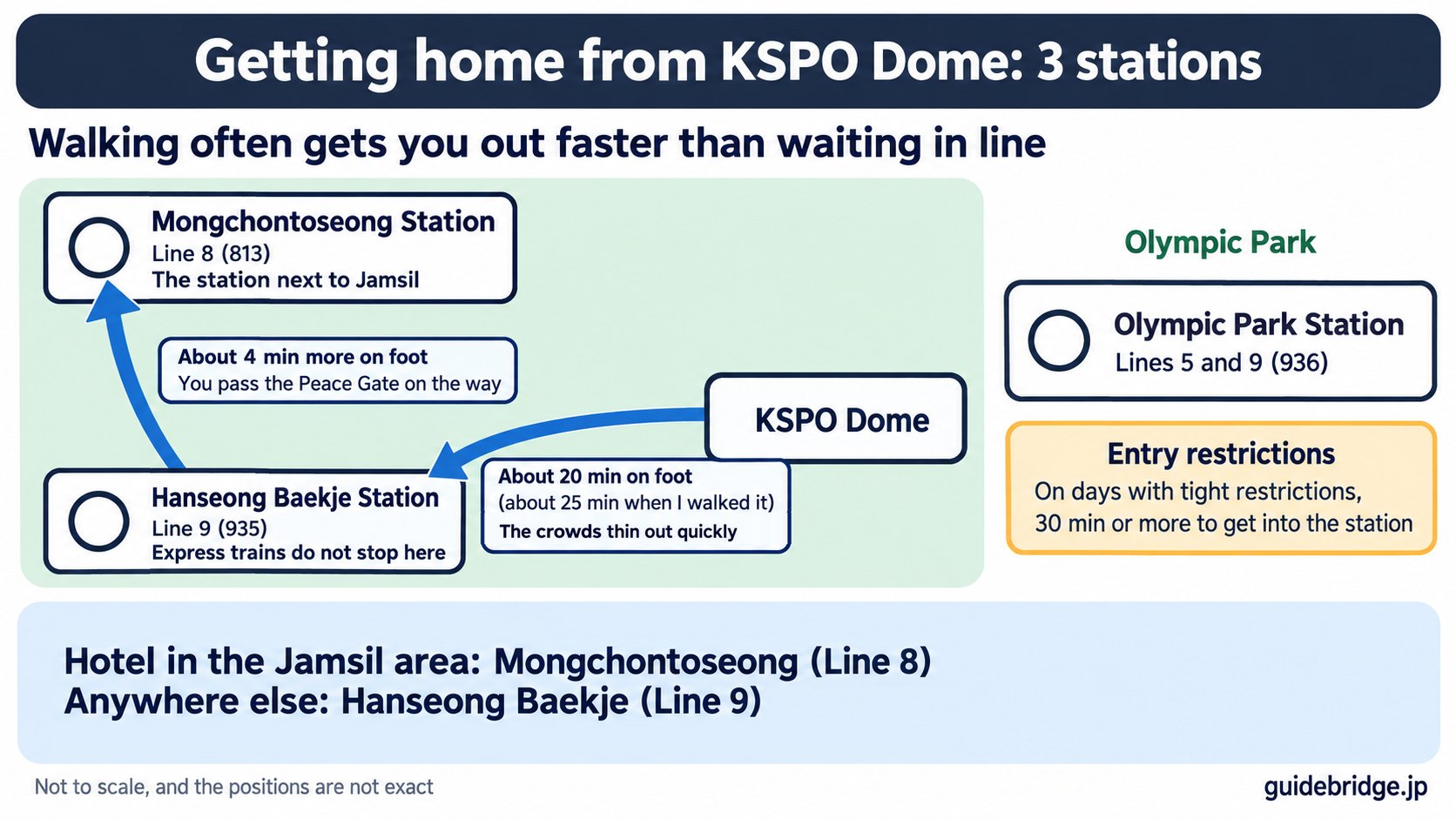
The main route: Olympic Park Station
Most people choose this route:
- Line up and wait out the entry restrictions at Olympic Park Station
That is the default.
However:
- On days with tight restrictions, it takes 30 min or more just to get into the station
- The crowd moves slowly
Neither is unusual.
The back route: walk to Hanseong Baekje Station
The other option is to walk to Hanseong Baekje Station.
- About 20 min on foot
- The crowds thin out quickly
- There is a good chance you can board a train without trouble
When I walked it in August 2026, stopping to take photos, it took me about 25 min (on a route that cuts southwest through Olympic Park to the station). There is a Starbucks in front of the station with a restroom you can use and places to sit. It is also a good place to wait for the post-show crowd to thin out.
Keep walking west, and you reach Mongchontoseong Station (813) on Line 8. From Hanseong Baekje Station, it took me about 4 min (August 2026). On the way, you pass the Peace Gate, a large gate-shaped monument. By my count, it was about 50 seconds from first seeing the gate to the station entrance. Both stations are on the west side of the venue. So you can stay clear of the entry restrictions at Olympic Park Station and still choose Line 9 or Line 8 for the ride home. If your hotel is in the Jamsil area, Mongchontoseong is the station next to Jamsil, so you have fewer transfers. For anywhere else, ride Line 9 straight from Hanseong Baekje Station.
It takes a little more energy, but you often reach your hotel sooner in the end.
GuideBridge’s verdict
After the show, the key decision is this:
- Wait where you are
- Or walk a little and get out of the main flow
That choice matters.
If you have energy to spare, walking out is well worth considering.
Rather than waiting in line for ages, walk your way out. It is the practical answer.
That is the trick to a KSPO Dome trip.
Where to stay: choose your hotel by whether you can get back, not by price
This section is for people staying the night in Seoul. If you live in Seoul and head home the same night, you can skip ahead.
On a KSPO Dome trip, getting the hotel wrong can drag down the whole trip. That is not an overstatement.
These are the common mistakes:
- You chose on price alone, and after the show it is one transfer after another
- The streets are dark at night, and walking back alone feels unsafe
- By the time you reach the hotel, you have no energy left
Choose your hotel for how you will feel after the show
At GuideBridge, this is the test we use for choosing a hotel:
“After the show, worn out, can you get to your bed without getting lost, safely and without strain?”
Look at it this way, and the areas worth choosing narrow down on their own.
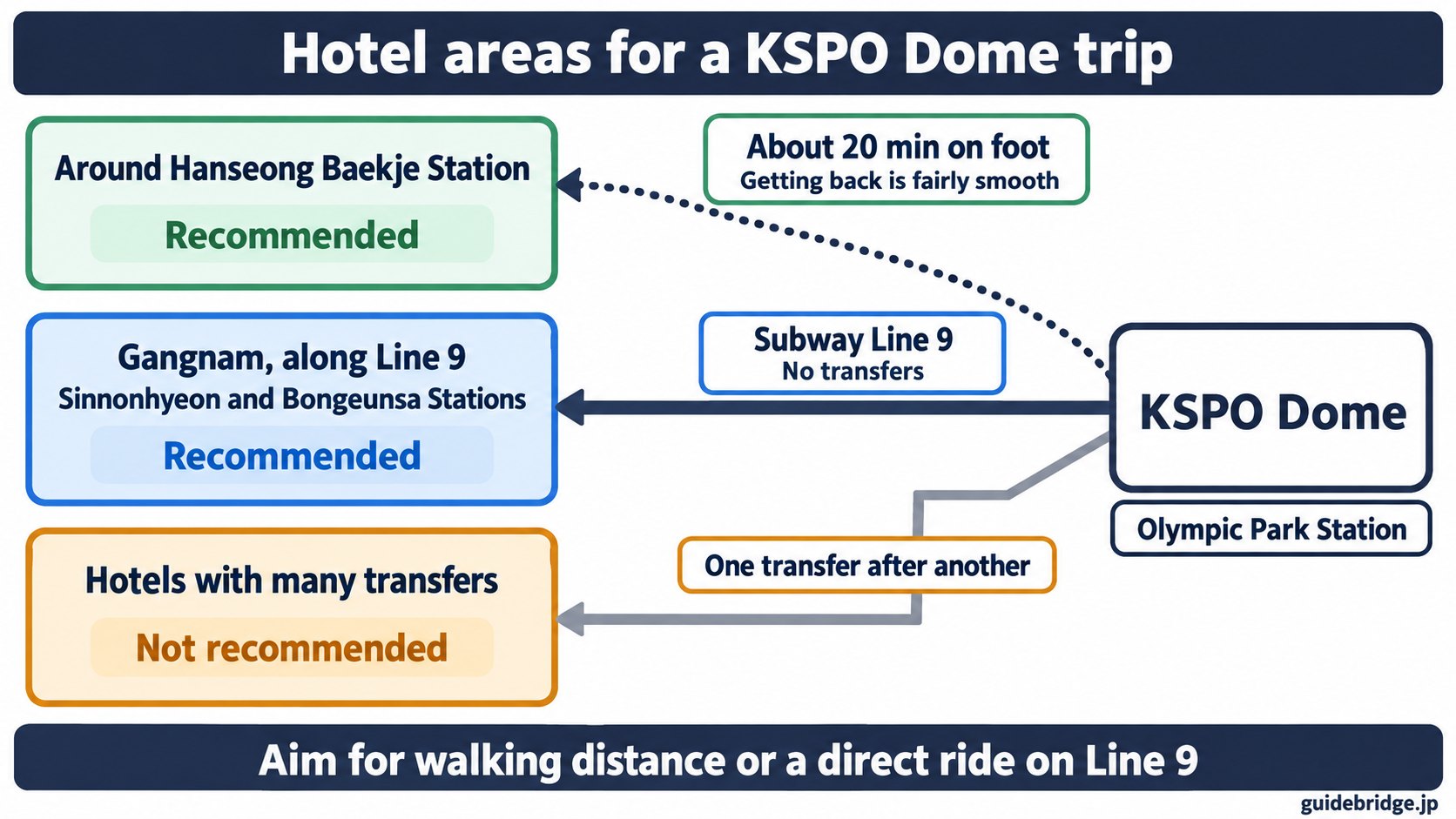
Option 1: Around Hanseong Baekje Station
This is where the walking route out ends, as covered in the getting-home section above.
- About 20 min on foot from KSPO Dome
- The crowd after the show spreads out, so getting back is fairly smooth
- Hotel prices are more moderate than in central Gangnam
If you just want to get back without waiting in line, or if crowds are hard for you, this is a very practical choice.
You don’t need a hotel in this area if you live in Seoul and can get home by subway after the show, or if you already have a room on an easy route back. The Trip.com link opens a hotel search around the station.
Narrowed down by the route from the venue
Option 2: Areas a single subway ride away (Jamsil and Gangnam)
Within this option, I especially recommend the stretch along subway Line 9, which runs straight to KSPO Dome. Gangnam is the busy district south of the Han River, and from there Line 9 reaches the venue with no transfer.
Specifically:
- Sinnonhyeon Station
- Bongeunsa Station
Using one of these as your base gives you:
- No transfers
- Busy streets even late at night, so you can feel at ease about safety
- Plenty of restaurants and convenience stores, so you are covered at night
Those are the benefits. For Jamsil, the Line 8 route from Mongchontoseong Station in the getting-home section applies.
Prices are somewhat higher. Still, paying for an easy ride back and peace of mind is a perfectly reasonable choice on a concert trip.
Here too, you don’t need a hotel if you can already get home or back to your room by an easy route. If you are staying the night, the link works the same way as the one above.
Narrowed down by the route from the venue
GuideBridge’s verdict
However cheap it is, I do not recommend a hotel with any of these:
- Many transfers
- Cutting it close to the last train
- Dark streets at night, or few people around
Skip hotels like these.
A concert trip is a break from everyday life. A plan that does not push you too hard is, in the end, the easiest one.
The day after: care that keeps the trip’s fatigue from showing on your face
This section follows principle 3 of the GuideBridge charter.
The day after the show, do you wake up like this?
- Your legs are swollen and heavy
- Your shoulders and neck are stiff
- Your face is puffy, and you don’t feel like taking photos
But if you are still in Korea the next day, you want to enjoy it too.
What GuideBridge does not cover
Let me make this clear first.
GuideBridge does not cover cosmetic medical treatments (injections or procedures) that carry downtime or risk.
- They may cause swelling
- Pain can linger
- They can get in the way of your plans the next day
Treatments like these do not go well with a trip to see the artist you love.
The care GuideBridge recommends
What we cover is care focused on recovery and relaxation.
- Spas and saunas
- Beauty treatments (non-medical)
- Skin care centered on soothing and moisturizing
There is only one goal:
“Shake off the fatigue and start the next day feeling good.”
Korea has many high-quality spas and care options that take just 1–2 hours.
GuideBridge’s verdict
Care during a trip is not about changing yourself. It is about getting back to normal.
Don’t overdo it. Just reset your body and your face.
That alone makes a big difference to how much you enjoy the next day.
No injections or invasive treatments included
Frequently asked questions
Summary: how to make your KSPO Dome trip a success
The goal of a KSPO Dome trip is not just getting to the venue.
It is to be in the best shape you can, in mind and body, at the moment you see your favorite artist.
What matters for that:
- A route where you do not get lost
- A plan that does not wear you out
- Decisions that do not push you too hard
GuideBridge is an online information desk built to help you make the calls that avoid mistakes, not to sell.
I hope this guide makes your trip a little easier and leaves you with happy memories.
For how GuideBridge makes its calls, see our “no hard sell” pledge (Japanese only for now).
For other venues, my complete guides to Inspire Arena and Gocheok Sky Dome use the same way of deciding. To compare how hard each venue is in one place, there is also my comparison of the 5 major concert venues in Korea. All three are in Japanese only for now.
If you find yourself unsure again, come back here any time.
If you are torn over which area to stay in for a trip to this venue, my guide comparing 5 areas is the place to start. Written for women traveling alone, it compares areas including Myeongdong, Hongdae, Gangnam/Jamsil, and Incheon/the airport (Japanese only for now).
This page was produced from the Japanese original with AI assistance. Every number, station name and time was machine-checked against the Japanese source and its official references. If something is wrong, tell us here -> /en/contact/.