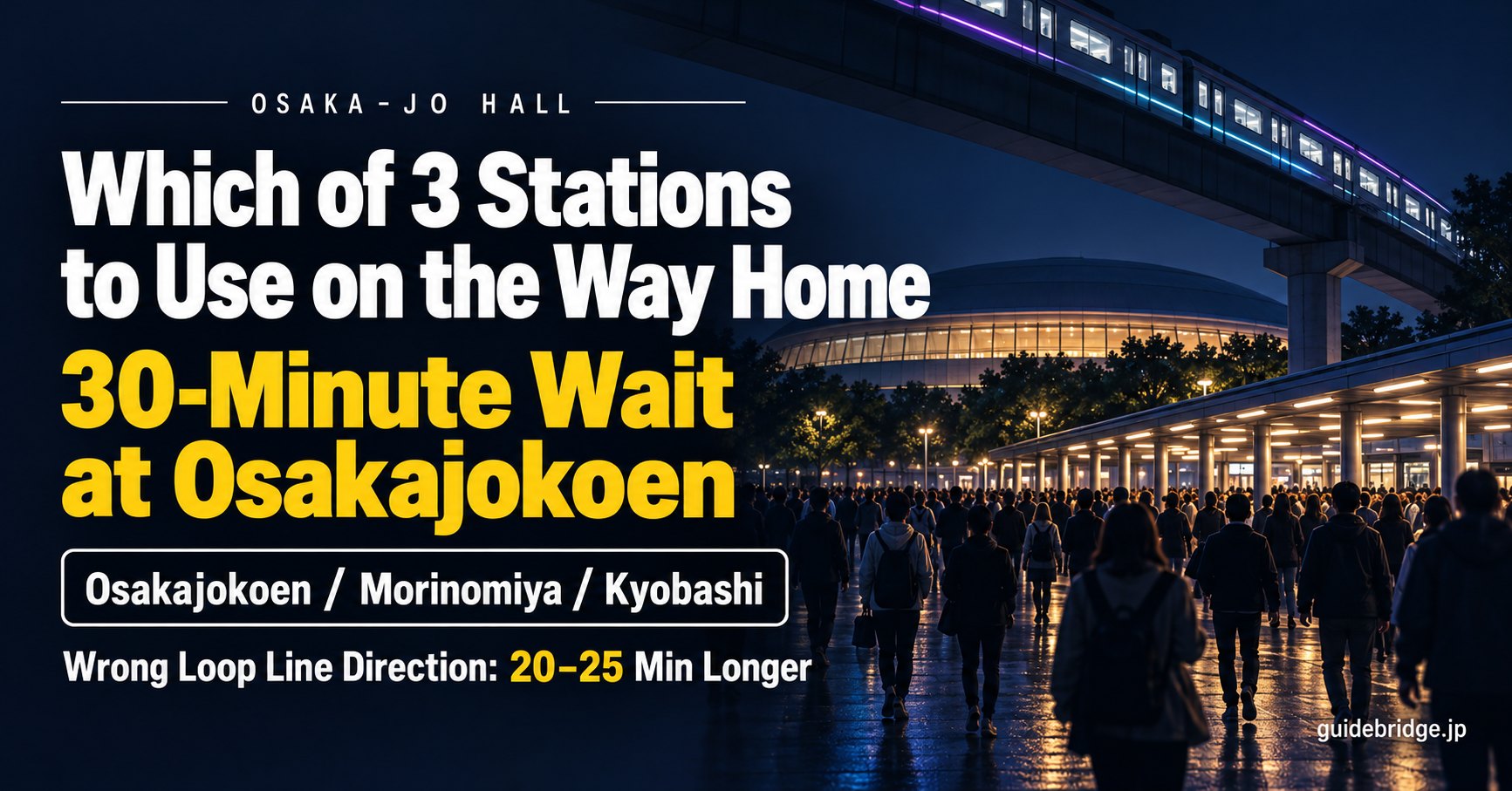
Getting home from Osaka-Jo Hall comes down to one choice: which of 3 stations you walk to (Osakajokoen, Morinomiya or Kyobashi). That choice alone can change your trip home by 20–25 minutes. The official guides put all three at a 5–20 min walk. But if you head for the closest one, Osakajokoen Station, right after the show, you follow the same route as most of the 16,000-strong crowd. Expect a 30-minute wait just to reach the platform. First-timers in Kansai (Osaka, Kyoto, Kobe, Nara) also run into a JR Osaka Loop Line trap: trains go both ways around the loop, called the inner loop and the outer loop. Both seem to head for Osaka Station, and the wrong one costs a 20–25 minute detour. And there are almost no business hotels (Japan’s compact, no-frills hotels) around Osakajokoen Station. Fans who assume they can stay by the nearest station end up without a room at the last minute.
Osaka-Jo Hall opened in 1983 and holds up to 16,000 people, which makes it one of the longest-serving full-scale multipurpose arenas in Japan. EXO, BTS, BLACKPINK and TWICE play here on every tour, and it is the landmark venue for K-pop concerts in the Kansai region. First-timers tend to fall into 3 traps: (1) the crush at Osakajokoen Station after the show, (2) boarding the Loop Line in the wrong direction, and (3) not checking in advance that there are no hotels around Osakajokoen Station. All three are avoidable if you know about them, but at your first show, nobody tells you.
This guide covers avoiding a mix-up with other K-pop arenas, how to use the 3 stations, which station to use for the direction you are heading, the inner and outer loops, last-train deadlines, and four areas where a woman traveling alone can stay. It is written for fans who live in Japan and arrive by local train or by Shinkansen (Japan’s bullet train, which stops at Shin-Osaka Station). If you are visiting Japan, treat “home” in this guide as wherever you are sleeping tonight. The route to Kansai International Airport is in the Loop Line table.
- How to tell Osaka-Jo Hall from other K-pop venues (Namba Hatch, INTEX Osaka and others)
- The basics of Osaka-Jo Hall (opened in 1983, room for 16,000, and how it became a K-pop landmark)
- Walking times from the 3 stations (Osakajokoen, Morinomiya, Kyobashi) and when to use each
- Which station to use, by where you are heading home (Umeda, Tennoji, Namba, Nara, Kyoto, the Shinkansen)
- How to choose the inner loop or the outer loop on the Osaka Loop Line (a trap specific to Kansai)
- Last-train deadlines by direction (what to do if the show ends in the 22:00 hour or the 23:00 hour)
- Four areas where a woman traveling alone can stay (with Kyobashi, Morinomiya or Namba as a base)
The approximate last-train times, walking and transfer times, and capacity figures here are as of May 2026, when the Japanese original was published. For the latest last trains, check the official timetables for the JR Osaka Loop Line, the JR Tozai Line, Osaka Metro and Keihan.
Check first: is your ticket for Osaka-Jo Hall, or for another Kansai arena?
Before you plan your way home from Osaka-Jo Hall, check the venue name on your ticket. When people hear “a K-pop show in Osaka,” some of them, mostly first-timers, mix up Osaka-Jo Hall with another venue. The ones to watch for are Namba Hatch (in Minato-machi, Chuo-ku) and INTEX Osaka (in Nankokita, Suminoe-ku). Each sits in a different part of the city, with a different nearest station.
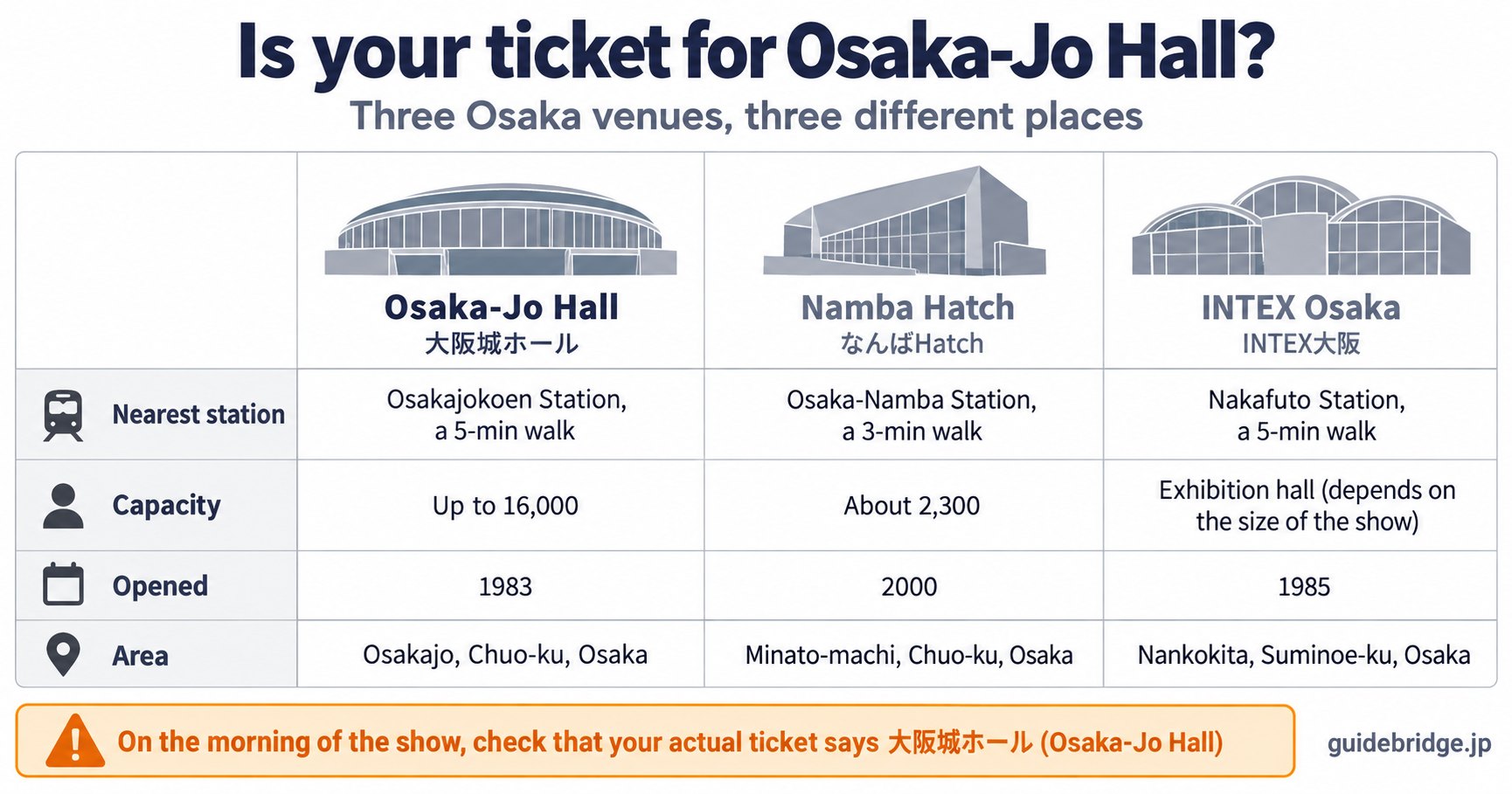
| Item | Osaka-Jo Hall | Namba Hatch | INTEX Osaka |
|---|---|---|---|
| Nearest station | Osakajokoen Station, a 5-min walk | Osaka-Namba Station, a 3-min walk | Nakafuto Station, a 5-min walk |
| Capacity | Up to 16,000 | About 2,300 | Exhibition hall (depends on the size of the show) |
| Opened | 1983 | 2000 | 1985 |
| Area | Osakajo, Chuo-ku, Osaka | Minato-machi, Chuo-ku, Osaka | Nankokita, Suminoe-ku, Osaka |
Osaka-Jo Hall (address: 3-1 Osakajo, Chuo-ku, Osaka) stands inside Osaka Castle Park. It is in a separate area, at least 3–5 km as the crow flies from Namba Hatch and the other venues around Namba. The only way to prevent a mix-up is a simple habit: on the morning of the show, read the venue name on your actual ticket out loud and confirm that it says 大阪城ホール or Osaka-Jo Hall.
Osaka-Jo Hall is at 3-1 Osakajo, Chuo-ku, Osaka, and its nearest stations are JR Osakajokoen, Morinomiya and Kyobashi. Namba Hatch and INTEX Osaka are in entirely different locations. Checking the venue name on your actual ticket that morning is the first condition for a smooth day.
Osaka-Jo Hall by the numbers: opened in 1983, room for 16,000, a K-pop landmark
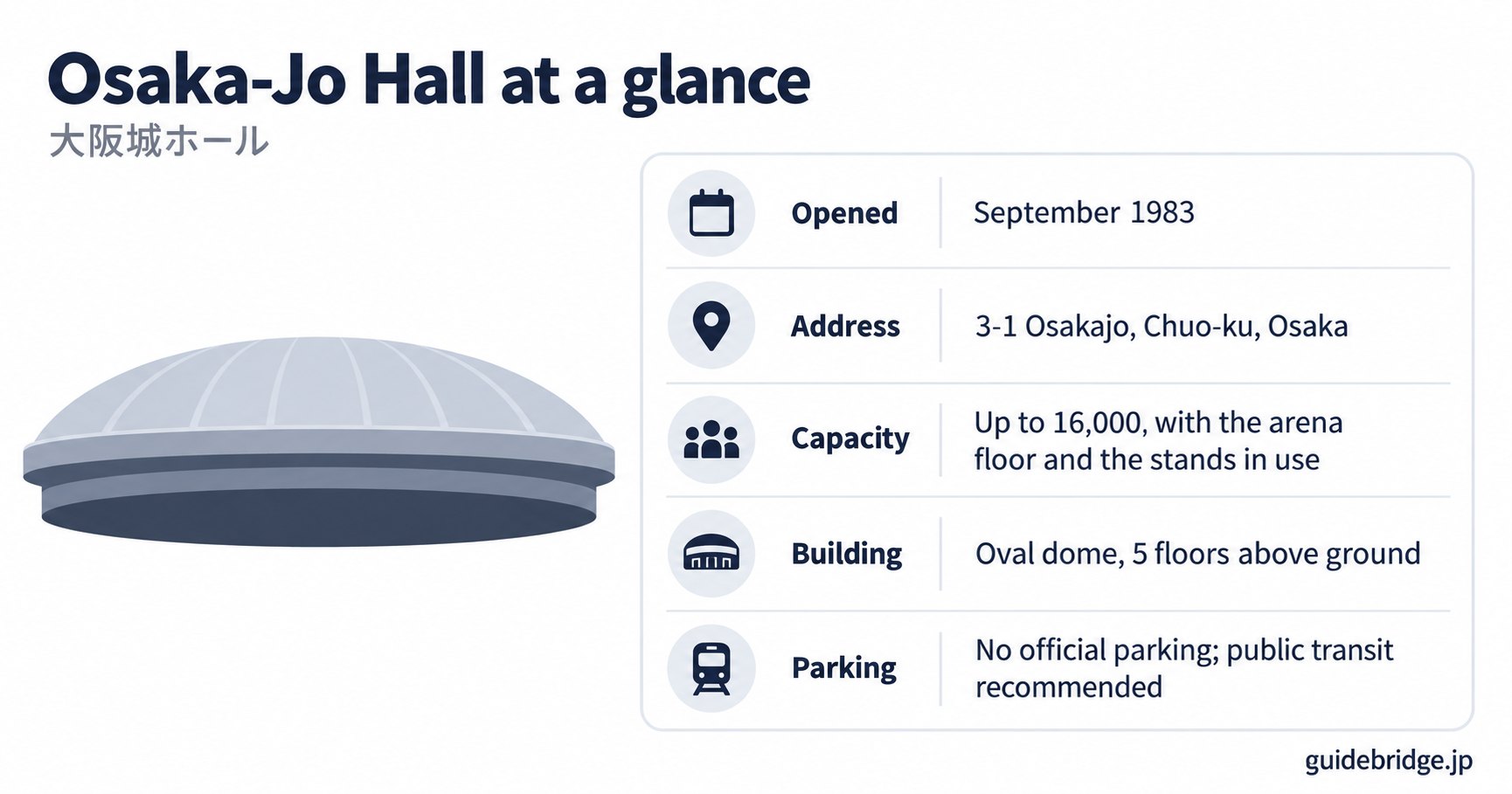
Osaka-Jo Hall opened in September 1983 (1983-09, or Showa 58 in Japan’s era calendar) at 3-1 Osakajo, Chuo-ku, Osaka. It is a multipurpose arena with a maximum capacity of 16,000, run by Osaka-Jo Hall Co., Ltd., a company led by the City of Osaka. As one of Japan’s earliest full-scale indoor multipurpose arenas, it has been in use for more than 40 years, and its design is distinctive: an oval dome with 5 floors above ground. There is no official parking, and the venue officially recommends public transit.
How it became a K-pop landmark
It started with the first wave in the 1990s, with acts such as H.O.T. and BoA, and continued through EXO, SHINee and 2PM in the 2010s. Since 2017, BTS, BLACKPINK and TWICE have played Osaka-Jo Hall on every tour. Among K-pop fans, “the Osaka show” and “Osaka-Jo Hall” mean the same thing, and the hall is regarded as the landmark live venue of the Kansai region. Along with Jingu Stadium and Tokyo Dome in Tokyo, it is also one of the venues where K-pop tours of Japan often end.
Venue specs and what to watch for
Capacity is 16,000 at most, with both the arena floor and the stands (the tiered seating around it) in use, and 8,000–10,000 when only the arena floor is used, so it varies with how each show is set up. Because the building is an oval dome, large screens help you see the stage even from the back of the stands. The arena floor is often standing-only, and the front areas get very crowded. Coin lockers are available inside the venue and nearby, but on show days, grab one early.
Getting there: 3 stations, a 5–20 min walk, and when to use each (you can walk from any of them)
Osaka-Jo Hall has 3 nearest stations. In order of distance, they are Osakajokoen Station (about a 5-min walk), Morinomiya Station (about a 15-min walk, per the official Osaka-Jo Hall guide as of October 2026) and Kyobashi Station (about a 15–20 min walk). The closest is Osakajokoen, then Morinomiya, then Kyobashi, but the number of lines you can take home grows in the reverse order. This reversal is the root of the “wrong station” mistake on the way home.
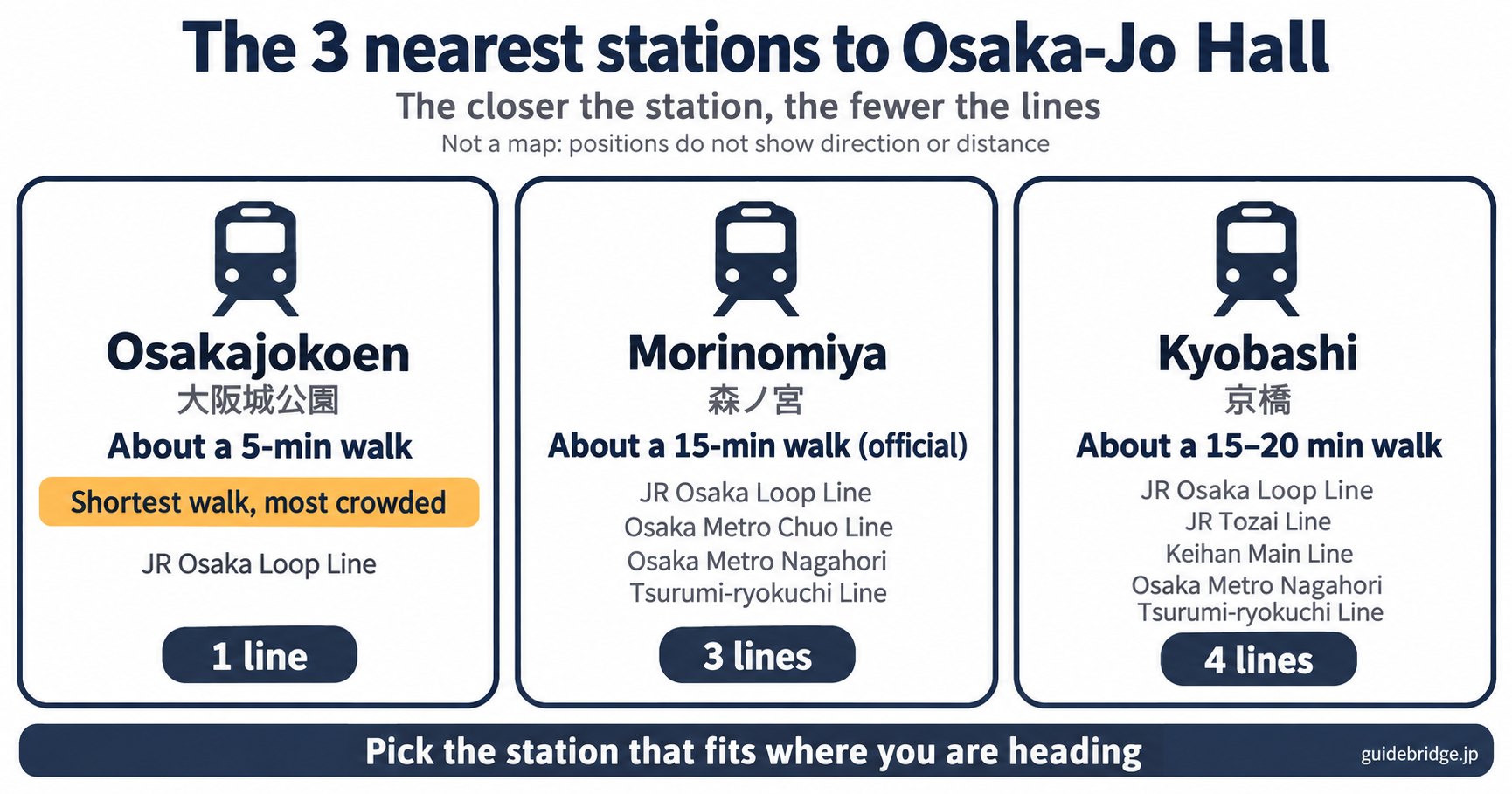
| Station | Lines | Walk | Number of lines |
|---|---|---|---|
| Osakajokoen Station | JR Osaka Loop Line | About 5 min | 1 line (you must transfer to go anywhere off the loop) |
| Morinomiya Station | JR Osaka Loop Line / Osaka Metro Chuo Line / Osaka Metro Nagahori Tsurumi-ryokuchi Line | About 15 min (official Osaka-Jo Hall guide, as of 2026-10) | 3 lines |
| Kyobashi Station | JR Osaka Loop Line / JR Tozai Line / Keihan Main Line / Osaka Metro Nagahori Tsurumi-ryokuchi Line | About 15–20 min | 4 lines |
Morinomiya and Kyobashi are shared by several rail operators, each with its own gates and fares. For a barrier-free route, the way from Morinomiya Station to the east entrance of the Osaka Castle grounds is known for having fewer steps. If you have a suitcase or a lot of luggage, take the Morinomiya route. If you are arriving the day before, a hotel in the Kyobashi or Morinomiya area is the best choice.
You don’t need a hotel near the venue if the show ends early enough for your last train and you live in or near Osaka, or already have a room in Osaka city (in Umeda or Namba, for example). The deadlines are in the table further down. The button below is for fans arriving the day before, or heading far from Osaka after the show.
The main trap: picking the wrong station on the way home, and how to choose fast by direction
On the way home from Osaka-Jo Hall, your first decision is which station to walk to: Osakajokoen, Morinomiya or Kyobashi. After the show, most people head for Osakajokoen Station because it is the shortest walk, so it becomes the most crowded, and there is a 30-minute wait just to reach the platform. The rule for losing no time: pick the station that fits where you are heading, not the shortest walk.
Place names below: Umeda is the area around Osaka Station; Namba and Shinsaibashi are the Minami shopping district; Tennoji and Abeno are the hub to the south; Higashi-Osaka lies east, toward Nara; Shin-Osaka is the Shinkansen station.
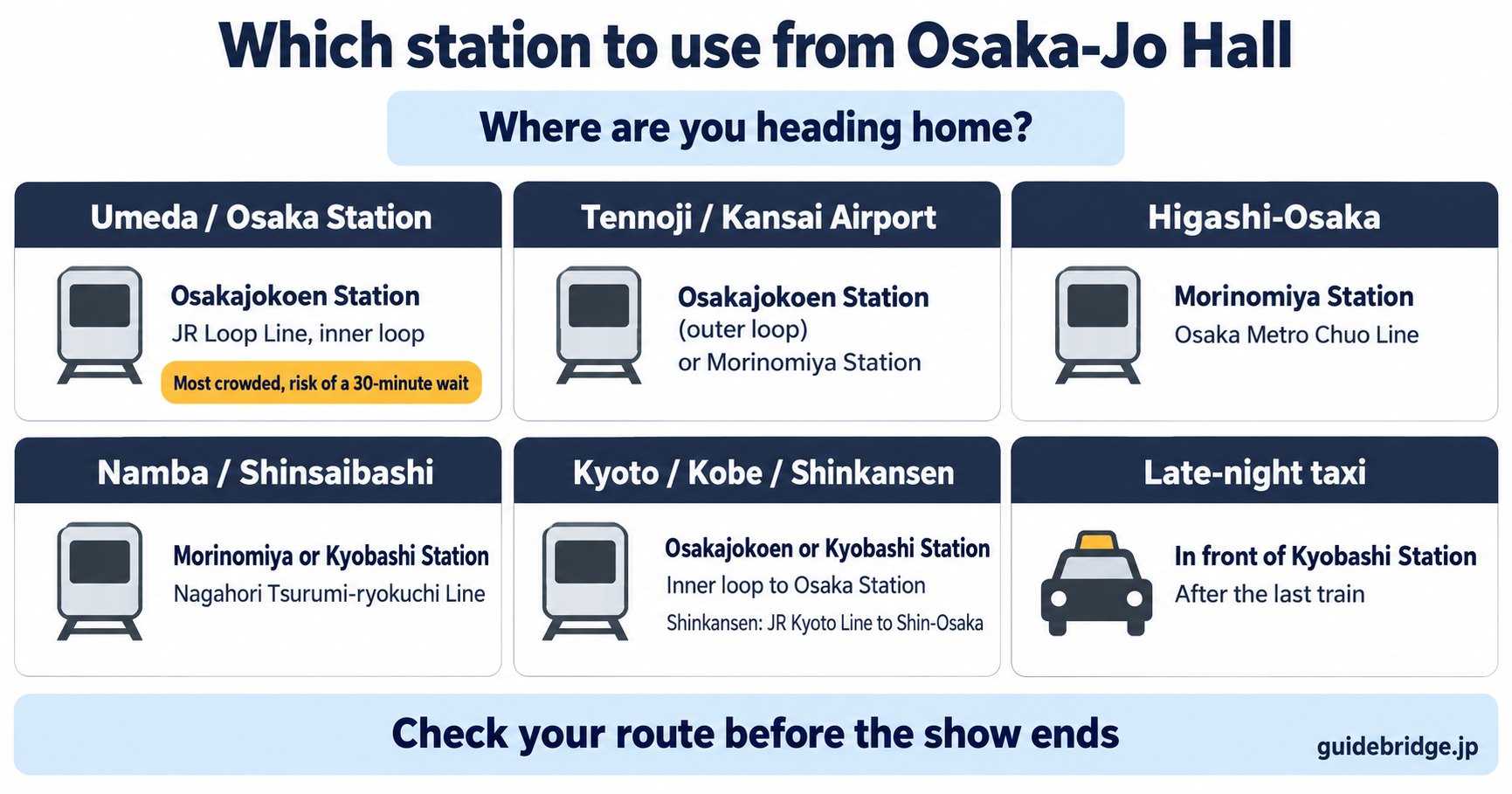
How to choose your station by direction
| Heading home toward | Recommended station | Line and notes |
|---|---|---|
| Umeda / Osaka Station | Osakajokoen Station (JR Loop Line, inner loop) | Shortest walk but the most crowded. To avoid the crowd, you can also board at Morinomiya Station |
| Tennoji / Abeno / Kansai Airport | Osakajokoen Station (JR Loop Line, outer loop) or Morinomiya Station | To avoid the crowd, take the outer loop from Morinomiya |
| Higashi-Osaka / Nara | Morinomiya Station | Direct on the Osaka Metro Chuo Line, no transfer |
| Namba / Shinsaibashi | Morinomiya Station or Kyobashi Station | Both give access to the Osaka Metro Nagahori Tsurumi-ryokuchi Line |
| Kyoto / Kobe (connecting to the Shinkansen) | Osakajokoen Station or Kyobashi Station (JR Loop Line, inner loop) → Osaka Station → JR Kyoto Line → Shin-Osaka | For Kyoto, the Keihan Main Line from Kyobashi Station also works. For Kobe, the JR Tozai Line from Kyobashi Station (toward Kitashinchi and Amagasaki) also works. The JR Tozai Line does not pass through Shin-Osaka |
| Late-night taxi (after the last train) | In front of Kyobashi Station | Has a taxi stand where cabs line up, and wide roads make it easy to catch one |
The crowd after the show eases in stages. For the first 15 min (0–15 min after the show), lines build on the platform at Osakajokoen Station. At 15–30 min, Morinomiya Station hits its peak as well. At 30–45 min, every station starts to ease, and from 45 min on, boarding around Kyobashi Station feels almost like a normal day. The most efficient way to avoid the crowd is to wait it out on purpose: shop for merch or take a café break, and aim to board your train 45 minutes after the show ends.
Pia Arena MM in Yokohama poses the same choice with 2 stations; Osaka-Jo Hall has 3, which makes the decision harder. Our guide to getting home from Pia Arena MM (Japanese only for now) works through the same kind of by-direction decision.
Toward Umeda, use Osakajokoen Station (inner loop). Toward Nara or Higashi-Osaka, use Morinomiya Station (Chuo Line). Toward Namba or Kyoto, use Kyobashi Station. For the Shinkansen at Shin-Osaka, take the JR Loop Line inner loop to Osaka Station and change to the JR Kyoto Line. The biggest trap is assuming the shortest walk, Osakajokoen, is the right station. Deciding your station before the show ends, working back from where you are heading, is the one way to avoid losing 50 minutes.
A Kansai-specific trap: boarding the Osaka Loop Line in the wrong direction (inner loop vs. outer loop)
The JR Osaka Loop Line is not a one-way loop: trains run in two directions on the same line, the inner loop and the outer loop. Many cases are reported of first-timers used to JR lines around Tokyo boarding at Osakajokoen or Morinomiya without checking the direction. They assume any Loop Line train will take them back to Osaka Station. At the JR Osaka Loop Line platforms at Osakajokoen and Morinomiya stations, the inner loop is signed “Kyobashi / Osaka” (京橋・大阪方面) and the outer loop is signed “Tsuruhashi / Tennoji” (鶴橋・天王寺方面) (JR West station maps, as of October 2026).
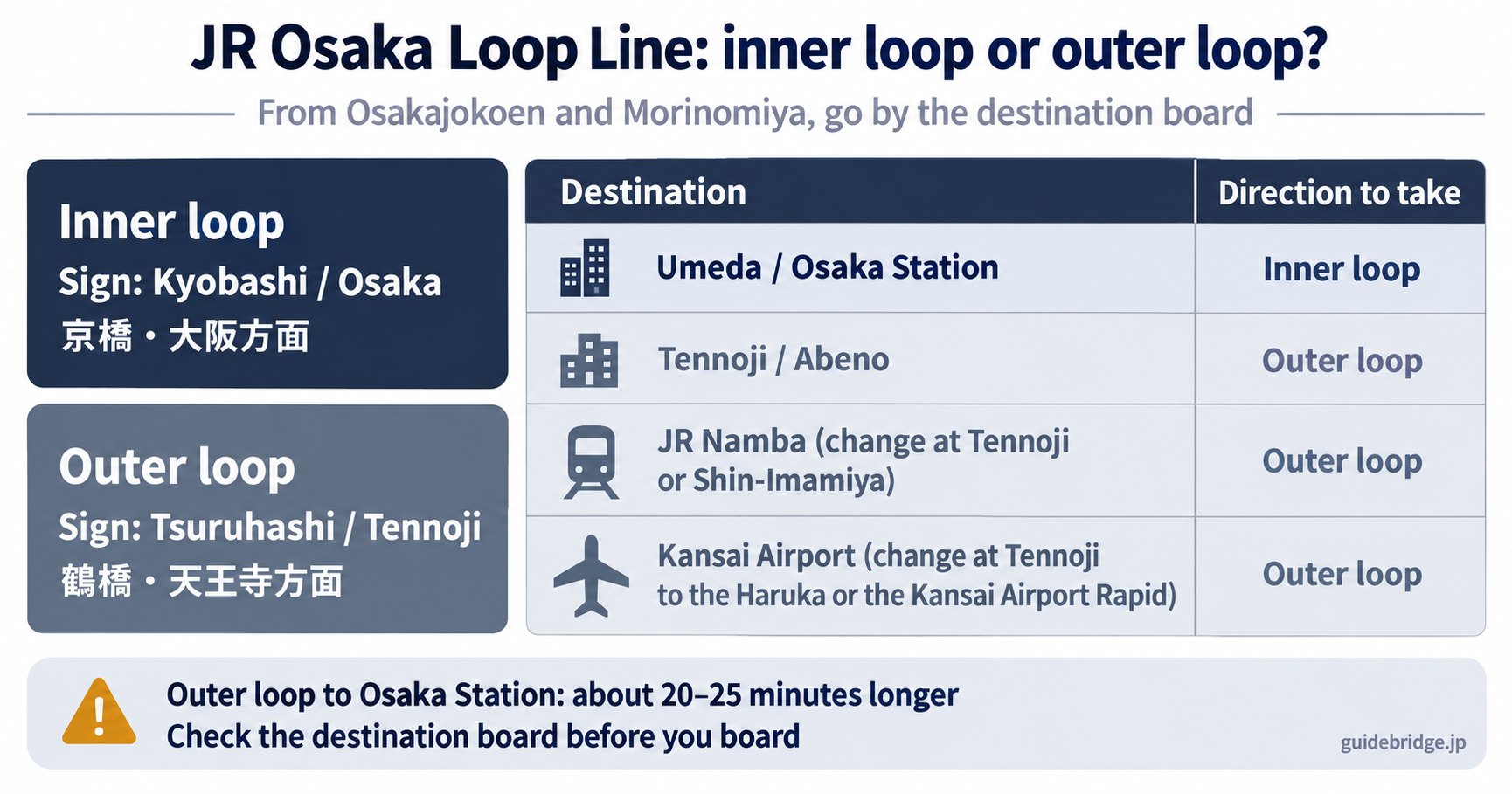
How to tell the inner loop from the outer loop
From Osakajokoen or Morinomiya to Umeda and Osaka Station, the right choice is the inner loop (via Kyobashi and Temma). If you board the outer loop (via Tennoji and Shin-Imamiya), you still reach the same Osaka Station, but it takes about 20–25 minutes longer. In the crowded window after a show, losing those 20 minutes can decide whether you make your last train.
| Destination | Direction to take | Via (landmark stations) |
|---|---|---|
| Umeda / Osaka Station | Inner loop | Via Kyobashi and Temma |
| Tennoji / Abeno | Outer loop | Via Tsuruhashi and Momodani |
| Changing for Namba (JR Namba) | Outer loop → change at Shin-Imamiya | Change at Tennoji or at Shin-Imamiya |
| Toward Kansai Airport (JR) | Outer loop → change at Tennoji | At Tennoji, change to the Haruka or the Kansai Airport Rapid |
Here is how to check before you board: on the platform’s destination board, “Kyobashi / Osaka” means the inner loop, and “Tsuruhashi / Tennoji” means the outer loop. When it is crowded or late at night, there are few staff around, so you need to check for yourself. Decide where you are heading and which direction to take before the show ends, and you won’t have to hesitate on the platform.
From Osakajokoen or Morinomiya to Umeda, take the inner loop (via Kyobashi and Temma). The outer loop reaches the same Osaka Station but takes a 20–25 minute detour. Check the destination board on the platform before you board.
Last-train deadlines by direction, plus where to stay as a woman traveling alone: four areas compared (Kyobashi and Morinomiya as bases)
If the show ends around 22:00, or up to 30 minutes later, you have time to catch the last train on every line. If it ends at 23:00 or later, though, you risk missing the last train. Use the approximate times below and plan your route home backward from when the show ends. In Japan, trains stop for the night after the last train and do not run again until morning.
Last-train deadlines by direction (approximate; check the official timetables in advance)
| Line / direction | Nearest station | Approx. last train | What it means |
|---|---|---|---|
| JR Osaka Loop Line (toward Osaka / Umeda) | Osakajokoen / Morinomiya | Late in the 23:00 hour | 22:00 finish: home the same night. 23:00 finish or later: check the timetable |
| Osaka Metro Chuo Line (toward Hommachi / Cosmosquare) | Morinomiya | Around 24:00 | Plenty of time |
| Osaka Metro Nagahori Tsurumi-ryokuchi Line (toward Namba / Nishi-Umeda) | Morinomiya / Kyobashi | Late in the 23:00 hour | 22:00 finish: home the same night |
| JR Tozai Line (toward Amagasaki / Takarazuka) | Kyobashi | Late in the 23:00 hour | 22:00 finish: home the same night |
| Keihan Main Line (toward Yodoyabashi / Kyoto) | Kyobashi | Late in the 23:00 hour to around 24:00 | Plenty of time to Kyoto. Beyond Kyoto: check the timetable |
If you are taking the Shinkansen, note the route. From Osaka-Jo Hall to Shin-Osaka Station, the basic route is the JR Loop Line inner loop from Osakajokoen or Kyobashi to Osaka Station, then a change to the JR Kyoto Line (toward Shin-Osaka and Kyoto). The JR Tozai Line runs from Kyobashi toward Kitashinchi and Amagasaki and does not go to Shin-Osaka. With the post-show crowd, allow 60–90 minutes to reach Shin-Osaka. The Shinkansen also stops for the night after its last departure, so getting home the same night toward Nagoya or farther can be hard, depending on the show time. We recommend arranging a room in Osaka in advance.
Four areas for a woman traveling alone (compared on the trip home, peace of mind and value)
There are almost no business hotels around Osakajokoen Station. The assumption that “the nearest station is Osakajokoen, so I can stay nearby” is the biggest reason fans end up without a room at the last minute. The realistic areas for the night before or after the show are Kyobashi and Morinomiya.
| Area | What it’s like | Best for |
|---|---|---|
| Around Kyobashi | Within walking distance of Osaka-Jo Hall. A busy district with plenty of places to eat, izakaya (Japanese pubs) and convenience stores. Taxis are easy to catch | An after-show get-together / another show the next day |
| Around Morinomiya | A cluster of business hotels. Quieter, with reasonable rates. A woman traveling alone can feel at ease | Value first / heading home early the next morning |
| Namba / Shinsaibashi | Sightseeing, shopping and food all in one place. You must transfer to reach Osaka-Jo Hall, but it works if you fly out of Kansai Airport the next day | Kansai Airport the next day / combining the trip with sightseeing |
| Around Shin-Osaka | For fans on back-to-back trips who take the Shinkansen the next day. Easy to get moving the next morning | Back-to-back shows from Tokyo / fans from outside the region who cannot do a day trip |
Kyobashi is served by the JR Tozai Line, the JR Osaka Loop Line, the Keihan Main Line and the Osaka Metro Nagahori Tsurumi-ryokuchi Line, so you have several lines to choose from for the trip home the next morning. If you are staying in Osaka for another show the next day, a Kyobashi base keeps your travel to a minimum.
You don’t need a hotel near the venue if the show ends around 22:00 and you live in Kansai, or already have a room in Osaka city or elsewhere in Kansai. The last trains in the table above get you back, but beyond Kyoto, check the timetable. If the show ends at 23:00 or later, check the timetable first, and book a room if you cannot make your last train. A room also makes sense if you are heading for Shin-Osaka and a Shinkansen.
If you have decided to stay and want to narrow it down to one hotel, we have a separate guide (Japanese only for now) with 3 hotels: a budget pick, the closest pick and a pick that is comfortable for a woman traveling alone, chosen from hotels in Kyobashi and Namba, plus the full-service hotel closest to the venue. For each one, it covers how to get there from the venue, reception hours and how busy the hotels get on show days.
Summary: recommended plan by where you are coming from (getting there, getting home, where to stay)
The right way home from Osaka-Jo Hall depends on where you are coming from. Find your starting point in the matrix below. Visitors to Japan: read the first column as where you sleep tonight.
| Coming from | Recommended plan | Stay the night? |
|---|---|---|
| Osaka city (Umeda, Namba) | Home: check the by-direction guide (the fourth section above), then pick one of the 3 stations | Home the same night |
| Kyoto / Nara | Home: Keihan Main Line (Kyobashi) or JR Loop Line (change at Osaka Station) | 22:00 finish: home the same night. 23:00 finish or later: check the timetable |
| Kobe / Hyogo | Home: Kyobashi → JR Tozai Line → Amagasaki | Stay in Osaka if you can’t make the last train |
| Nagoya / Tokai | Home: check the last Shinkansen from Shin-Osaka. Allow 60–90 min to reach Shin-Osaka | Stay in Osaka if you can’t make it |
| Kanto / Tokyo | Home: often not possible the same night. Check the last Shinkansen departure from Shin-Osaka in advance | Staying in Osaka recommended |
| Kyushu / western Japan | Home: getting back the same night is extremely hard | You must stay in Osaka |
This guide’s top recommendation is to stay the night before or after in Kyobashi or Morinomiya. With the walk to the arena kept short, you avoid both the wrong-station mistake and the wait in the post-show crowd. If you are coming from Tokyo or farther, the safest way to plan an Osaka-Jo Hall trip is to assume you cannot get home the same night. Arrange your room early.
From nearby Kansai, you can get home the same night. From Nagoya or farther, check the last Shinkansen from Shin-Osaka in advance. From Tokyo or farther, staying in Osaka is the safest choice. Your first decision on the way home is which of the 3 stations fits where you are heading. There are almost no hotels around Osakajokoen Station, so arrange a room in Kyobashi or Morinomiya early.
You don’t need a hotel near the venue if the show ends around 22:00 and you live in Osaka city or elsewhere in Kansai (beyond Kyoto, check the timetable), or already have a room there. The button below is for anyone who still needs a room in Osaka the night before or after the show, whether you are coming from Nagoya, Tokyo, Kyushu or abroad.
This page was produced from the Japanese original with AI assistance. Every number, station name and time was machine-checked against the Japanese source and its official references. If something is wrong, tell us here -> /en/contact/.