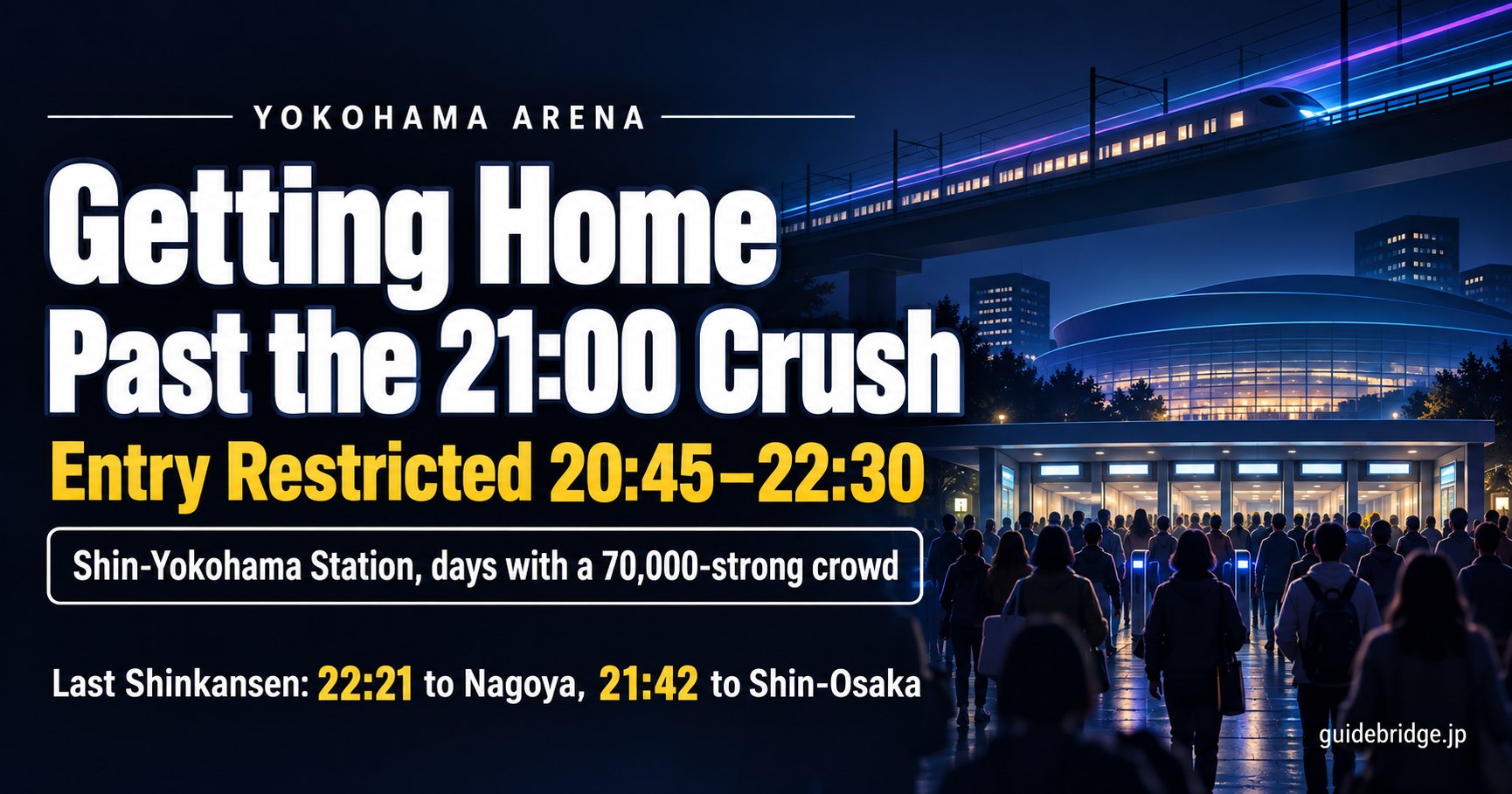
Planning your way home from Yokohama Arena? The first problem you hit is getting stuck at the ticket gates of Shin-Yokohama Station (新横浜). When a 70,000-person crowd is in the area, the station restricts entry from 20:45 to 22:30, and boarding a train can take 30 to 60 minutes. On the Shinkansen, the last train toward Nagoya is the 22:21 Hikari, which terminates at Nagoya, and the last train to Shin-Osaka is the 21:42 Nozomi (as of October 2026). On Yahoo! Chiebukuro (a Japanese Q&A site) and X, fans also describe show-day mix-ups of Yokohama Arena with K-Arena Yokohama, a different venue near Minatomirai Station.
Yokohama Arena opened in 1989, and its strength is its location: a 5-min walk from Shin-Yokohama Station. That same location is why the trip home falls apart. Fans from Tokyo, Nagoya, Osaka and Hakata all arrive on the Tokaido Shinkansen, so the JR Yokohama Line, the Yokohama Municipal Subway and the Shinkansen jam at once: a triple crush at one station.
This guide sets out the decisions you face getting home after a 21:00 finish: avoiding the K-Arena Yokohama mix-up, last trains on four lines, the back routes, four hotels near Shin-Yokohama Station and the coin lockers. It is written for fans who live in Japan and travel by Shinkansen. If you are visiting Japan, read “where you are coming from” as where you sleep tonight, and if you flew into Haneda, Narita or Kansai International Airport, check your next-morning flight before picking a plan.
- How to tell Yokohama Arena from K-Arena Yokohama (and not end up at Minatomirai Station)
- What the entry restrictions at Shin-Yokohama Station (20:45–22:30) look like after a 21:00 finish
- Last-train deadlines on four lines, by where you are coming from (Tokyo, Nagoya, nearby Kanto)
- Whether Kikuna, Kita-Shin-Yokohama or a taxi makes sense for a woman traveling alone
- Four hotels in Shin-Yokohama for women traveling alone, all within a 5-min walk of the station
- The coin-locker trap: about 600 lockers, 100-yen coins only (a large one takes six)
The last westbound Tokaido Shinkansen times here are as of June 2026; other last trains, restriction hours and locker fares are as of April 2026, when the Japanese original was published. For the latest, check the official timetables for the Tokaido Shinkansen, the JR Yokohama Line, the municipal subway Blue Line and Tokyu, and the official Yokohama Arena website.
Check first: is your ticket for Yokohama Arena or for K-Arena Yokohama?
Before you plan your trip home from Yokohama Arena, look at your ticket. If the venue reads Yokohama Arena (横浜アリーナ), your nearest station is Shin-Yokohama (新横浜). If it reads K-Arena Yokohama (Kアリーナ横浜), you want Minatomirai (みなとみらい) or Shin-Takashima (新高島) station instead. Several Yahoo! Chiebukuro posts describe this: “quite a few people confuse it with K-Arena and go to Shin-Yokohama,” and “I thought Yokohama Arena was at Yokohama Station and went there.” Note that Yokohama Station (横浜) and Shin-Yokohama Station are different stations; the Shinkansen stops only at Shin-Yokohama.
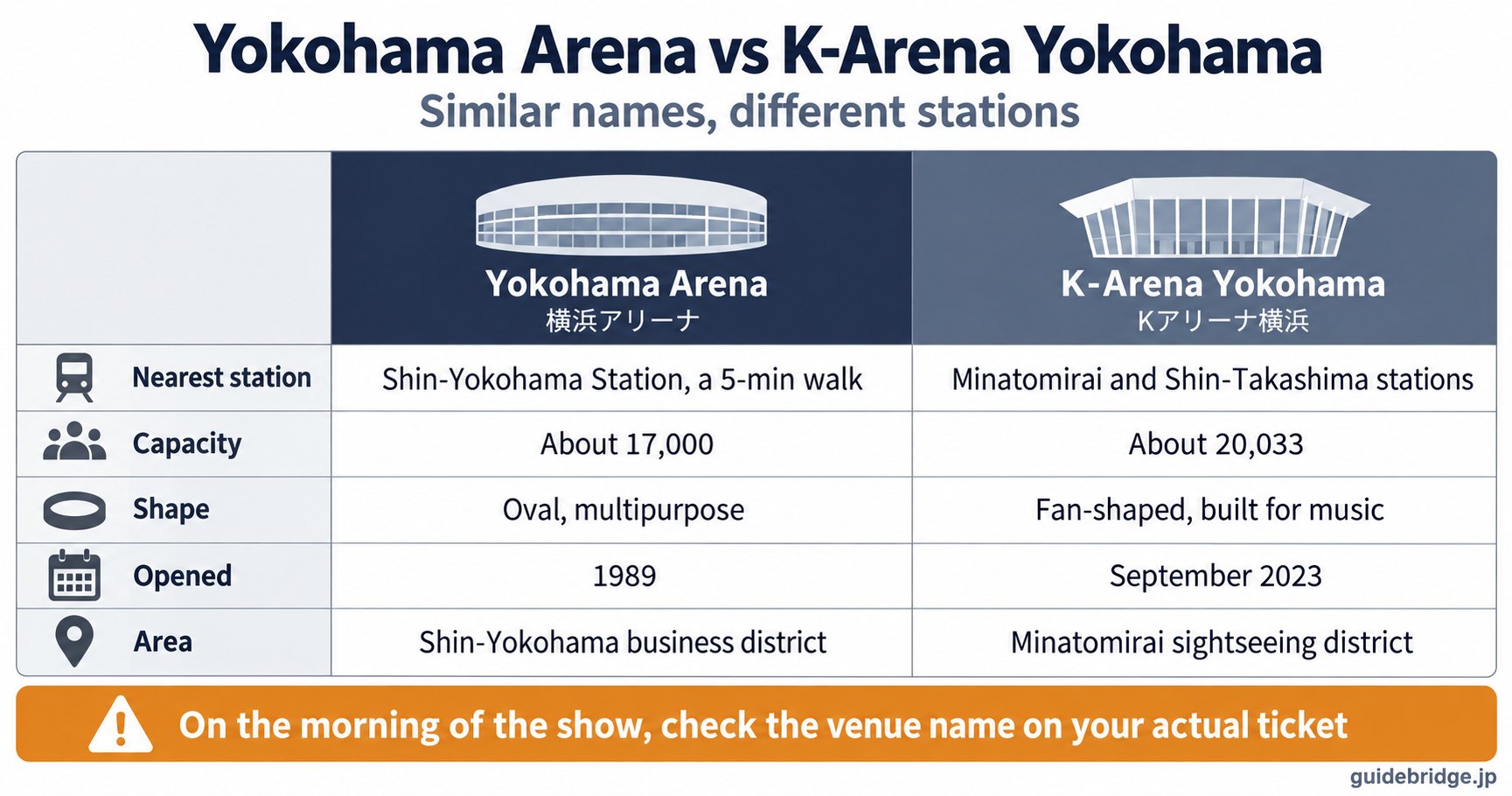
| Item | Yokohama Arena | K-Arena Yokohama |
|---|---|---|
| Nearest station | Shin-Yokohama Station, a 5-min walk | Minatomirai and Shin-Takashima stations |
| Capacity | About 17,000 | About 20,033 |
| Opened | 1989 | September 2023 |
| Shape | Oval, multipurpose | Fan-shaped, built for music |
| Area | Shin-Yokohama business district | Minatomirai sightseeing district |
The check is simple: read the venue name on your actual ticket out loud. That one step is enough to avoid the mix-up. The two venues are about 30 minutes apart by train, so going to the wrong one means missing the start. If your ticket is for K-Arena Yokohama, hotels on the Minatomirai side are covered in a separate guide (Japanese only for now).
Yokohama Arena means Shin-Yokohama Station; K-Arena Yokohama means Minatomirai Station. The two are about 30 minutes apart by train, so the first condition for a smooth day is checking the venue name on your actual ticket that morning.
You don’t need a hotel near K-Arena Yokohama if your ticket says Yokohama Arena. The button below is for readers whose ticket turns out to be for K-Arena Yokohama.
Yokohama Arena by the numbers: room for 17,000, 5 seat types and a layout that changes
Yokohama Arena opened on April 1, 1989: a multipurpose arena with a maximum capacity of about 17,000 and 11,000 seats, run by Yokohama Arena Co., Ltd. (Seibu Railway group). A 5-min walk from Shin-Yokohama Station puts it one Shinkansen ride from Tokyo, Nagoya, Osaka and Hakata, which makes it a hub venue for fans from all over Japan.
Five seat types and the movable Lambda System
There are 5 seat types: center seats, arena seats, stand seats, suite boxes and standing areas. A movable seating system called the Lambda System switches the layout among 3 patterns, and a changeover takes about 3 hours. The layout can change a lot from show to show, so it helps to look up the block (the seating section printed on your ticket) in the official seating guide before show day.
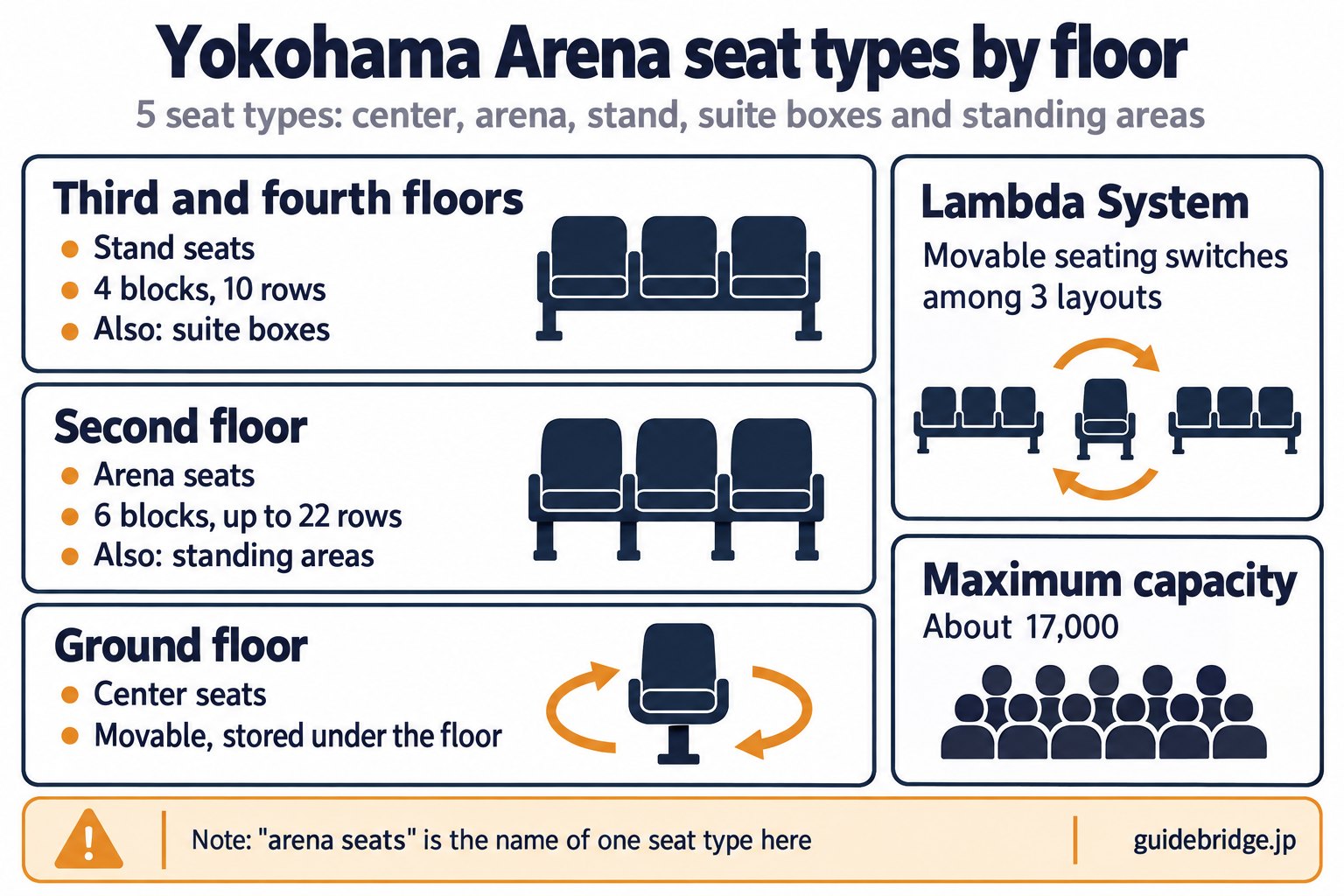
How the seating is stacked: center on the ground floor, arena on the second, stands on the third and fourth
The ground floor holds the movable center seats, stored under the floor. The second floor has the arena seats (6 blocks, up to 22 rows deep) and the standing areas. The third and fourth floors have the stand seats (4 blocks, 10 rows) and the suite boxes. Note that “arena seats” is the name of one seat type here, alongside the center seats. The top tier is far from the stage, so we recommend bringing binoculars. The easy access from anywhere in Japan is also the main cause of the crush on the way home, covered below. Keep this in mind: Yokohama Arena is where fans from all over the country converge.
Getting from Shin-Yokohama Station to Yokohama Arena: what the official 5-min walk really means
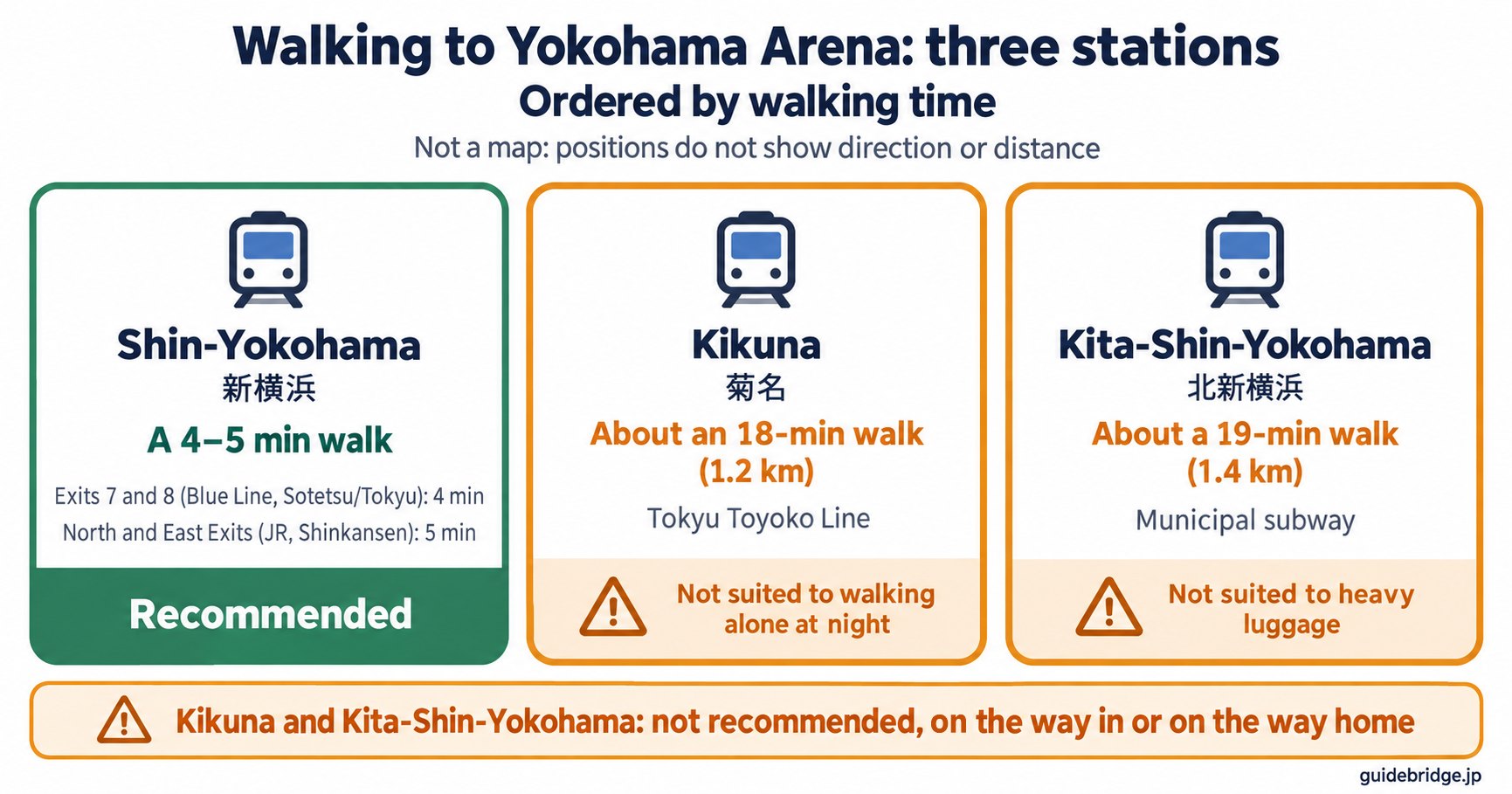
The official access guide gives a 4-min walk from Exits 7 and 8 of the municipal subway Blue Line and the Sotetsu/Tokyu Shin-Yokohama Line, and a 5-min walk from the North and East Exits of the JR Yokohama Line and the Tokaido Shinkansen. Shin-Yokohama is shared by several operators, each with its own gates and fares, so your exit depends on your line. There is no parking or bicycle parking, so plan on public transit.
The pre-show rush: fans from all over Japan arrive at once
On show days, fans arriving by Shinkansen from Tokyo, Nagoya, Osaka and Hakata all stream toward Blue Line Exits 7 and 8. The official 5-min walk is accurate, but from 2 hours to 1 hour before the start the walkways get dense, so allow 10–15 minutes. Official walking times describe an ordinary day, not a show-day crowd.
Kikuna and Kita-Shin-Yokohama are poor choices on the way in
Kikuna Station (菊名, on the Tokyu Toyoko Line) is about an 18-min walk, 1.2 km away. Kita-Shin-Yokohama Station (北新横浜, on the municipal subway) is about a 19-min walk, 1.4 km away. Neither is realistic with a suitcase. Make Shin-Yokohama Station your first choice.
You don’t need a hotel near the arena if you are sleeping in Tokyo or nearby Kanto tonight; those last trains run late, as shown below. A room matters if you are heading toward Nagoya or further west, or want to skip the station crowd.
The main issue: Shin-Yokohama Station at 21:00 after the show, with entry restrictions and crowds
The hardest point on the way home is Shin-Yokohama Station at 21:00. On days when a 70,000-strong crowd is in the area (for example, a same-day event at nearby Nissan Stadium), the station formally restricts entry: it holds people back from the ticket gates. This is separate from the venue letting the audience out block by block. According to Shin-Yokohama Shimbun, a local news site, the Sotetsu, Tokyu and municipal subway lines restrict entry from 20:45 to 22:30, and the escalators are sometimes stopped. The JR Yokohama Line also restricts entry at Kozukue (小机) and Shin-Yokohama stations from 20:30 to 22:30.
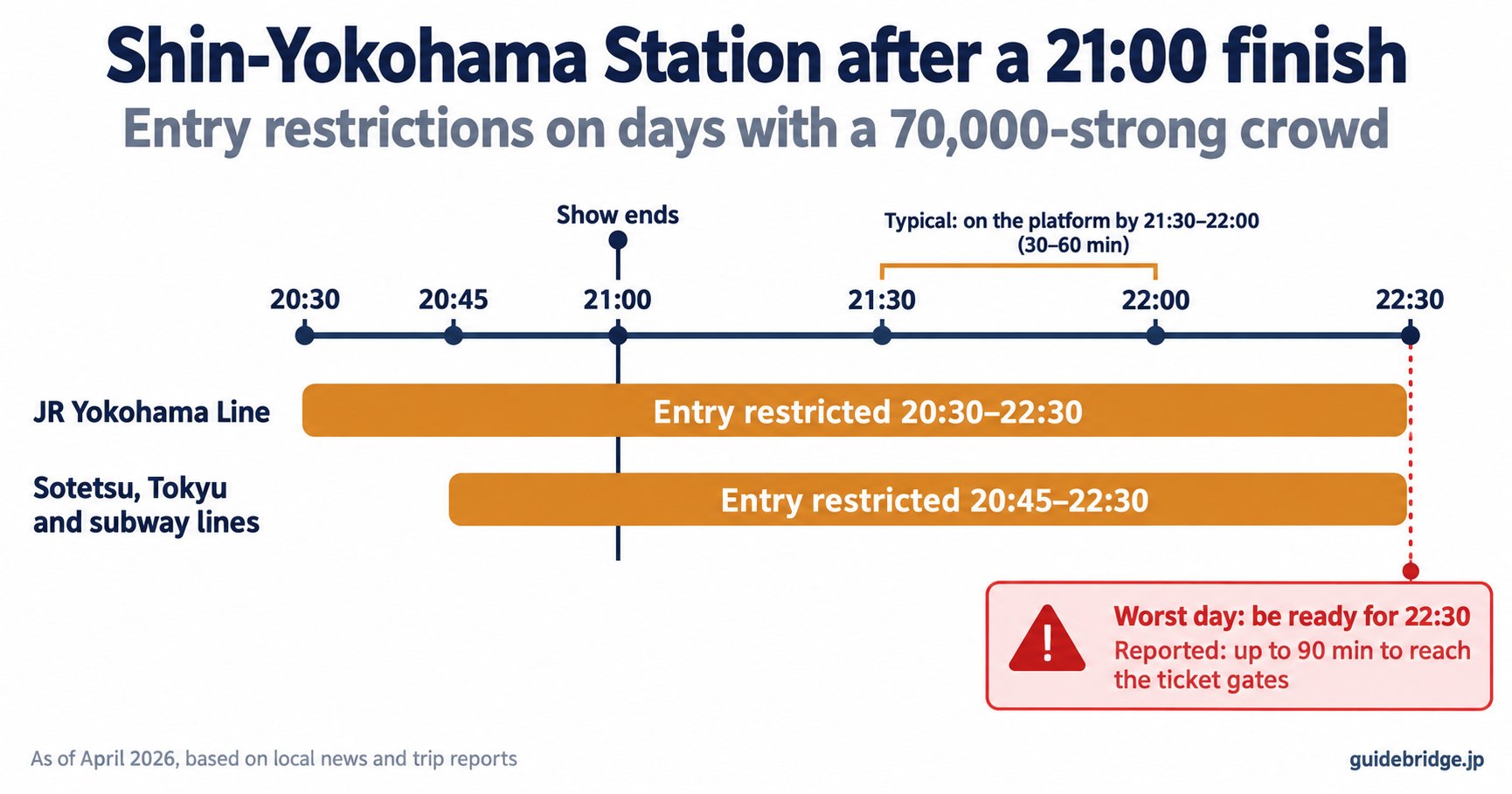
30 to 60 minutes before you board a train
People describe crowds packed at the gates, unable to move, with escalators stopped and the crowd funneled onto the stairs. Several trip reports put the time from the end of the show to boarding a train at 30 to 60 minutes. On days when the peak crowd builds right after the show, there have been reports of up to 90 minutes just to reach the ticket gates. If the show ends at 21:00, expect to be on the platform at 21:30–22:00, and be ready for 22:30 on the worst day.
Why Yokohama Arena gets especially chaotic
What sets Yokohama Arena apart is that three streams of people jam at once. People heading for central Tokyo on the JR Yokohama Line, people heading toward Yokohama and Azamino on the Blue Line, and people scattering across Japan on the Shinkansen all converge on one point: Shin-Yokohama Station. Toward Nagoya or further west, the last Shinkansen leaves early, so the moment you are caught in the restrictions, not getting home tonight becomes a real prospect. The Shinkansen does not run again until morning.
On days with a 70,000-strong crowd, Shin-Yokohama Station restricts entry from 20:45 to 22:30, and getting onto a train takes 30 to 60 minutes. The triple crush, with the JR Yokohama Line, the municipal subway and the Shinkansen jammed at once, is what most sets this venue apart from other arenas.
Last-train deadlines by line: four lines compared
A 21:00 finish plus 30 to 60 minutes of restricted entry puts you on the platform at 21:30–22:00. On that basis, the options by destination split clearly. Japanese railways call trains toward Tokyo “up” (nobori) and trains away from it “down” (kudari).
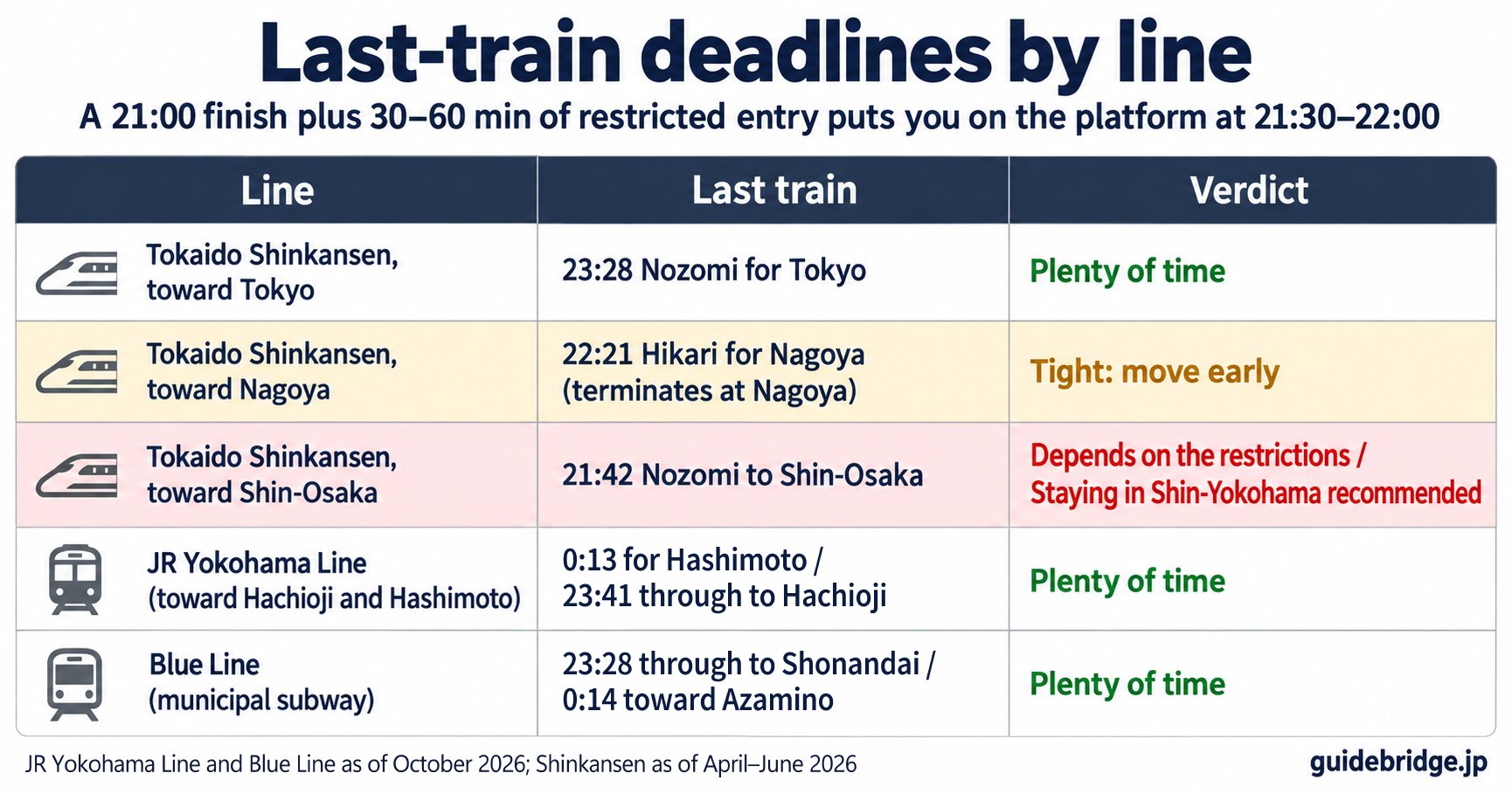
Tokaido Shinkansen, up trains (toward Tokyo)
The last train from Shin-Yokohama toward Tokyo is the 23:28 Nozomi bound for Tokyo. During the 22:00 hour there are also 4 Nozomi, 3 Hikari and 1 Kodama, so fans heading back to Tokyo or nearby in the Kanto region have plenty of time. Even if restricted entry costs you 30 minutes, you still make a train in the 22:00 hour. (Nozomi is fastest, Hikari stops more, Kodama stops everywhere.)
Tokaido Shinkansen, down trains (toward Nagoya and Osaka)
Heading down the line is a different story. The last train to Shin-Osaka is the 21:42 Nozomi, and the last one that runs all the way through to Hakata leaves even earlier, at 19:10. For Nagoya, the 22:21 Hikari bound for Nagoya is in practice the last train that gets you home to Nagoya the same night; it terminates at Nagoya, so it will not take you on to Osaka. The 23:07 Kodama bound for Mishima stops at Mishima (三島) and reaches neither Nagoya nor Osaka. The destination on the train decides how far you get. Toward Nagoya or further west, restricted entry can cost you the last train.
JR Yokohama Line and the municipal subway Blue Line
The last JR Yokohama Line train toward Hachioji and Hashimoto is the 0:13 bound for Hashimoto, with 5 trains during the 23:00 hour. The last one that goes all the way to Hachioji leaves at 23:41 (JR East timetable, as of October 2026). On the Blue Line, the last trains are the 23:59 toward Yokohama and Sakuragicho (bound for Kaminagaya) and the 0:14 toward Azamino (bound for Azamino). The last through train to Shonandai leaves at 23:28 (Yokohama Municipal Transportation Bureau timetable for weekends and holidays, as of October 2026). Fans heading home to nearby parts of the Kanto region have plenty of time.
Extra trains on days with a 70,000-strong crowd
On large event days, extra trains run. Tokyu adds an express to Shibuya at 21:33 and 4 local trains on the Meguro Line departing from 21:00 to 22:12, and the Blue Line adds a train to Kamiooka at 21:19 and one to Kaminagaya at 21:52. If you can reach the station during the 21:00 hour, these extra trains can help spread out the crowd.
Toward Tokyo, the 23:28 last Nozomi leaves plenty of time. Toward Nagoya, the 22:21 Hikari (terminating at Nagoya) is in practice the last train; toward Shin-Osaka, it is the 21:42 Nozomi. Nearby Kanto is in the safe zone with the JR Yokohama Line at 0:13 (bound for Hashimoto; the last train through to Hachioji is 23:41) and the Blue Line at 23:59 (bound for Kaminagaya; the last train through to Shonandai is 23:28). If you are heading toward Nagoya or further west, you need to move early.
Working back by destination: when you must leave Shin-Yokohama Station to get home from Yokohama Arena
This section lines up the last trains from the previous section on a single axis: what time you need to leave Shin-Yokohama Station. What you really need to know is not when you get home. It is the time by which you must be on the platform, and whether your show finishes early enough for you to make it.
Table A: Shinkansen down trains from Shin-Yokohama
| Destination | Last train from Shin-Yokohama | Train |
|---|---|---|
| Hakata | 19:10 | Nozomi |
| Hiroshima | 20:18 | Nozomi |
| Okayama | 20:58 | Nozomi |
| Shin-Kobe and Himeji | 21:12 | Nozomi |
| Kyoto and Shin-Osaka | 21:42 | Nozomi |
| Hamamatsu and Nagoya | 22:21 | Hikari (terminates at Nagoya) |
| Shizuoka | 22:30 | Kodama |
| Mishima | 23:07 | Kodama (the last down train of the night) |
Times are from the JR East timetable as of October 2026 (Tokaido Shinkansen, down trains from Shin-Yokohama Station). At this time of night, weekends, holidays and weekdays all share the same times. Times change when the timetable is revised. On some days an extra train to Shin-Osaka runs at 21:49, but only on a few days in October and November. Don’t plan around a possible extra train; treat 21:42 as the last one.
Table B: local lines from Shin-Yokohama (weekends and holidays)
| Line and direction | Last train from Shin-Yokohama |
|---|---|
| Tokyu Shin-Yokohama Line toward Shibuya (change at Hiyoshi) | 23:42 (connects at Hiyoshi with the last train bound for Shibuya) |
| Tokyu Shin-Yokohama Line toward Meguro (through service) | 0:08 (bound for Meguro) |
| Blue Line toward Yokohama and Sakuragicho | 23:59 (bound for Kaminagaya) / the last through train to Shonandai is 23:28 |
| Blue Line toward Azamino | 0:14 (bound for Azamino) |
| JR Yokohama Line toward Machida and Hachioji | 0:13 (bound for Hashimoto) / the last train that goes all the way to Hachioji is 23:41 |
| JR Yokohama Line toward Higashi-Kanagawa | 0:25 (bound for Higashi-Kanagawa) |
Times are from the station timetables (weekends and holidays) of the Yokohama Municipal Transportation Bureau, JR East and Tokyu Railways as of October 2026. On weekdays, some rows differ by a few minutes. Times change when the timetable is revised.
The destinations fall into three groups
As in the previous section, this guide assumes it takes 30 to 60 minutes from the end of the show to standing on the platform at Shin-Yokohama Station. That is our estimate, including restricted entry and station crowding, not an official figure. Subtract the slower 60 minutes and round to the earlier 5-minute mark, and you get a cutoff finish time for each destination, shown below. On the worst days noted in the previous section, when reaching the gates takes 90 minutes, each cutoff moves another 30 minutes earlier.
| Group | Heading home to | You make it if the show ends by |
|---|---|---|
| Group 1 | Hakata / Hiroshima / Okayama / Shin-Kobe and Himeji | Plan on not getting home after an evening show (18:10 / 19:15 / 19:55 / 20:10) |
| Group 2 | Kyoto and Shin-Osaka / Hamamatsu and Nagoya / Shizuoka / Mishima | 20:40 / 21:20 / 21:30 / 22:05 |
| Group 3 | Tokyo, Kanagawa and the Machida area (local lines) | No need to stay over (last trains 23:28 to 0:25) |
With the same 21:00 finish as in the previous section, you make it to Nagoya, Shizuoka and Mishima, but not to Shin-Osaka or Kyoto. On the worst day from the previous section (90 minutes to the gates, on the platform at 22:30), though, you also miss the 22:21 to Nagoya and the 22:30 to Shizuoka. If you are heading to Nagoya or Shizuoka and the show looks likely to run past 20:50, plan on staying over too. The 40 minutes separating the 21:42 to Shin-Osaka and the 22:21 to Nagoya split fans heading west on the same Tokaido Shinkansen into two different answers. You can check the show’s running time in the organizer’s announcements.
If you are in Group 2 and expect the show to end before your cutoff, plan to go home, and get your Shinkansen ticket before you enter the venue. If the show will run past your cutoff, or you can’t tell, plan from the start to stay in Shin-Yokohama; then there is nothing to decide after the show. Group 3 also has lines that finish early: 23:42 toward Shibuya, and 23:28 for the through train to Shonandai. Check the row for your own line before the show ends.
The back routes: are Kikuna, Kita-Shin-Yokohama or a taxi worth it?
Other sites suggest Kikuna, Kita-Shin-Yokohama or a taxi to dodge the Shin-Yokohama crowd. For a woman traveling alone, each has its own risks.
Kikuna Station (Tokyu Toyoko Line): an 18-min walk
The route to Kikuna Station runs through residential streets with sparse streetlights. For a woman walking alone during the 21:00 hour, the route is dark and easy to get lost on. We do not recommend it for solo travelers.
Kita-Shin-Yokohama Station (municipal subway): a 19-min walk
Kita-Shin-Yokohama Station is a 19-min walk, 1.4 km away, which is too far to pull a suitcase after the show. Waiting for the crowd at Shin-Yokohama Station to ease takes less out of you.
Taxi: use the GO app, and expect a long line at the stand
After the show, the taxi stand at the North Exit of Shin-Yokohama Station has a long line. GO, a Japanese taxi-hailing app, is the recommended way, but many spots near the station ban pickups, so walk a little away before requesting a car. Visitors should install the app and set up payment in advance. Yokohama Station is about 30 minutes away by taxi and the fare is high, so a taxi suits a group sharing the cost. For a woman traveling alone, the safest choices are walking to Shin-Yokohama Station or staying the night in Shin-Yokohama.
Four hotels in Shin-Yokohama for women traveling alone (within a 5-min walk of the station)
Heading toward Nagoya or further west, or want to take your time? A night in Shin-Yokohama is the best answer. Here are four hotels within a 5-min walk of the station where a woman traveling alone can feel at ease. When you choose, give priority to the shortest walk from the station.
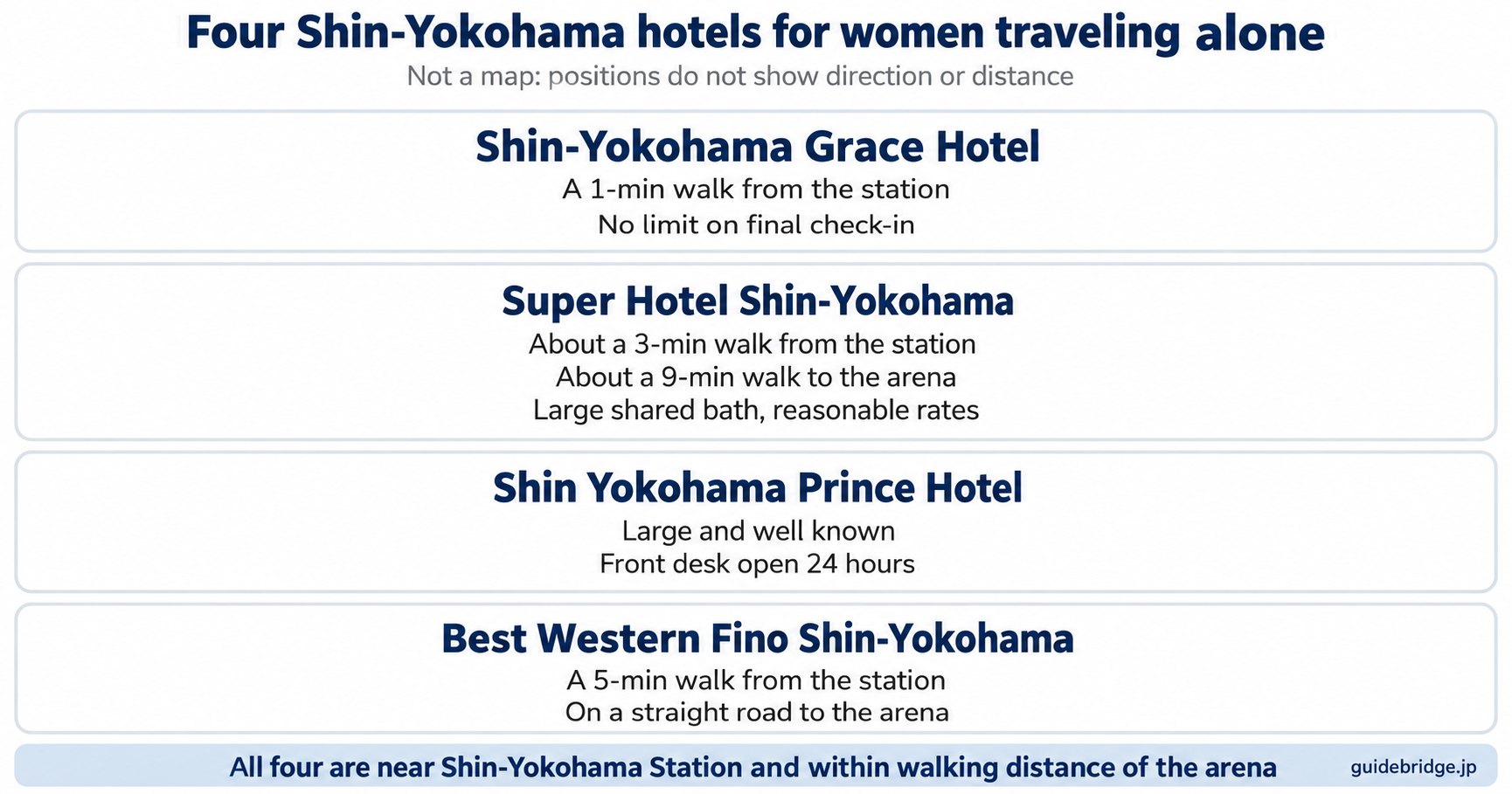
Shin-Yokohama Grace Hotel (a 1-min walk from the station)
A 1-min walk from Shin-Yokohama Station (per the hotel’s official site). There is no limit on final check-in, and guests arriving later than planned are asked to let the hotel know (official FAQ). The 1-minute walk from the station is the biggest reason to feel at ease here.
Super Hotel Shin-Yokohama (about a 3-min walk from Shin-Yokohama Station)
About a 3-min walk from Shin-Yokohama Station and about a 9-min walk to Yokohama Arena. It has a large shared bath and reasonable rates. It is a business hotel (Japan’s compact, no-frills city hotel) close enough to walk back to without getting lost.
Shin Yokohama Prince Hotel (large and well known)
A large, well-known hotel that gives a woman traveling alone a sense of security. The front desk is open 24 hours, so you can check in late at night. Rates are higher than at the other three, so it suits travelers who put facilities first.
Best Western Fino Shin-Yokohama (a 5-min walk from the station)
A 5-min walk from Shin-Yokohama Station, on a straight road to the arena. It is compact and clean, with a good balance of price and location, and it is the fallback when the three above are full. One caution about the area: Shin-Yokohama 1-chome (新横浜1丁目) has a cluster of love hotels (adult hotels rented by the hour), so avoid dark streets away from the station, and ignore anyone who approaches you on the street trying to bring in customers. If you pick a business hotel right by the station, you stay clear of that risk.
You don’t need a room here if tonight’s bed is in Tokyo or nearby Kanto; the late last trains cover you. A room here makes sense if you are heading toward Nagoya or further west.
Coin lockers: the trap that takes six 100-yen coins
There are about 600 coin lockers inside Yokohama Arena. The ground-floor lobby has 180 small lockers at ¥300 and 68 large ones at ¥600, and the second-floor lobby has 290 small lockers at ¥300 and 54 large ones at ¥600. There are none outside the building on the ground floor, and none on the third floor.
The biggest trap is that every locker takes 100-yen coins only and uses a physical key, with no IC card payment. In Japan, station lockers often take transit IC cards, which is why this catches people out. A large locker needs ¥600 in 100-yen coins: 6 coins. Fans have run out of coins after the show and been unable to get their bags out.
What to bring
- At least six 100-yen coins (for the coin lockers)
- Cash (in case you end up taking a taxi)
- A power bank (the long wait drains your phone)
- Binoculars (for the stands on the third and fourth floors)
Of these, binoculars and a power bank are hard to pick up locally on the day. Here is what to look for. If your seat is confirmed in the arena seats (ground or second floor), binoculars are not essential. Consider them if you are in the stands on the third or fourth floor.

Binoculars for concerts (8–10x)
The stands on the third and fourth floors at Yokohama Arena are a long way from the stage. Aim for 8–10x magnification. If shaky hands bother you, an image-stabilized model is another option. These are Japanese retailers, so pricing and delivery are domestic.

Power bank (around 10,000 mAh)
After the show, entry restrictions at Shin-Yokohama Station can keep you waiting 30 to 60 minutes. Phone use while waiting drains the battery, so extra capacity helps. These are Japanese retailers, so pricing and delivery are domestic.
Frequently asked questions
Summary: pick your route home from three options
The right way home depends on where you are coming from. Use the matrix to decide. Visitors: read the first column as where you sleep tonight.
| Coming from | Recommended option | Why |
|---|---|---|
| Tokyo and the Kanto region | A (Shinkansen home the same night) or B (local trains to a hotel in Yokohama or Tokyo) | Plenty of time with the 23:28 last Nozomi |
| Nagoya and the Tokai region | A (the 22:21 Hikari is a must) or C (stay in Shin-Yokohama) | Miss that one train and you cannot get home |
| Osaka and the Kansai region | C (staying in Shin-Yokohama recommended) | The last train to Shin-Osaka is the 21:42 Nozomi (with a 21:00 finish, whether you make it depends on the entry restrictions) |
| Kyushu and western Japan | C (you must stay in Shin-Yokohama) | No last train you can make after the show |
There are three options. A: take the Shinkansen home the same night. B: take local trains and stay in central Tokyo or Yokohama. C: stay at a hotel within walking distance of Shin-Yokohama Station. This guide recommends C: you skip the 30 to 60 minute wait under entry restrictions and head home at an easy pace the next morning.
From nearby in the Kanto region, you can get home the same night by Shinkansen or local train. From Nagoya or further west, staying in Shin-Yokohama is the safest choice. Assume a 21:00 finish plus 30 to 60 minutes of restricted entry, then work backward from your own last train to pick your option.
You don’t need a room near the station if you are heading to Tokyo or nearby Kanto. From Osaka and the Kansai region, we recommend option C, since making the 21:42 depends on the entry restrictions. The button is for option C.
This page was produced from the Japanese original with AI assistance. Every number, station name and time was machine-checked against the Japanese source and its official references. If something is wrong, tell us here -> /en/contact/.